Gadkari Urges Multi-Fuel Strategy For Green Transport Transition
ECONOMY & POLICY

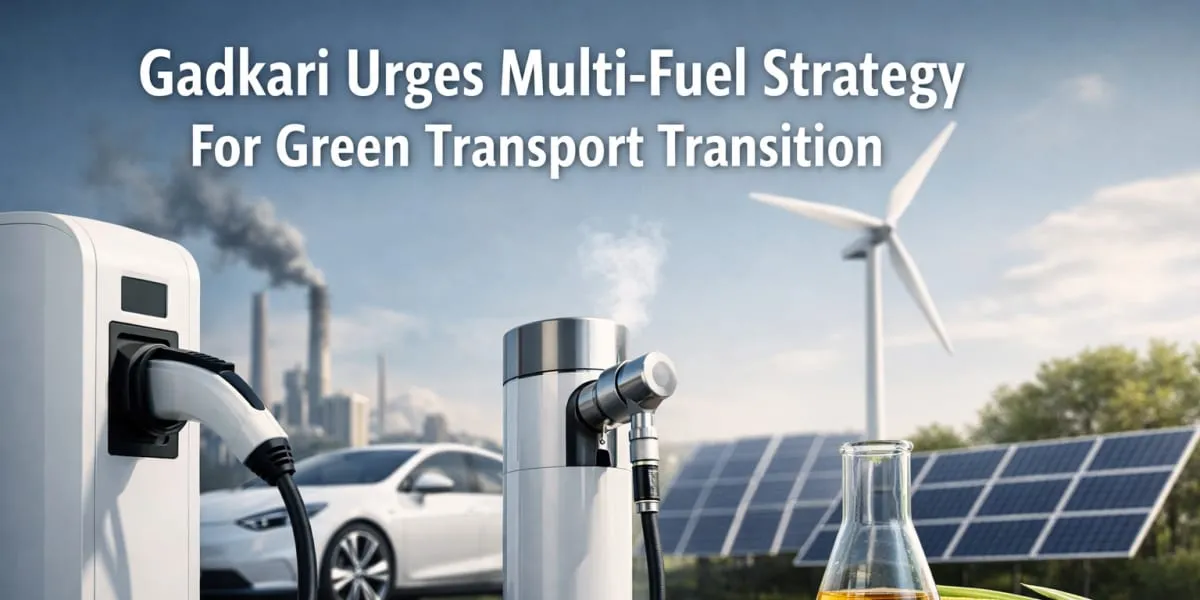
Gadkari Urges Multi-Fuel Strategy For Green Transport Transition

Union Minister of Road Transport and Highways Nitin Gadkari opened the two-day Green Transport Conclave in the national Capital, saying the transport sector is a major contributor to carbon emissions and requires urgent coordinated action for sustainable mobility. He highlighted that India currently imports nearly 87 per cent of its energy requirements and urged energy self-reliance. He argued that no single technology, such as electric vehicles, hydrogen or flex-fuel, can meet the country's growing energy demand and therefore called for a balanced multi-fuel strategy.

The conclave was organised by the Indian Federation of Green Energy, with support from the Ministry of Road Transport and Highways, and brought together officials and stakeholders from road transport, aviation, railways and marine sectors. Manoj Kumar Singh, CEO of the UP State Transformation Commission, attended as the Guest of Honour at the inaugural session and said India's transport strategy is evolving beyond electrification towards a multi-fuel and multi-modal ecosystem. The forum highlighted the integration of electric vehicles, biofuels, sustainable aviation fuels and green logistics as complementary elements of a resilient mobility framework.

Delegates discussed enabling policy frameworks at central and state levels to support low-carbon transport, and explored measures to advance sustainable urban mobility through electric vehicles and biofuels. The discussions also addressed decarbonisation of long-haul, intercity and rural transport across road, rail and aviation sectors as well as promoting efficient freight movement via road, maritime and rail networks. Participants emphasised the role of advanced technologies such as automation, artificial intelligence and system integration, together with fuel dispensing infrastructure, in modernising the transport ecosystem.

A notable outcome was the signing of a Memorandum of Understanding between CSIR Central Road Research Institute and the Indian Federation of Green Energy to foster joint research on sustainable transport. The conclave was supported by media partners and provided a platform for officials and industry to align road transport with logistics corridors and clean energy infrastructure. Organisers indicated the deliberations aim to inform policy and catalyse industry action for a future-ready mobility framework.

Union Minister of Road Transport and Highways Nitin Gadkari opened the two-day Green Transport Conclave in the national Capital, saying the transport sector is a major contributor to carbon emissions and requires urgent coordinated action for sustainable mobility. He highlighted that India currently imports nearly 87 per cent of its energy requirements and urged energy self-reliance. He argued that no single technology, such as electric vehicles, hydrogen or flex-fuel, can meet the country's growing energy demand and therefore called for a balanced multi-fuel strategy. The conclave was organised by the Indian Federation of Green Energy, with support from the Ministry of Road Transport and Highways, and brought together officials and stakeholders from road transport, aviation, railways and marine sectors. Manoj Kumar Singh, CEO of the UP State Transformation Commission, attended as the Guest of Honour at the inaugural session and said India's transport strategy is evolving beyond electrification towards a multi-fuel and multi-modal ecosystem. The forum highlighted the integration of electric vehicles, biofuels, sustainable aviation fuels and green logistics as complementary elements of a resilient mobility framework. Delegates discussed enabling policy frameworks at central and state levels to support low-carbon transport, and explored measures to advance sustainable urban mobility through electric vehicles and biofuels. The discussions also addressed decarbonisation of long-haul, intercity and rural transport across road, rail and aviation sectors as well as promoting efficient freight movement via road, maritime and rail networks. Participants emphasised the role of advanced technologies such as automation, artificial intelligence and system integration, together with fuel dispensing infrastructure, in modernising the transport ecosystem. A notable outcome was the signing of a Memorandum of Understanding between CSIR Central Road Research Institute and the Indian Federation of Green Energy to foster joint research on sustainable transport. The conclave was supported by media partners and provided a platform for officials and industry to align road transport with logistics corridors and clean energy infrastructure. Organisers indicated the deliberations aim to inform policy and catalyse industry action for a future-ready mobility framework.

Next Story
Infrastructure Transport

MMRDA Removes 1.14 lakh m of Metro Barricades

In a bid to ease congestion and improve urban mobility during monsoon, MMRDA has undertaken one of the largest coordinated barricade removal and monsoon preparedness drives across its ongoing metro and infrastructure projects.With substantial progress achieved in viaduct and structural works across multiple metro corridors, barricades from completed stretches beneath metro viaducts are being systematically removed, restoring maximum possible road space before the monsoon. Wider carriageways across key arterial roads are expected to improve traffic flow, reduce congestion, support better rainwa..

Next Story
Infrastructure Transport

Pune Division to Remove All Diamond Crossings by Year-End

The Pune railway division has announced plans to remove all 16 diamond crossings by the end of 2026 as part of a major yard remodelling project following the derailment of a Vande Bharat Express at Pune Junction on April 27. Railway authorities said the replacements aim to improve safety and streamline train operations across the busy station. The decision followed a Central Railway finding that the accident involved a non-standard diamond crossing and highlighted the need for replacement. Regular maintenance of existing crossings will continue until the replacement work is completed. Official..

Next Story
Infrastructure Urban

Goa Declares 80 Million Square Metres No Development Zone

The Goa state government has declared 80 million square metres (mn) of land a no development zone, designating the area as protected from new construction. The notification reclassifies tracts across the state under a no development category for planning and regulatory purposes. The declaration signals a formal halt to new building permits within the defined zone. Authorities indicated that maps will be issued to show broad boundaries while detailed surveys will refine precise limits. The move transfers responsibility for enforcement to local planning authorities and relevant departments, whic..

Advertisement

Subscribe to Our Newsletter

Get daily newsletters around different themes from Construction world.

STAY CONNECTED

Advertisement

Advertisement

Advertisement