+
GERC Closes Petition After Four Point One Five MW Project Commissioned
ECONOMY & POLICY

GERC Closes Petition After Four Point One Five MW Project Commissioned

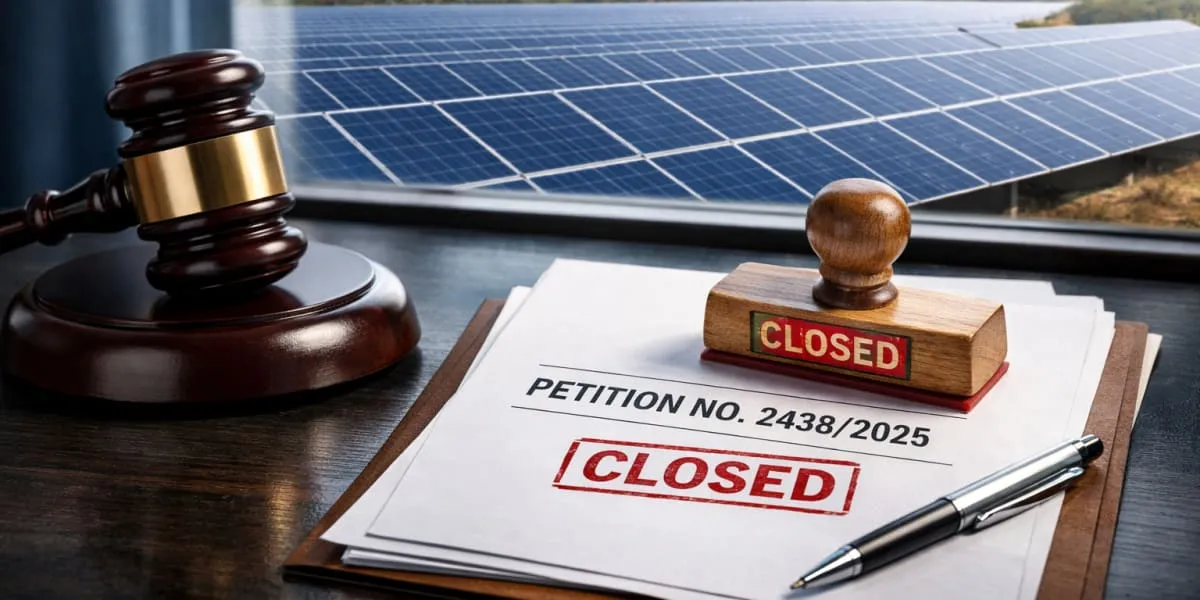
The Gujarat Electricity Regulatory Commission (GERC) has closed a legal petition after the petitioner withdrew its case following commissioning of a captive solar project. The petition concerned a four point one five megawatt (MW) captive solar plant and was filed by Durga Processors Private Limited, a Surat based company, as Petition No. 2438 of 2025. The Commission disposed of the petition after a hearing in Gandhinagar that reviewed submissions from both parties. The respondent was Gujarat Energy Transmission Corporation Limited (GETCO).

The petitioner had sought an extension for commissioning of the project evacuation line, bays and metering infrastructure connected to the captive plant and had requested a three month extension from the original transmission capacity allotment date of 30 December 2023. The company had also asked the Commission to direct GETCO not to invoke a bank guarantee of Rs two point zero seven five million (mn) during the proposed extension. The petition had been filed under Section 86 of the Electricity Act, 2003 and related to regulatory interpretation of a tariff order.

During the hearing on 26 February 2026 the petitioner stated that the plant had been commissioned on nine April 2025 and submitted a commissioning certificate issued by the Gujarat Energy Development Agency (GEDA) dated 27 May 2025. The petitioner explained that the petition had arisen from a misunderstanding of applicable regulatory provisions and that the firm had relied on a tariff order that did not apply. GETCO told the Commission that it had no objection to withdrawal of the petition. The petitioner filed a formal affidavit on 27 February 2026 confirming the request to withdraw.

A bench comprising Chairman Pankaj Joshi and Members Hiren Shah and Jatin N. Thakkar reviewed the records and concluded that disposal as withdrawn was appropriate. The Commission issued an order closing the matter on five March 2026, ending the proceedings since the solar plant had already been commissioned and regulatory relief was no longer required.

The Gujarat Electricity Regulatory Commission (GERC) has closed a legal petition after the petitioner withdrew its case following commissioning of a captive solar project. The petition concerned a four point one five megawatt (MW) captive solar plant and was filed by Durga Processors Private Limited, a Surat based company, as Petition No. 2438 of 2025. The Commission disposed of the petition after a hearing in Gandhinagar that reviewed submissions from both parties. The respondent was Gujarat Energy Transmission Corporation Limited (GETCO). The petitioner had sought an extension for commissioning of the project evacuation line, bays and metering infrastructure connected to the captive plant and had requested a three month extension from the original transmission capacity allotment date of 30 December 2023. The company had also asked the Commission to direct GETCO not to invoke a bank guarantee of Rs two point zero seven five million (mn) during the proposed extension. The petition had been filed under Section 86 of the Electricity Act, 2003 and related to regulatory interpretation of a tariff order. During the hearing on 26 February 2026 the petitioner stated that the plant had been commissioned on nine April 2025 and submitted a commissioning certificate issued by the Gujarat Energy Development Agency (GEDA) dated 27 May 2025. The petitioner explained that the petition had arisen from a misunderstanding of applicable regulatory provisions and that the firm had relied on a tariff order that did not apply. GETCO told the Commission that it had no objection to withdrawal of the petition. The petitioner filed a formal affidavit on 27 February 2026 confirming the request to withdraw. A bench comprising Chairman Pankaj Joshi and Members Hiren Shah and Jatin N. Thakkar reviewed the records and concluded that disposal as withdrawn was appropriate. The Commission issued an order closing the matter on five March 2026, ending the proceedings since the solar plant had already been commissioned and regulatory relief was no longer required.

Next Story
Infrastructure Urban

Implementation Status of Jal Jeevan Mission

Since August 2019 the Government has implemented Jal Jeevan Mission to provide assured potable water through household tap connections in rural India. At the start of the mission only 32.3 million (mn) rural households, representing 16.7 per cent, were reported to have tap water connections. States and union territories have reported that 125.8 mn additional rural households have since been provided with tap connections. As a result, of about 193.6 mn rural households roughly 158.2 mn, or 81.71 per cent, are reported to have tap water supply at home.\n\nThe State, district and village level st..

Next Story
Infrastructure Urban

Jal Jeevan Mission Reaches Eighty One Per Cent Rural Coverage

The Government reported substantial progress under the Jal Jeevan Mission, launched in August 2019 to provide tap water to every rural household. At launch only 32.3 million (mn) rural households had tap connections and states and Union territories reported provision of 125.8 mn additional households by March 2026. Consequently, out of about 193.6 mn rural households around 158.2 mn, or 81.71 per cent, are reported to have tap water at home. The Finance Minister announced extension of the mission until 2028 in the 2025-26 budget speech. The Swachh Bharat Mission Grameen, launched in October 20..

Next Story
Infrastructure Urban

Empowering Local Governance for Sustainable Rural Water Supply

The Ministry of Jal Shakti has aligned the Jal Jeevan Mission (JJM) with the 73rd Amendment to strengthen village level planning and community ownership of water supply. Gram Panchayats, village water and sanitation committees and Pani Samitis are to plan, implement, manage and maintain piped water systems, with gram sabha processes formalising handover and oversight. Implementation support agencies including non government organisations, community based organisations and self help groups have been empanelled to train local committees and promote women participation. Under JJM, the department ..

Advertisement

Subscribe to Our Newsletter

Get daily newsletters around different themes from Construction world.

STAY CONNECTED

Advertisement

Advertisement

Advertisement