+
Global Economic Cooperation 2026 to Convene Leaders in Mumbai
ECONOMY & POLICY

Global Economic Cooperation 2026 to Convene Leaders in Mumbai

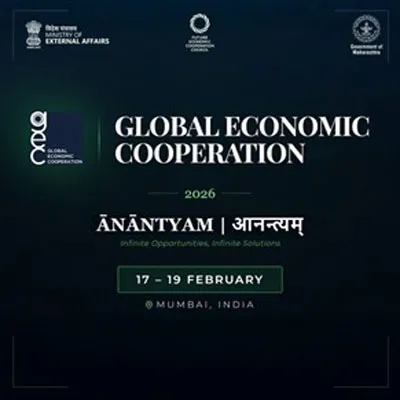
Senior policymakers, global CEOs, investors and leaders of multilateral institutions will gather in Mumbai from February 17–19, 2026, for the inaugural Global Economic Cooperation 2026 (GEC), an invitation-only forum focused on rethinking economic diplomacy and cooperation in a rapidly evolving multipolar world.

The summit is being convened by the Future Economic Cooperation Council (FECC), in partnership with the Ministry of External Affairs, Government of India, and the Government of Maharashtra. The FECC is guided by a governing council led by Maharashtra Chief Minister Devendra Fadnavis as Chief Patron, with Vijay Chauthaiwale, in-charge, Foreign Affairs, Bharatiya Janata Party, and Priyam Gandhi-Mody, Founder of Vishwamitra Research Foundation, serving as Directors.

Positioned against the backdrop of global economic transition, GEC 2026 will examine structural shifts reshaping global trade, investment flows and economic governance. Discussions will span infrastructure financing, advanced manufacturing, technology systems, energy transitions and resilient supply chains, with an emphasis on cooperation beyond traditional trade frameworks. Closed-door dialogues and plenary sessions will address economic corridors, capital alignment, digital connectivity, ESG frameworks and governance of emerging technologies.

Priyam Gandhi-Mody said the forum reflects India’s intent to convene governments, investors and industry leaders to develop practical pathways for cooperation that respond to fragmentation and uncertainty in the global economy. Vijay Chauthaiwale noted that economic engagement is increasingly intertwined with geopolitics, and the forum underscores India’s commitment to cooperative, rules-based economic frameworks.

The summit will also see the launch of the Emerging Leaders Circle on its third day, engaging young business leaders through curated discussions in collaboration with institutions such as the Indian Institutes of Management and Columbia University. Envisaged as an annual platform, GEC aims to foster long-term dialogue on inclusive growth, connectivity and global economic stability.

Senior policymakers, global CEOs, investors and leaders of multilateral institutions will gather in Mumbai from February 17–19, 2026, for the inaugural Global Economic Cooperation 2026 (GEC), an invitation-only forum focused on rethinking economic diplomacy and cooperation in a rapidly evolving multipolar world.The summit is being convened by the Future Economic Cooperation Council (FECC), in partnership with the Ministry of External Affairs, Government of India, and the Government of Maharashtra. The FECC is guided by a governing council led by Maharashtra Chief Minister Devendra Fadnavis as Chief Patron, with Vijay Chauthaiwale, in-charge, Foreign Affairs, Bharatiya Janata Party, and Priyam Gandhi-Mody, Founder of Vishwamitra Research Foundation, serving as Directors.Positioned against the backdrop of global economic transition, GEC 2026 will examine structural shifts reshaping global trade, investment flows and economic governance. Discussions will span infrastructure financing, advanced manufacturing, technology systems, energy transitions and resilient supply chains, with an emphasis on cooperation beyond traditional trade frameworks. Closed-door dialogues and plenary sessions will address economic corridors, capital alignment, digital connectivity, ESG frameworks and governance of emerging technologies.Priyam Gandhi-Mody said the forum reflects India’s intent to convene governments, investors and industry leaders to develop practical pathways for cooperation that respond to fragmentation and uncertainty in the global economy. Vijay Chauthaiwale noted that economic engagement is increasingly intertwined with geopolitics, and the forum underscores India’s commitment to cooperative, rules-based economic frameworks.The summit will also see the launch of the Emerging Leaders Circle on its third day, engaging young business leaders through curated discussions in collaboration with institutions such as the Indian Institutes of Management and Columbia University. Envisaged as an annual platform, GEC aims to foster long-term dialogue on inclusive growth, connectivity and global economic stability.

Next Story
Infrastructure Transport

Second Mountain Tunnel Breakthrough in Palghar Advances High Speed Rail

The Mumbai-Ahmedabad high speed rail (MAHSR) project reached a milestone with the breakthrough of a mountain tunnel in Palghar, Maharashtra. Mountain tunnel MT-six measures 454 metres long and 14.4 metres wide and will accommodate up and down tracks. The breakthrough follows MT-five near Saphale on second January 2026 and the MT-six excavation was completed from both ends using the New Austrian Tunnelling Method. The ministry reported that the tunnelling was completed within 12 months. The New Austrian Tunnelling Method is favoured for its flexibility in complex geology and irregular tunnel s..

Next Story
Infrastructure Transport

Modi Government Pushes Atmanirbhar Container Drive With BCSL MoU

The Union Government advanced a plan to create an integrated, domestically anchored container ecosystem with the signing of a Memorandum of Understanding to establish the Bharat Container Shipping Line (BCSL). The MoU was signed by key agencies including the Shipping Corporation of India and Container Corporation of India alongside major port authorities and Sagarmala Finance Corporation Limited under the Ministry of Ports, Shipping and Waterways, in the presence of senior ministers. The initiative aligns with the Container Manufacturing Assistance Scheme announced in the Union Budget 2026–2..

Next Story
Infrastructure Urban

Ministry Reports Gains In Mobility For Marginalised Communities

The Ministry of Social Justice and Empowerment is implementing skill development, education and rehabilitation schemes to promote socio-economic mobility and sustainable livelihoods for marginalised and disadvantaged communities across the country. Programmes target Scheduled Castes, Other Backward Classes, Economically Weaker Sections, De-notified Tribes and Safai Karamcharis through specialised implementing corporations and empanelled training institutes. Pradhan Mantri Dakshata Aur Kushalta Sampann Hitgrahi Yojana, or PM-DAKSH, provided skill training and placement support through the Nati..

Advertisement

Subscribe to Our Newsletter

Get daily newsletters around different themes from Construction world.

STAY CONNECTED

Advertisement

Advertisement

Advertisement

Open In App