+
GMR Plans Rs 194 Billion Expansion at New Delhi and Hyderabad
ECONOMY & POLICY

GMR Plans Rs 194 Billion Expansion at New Delhi and Hyderabad

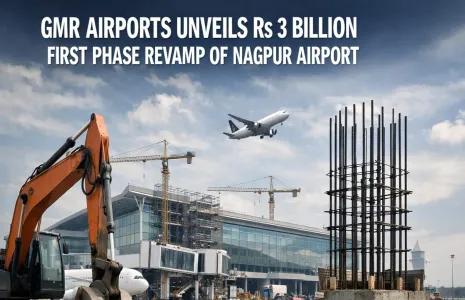
GMR Airports plans to invest Rs 194 billion (bn) over the next five to seven years to expand New Delhi and Hyderabad facilities. The spend will focus on capacity increases and modernisation to cope with a rapid rise in passenger volumes, the company said. The projects will be funded by a mix of debt and equity through the airport ventures and not by the holding company.

The company has earmarked about Rs 138 bn for Rajiv Gandhi International Airport in Hyderabad and up to Rs 56 bn for the New Delhi airport. Once completed, the Hyderabad upgrade will accommodate about 80 million (mn) passengers, more than double the current annual volume of 34 million (mn) fliers. GMR is the largest operator by number of fliers while Adani leads by number of airports.

The expansion comes as India remains the world’s third largest domestic aviation market, trailing only the US and China, and traffic is projected to grow six-fold to around one point one billion passengers over the next 14 years according to government estimates. The national commercial fleet is forecast to rise from 400 aircraft in 2014 to more than 2,350 by 2040. The company sees the build-outs as part of a broader modernisation drive across its portfolio.

GMR’s portfolio includes six airports in India, one in the Philippines and another under construction in Greece, and France’s Aeroports de Paris SA owns a 26.5 per cent stake in GMR Airports. Investment plans for the newly acquired Nagpur airport are under discussion after the June 2026 takeover. The group does not intend to enter the airline business even if policy changes permit operators to run carriers and will focus on airport operations, aircraft maintenance and related real estate.

GMR Airports plans to invest Rs 194 billion (bn) over the next five to seven years to expand New Delhi and Hyderabad facilities. The spend will focus on capacity increases and modernisation to cope with a rapid rise in passenger volumes, the company said. The projects will be funded by a mix of debt and equity through the airport ventures and not by the holding company. The company has earmarked about Rs 138 bn for Rajiv Gandhi International Airport in Hyderabad and up to Rs 56 bn for the New Delhi airport. Once completed, the Hyderabad upgrade will accommodate about 80 million (mn) passengers, more than double the current annual volume of 34 million (mn) fliers. GMR is the largest operator by number of fliers while Adani leads by number of airports. The expansion comes as India remains the world’s third largest domestic aviation market, trailing only the US and China, and traffic is projected to grow six-fold to around one point one billion passengers over the next 14 years according to government estimates. The national commercial fleet is forecast to rise from 400 aircraft in 2014 to more than 2,350 by 2040. The company sees the build-outs as part of a broader modernisation drive across its portfolio. GMR’s portfolio includes six airports in India, one in the Philippines and another under construction in Greece, and France’s Aeroports de Paris SA owns a 26.5 per cent stake in GMR Airports. Investment plans for the newly acquired Nagpur airport are under discussion after the June 2026 takeover. The group does not intend to enter the airline business even if policy changes permit operators to run carriers and will focus on airport operations, aircraft maintenance and related real estate.

Related Stories

Gold Stories

Next Story
Real Estate

BMC OC Amnesty Scheme Requires Key Approvals from Mumbai Societies

The Brihanmumbai Municipal Corporation (BMC) has clarified that housing societies applying under its Occupation Certificate (OC) amnesty scheme must possess key approvals linked to the original construction. The requirements include a valid Intimation of Disapproval (IOD), an approved building plan and a Commencement Certificate (CC), along with a No Objection Certificate (NOC) from the developer or original construction applicant. The Standard Operating Procedure (SOP) makes clear that the absence of an OC alone will not qualify a building for relief. Societies must establish that their build..

Next Story
Real Estate

Gurugram Emerges as Luxury Senior Living Hub

Gurugram is emerging as a potential hub for luxury senior living, supported by available land, healthcare infrastructure, connectivity and a concentration of affluent professionals, high-net-worth individuals and non-resident Indians. These factors could give the city an advantage over land-constrained metros such as Mumbai. A report by the Association of Senior Living India (ASLI) and JLL estimates that India’s organised senior living market could represent a $10.1 bn opportunity by 2030. The sector had about 25,050 organised units as of June 2026, while penetration stood at only 1.5 per ce..

Next Story
Real Estate

Corrosion Costs India’s Infrastructure Rs. 142 bn Annually

Corrosion costs India an estimated Rs. 1.42 tn annually, equivalent to 4.3 per cent of gross domestic product, according to a report by the Confederation of Indian Industry and the National Research Institute. Infrastructure accounts for Rs. 142 bn of the annual burden, making it the sector with the largest absolute cost among those examined. The report, presented at the CII Annual Infrastructure Summit 2026, said the infrastructure-sector cost equals about 2.9 per cent of the sector’s gross domestic product. It estimated that effective measures could generate maximum savings of Rs. 495.8 bn..

Advertisement

Subscribe to Our Newsletter

Get daily newsletters around different themes from Construction world.

STAY CONNECTED

Advertisement

SPECIAL OFFER
QR Code