+
Gross NPAs of Scheduled Commercial Banks Fall to Historic Low
ECONOMY & POLICY

Gross NPAs of Scheduled Commercial Banks Fall to Historic Low

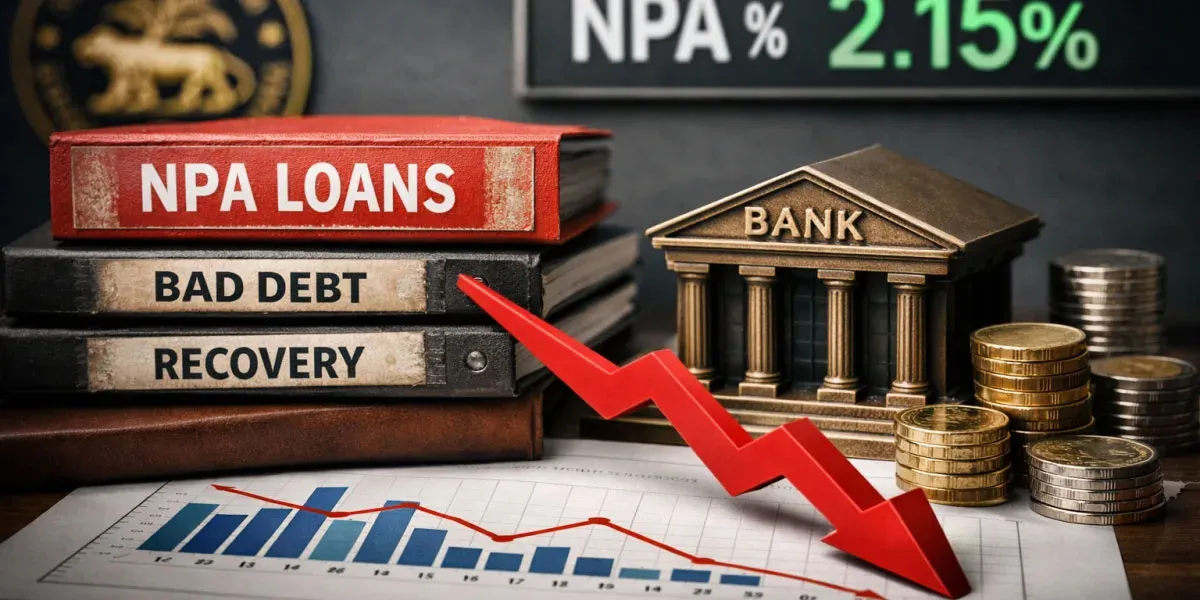
The gross non-performing assets (NPAs) ratio of Scheduled Commercial Banks (SCBs) for domestic operations has fallen steadily over the last eight financial years and reached a historic low of two point one five per cent at end September, 2025 on provisional data. The Reserve Bank of India (RBI) conducted an Asset Quality Review in 2015 and the Government implemented a four Rs strategy of recognising, resolving, recovering and recapitalising alongside broader banking reforms. These steps delivered a marked reduction in gross NPAs, especially among Public Sector Banks (PSBs).

According to data as on 30.9.2025, the gross NPA ratio for SCBs was two point one five per cent, for PSBs two point five per cent, for Private Sector Banks (PVBs) one point seven three per cent and for Foreign Banks zero point eight per cent. PSBs have registered a larger decline in gross NPAs since March, 2018 compared with PVBs and Foreign Banks. The lower NPA burden has reduced provisioning and supported profitability and credit growth.

Asset quality gains have strengthened bank balance sheets and underwriting, aiding loan growth. The slippage ratio, the fresh accretion of NPAs as a percentage of standard advances, has improved for PSBs over the last six financial years and was zero point eight per cent in September, 2025 compared with one point eight per cent in PVBs. The PSB reforms agenda instituted comprehensive early warning systems with approximately 80 triggers and greater use of third party data to enable time bound remedial action.

The Insolvency and Bankruptcy Code, 2016 altered the creditor-borrower framework, visible in more than 30,000 cases with underlying default of Rs. 13.78 trillion (tn) settled at pre-admission stage as of March, 2025. Legal changes included amendments to the Securitisation and Reconstruction of Financial Assets and Enforcement of Security Interest Act and enhancements to recovery routes such as Debts Recovery Tribunals where pecuniary jurisdiction was raised from Rs. one million (mn) to Rs. two million (mn). The Government and RBI continue to coordinate on measures to speed resolution and boost recoveries.

The gross non-performing assets (NPAs) ratio of Scheduled Commercial Banks (SCBs) for domestic operations has fallen steadily over the last eight financial years and reached a historic low of two point one five per cent at end September, 2025 on provisional data. The Reserve Bank of India (RBI) conducted an Asset Quality Review in 2015 and the Government implemented a four Rs strategy of recognising, resolving, recovering and recapitalising alongside broader banking reforms. These steps delivered a marked reduction in gross NPAs, especially among Public Sector Banks (PSBs). According to data as on 30.9.2025, the gross NPA ratio for SCBs was two point one five per cent, for PSBs two point five per cent, for Private Sector Banks (PVBs) one point seven three per cent and for Foreign Banks zero point eight per cent. PSBs have registered a larger decline in gross NPAs since March, 2018 compared with PVBs and Foreign Banks. The lower NPA burden has reduced provisioning and supported profitability and credit growth. Asset quality gains have strengthened bank balance sheets and underwriting, aiding loan growth. The slippage ratio, the fresh accretion of NPAs as a percentage of standard advances, has improved for PSBs over the last six financial years and was zero point eight per cent in September, 2025 compared with one point eight per cent in PVBs. The PSB reforms agenda instituted comprehensive early warning systems with approximately 80 triggers and greater use of third party data to enable time bound remedial action. The Insolvency and Bankruptcy Code, 2016 altered the creditor-borrower framework, visible in more than 30,000 cases with underlying default of Rs. 13.78 trillion (tn) settled at pre-admission stage as of March, 2025. Legal changes included amendments to the Securitisation and Reconstruction of Financial Assets and Enforcement of Security Interest Act and enhancements to recovery routes such as Debts Recovery Tribunals where pecuniary jurisdiction was raised from Rs. one million (mn) to Rs. two million (mn). The Government and RBI continue to coordinate on measures to speed resolution and boost recoveries.

Next Story
Building Material

NITI Aayog Unveils Cement Decarbonisation Roadmap

NITI Aayog has released a sector-specific decarbonisation roadmap for cement as part of three green transition reports covering cement, aluminium and MSMEs. The report projects cement production rising to around 2,100 million tonnes by 2070 from 391 million tonnes in 2023, while targeting a reduction in carbon intensity to 0.09–0.13 tCO₂e per tonne. It recommends clinker substitution, refuse-derived fuels, CCUS adoption and carbon trading mechanisms to enable deep decarbonisation. ..

Next Story
Technology

Genesys Launches Advanced GeoRadar System

Genesys International Corporation has launched an advanced Ground Penetrating Radar (GPR) solution from IDS GeoRadar for underground utility mapping in India. The system uses patented Equalised Scrambling Technology (EST) and Wide/Multi-Array Antenna Technology to deliver high-resolution three-dimensional imaging of subsurface infrastructure. The technology enables the detection and mapping of buried assets such as water pipelines, sewer networks, telecom cables and power lines. By providing detailed subsurface insights, the system aims to help urban authorities and infrastructure developers ..

Next Story
Infrastructure Urban

Hindustan Zinc Partners Virginia Tech to Boost Silver Recovery

Hindustan Zinc Limited recently signed a Memorandum of Understanding (MoU) with Virginia Tech to advance research aimed at improving silver recovery across its lead–zinc (Pb–Zn) concentrators. The collaboration will focus on refining flotation techniques and optimising reagent usage to improve concentrate quality and operational efficiency at processing plants.Virginia Tech, based in Blacksburg, Virginia, is globally recognised for its expertise in mining engineering, mineral processing and applied metallurgical research. Through this partnership, Hindustan Zinc will leverage global resear..

Advertisement

Subscribe to Our Newsletter

Get daily newsletters around different themes from Construction world.

STAY CONNECTED

Advertisement

Advertisement

Advertisement

Open In App