MeitY Launches 30 kW WBG Integrated Drive System for EVs
ECONOMY & POLICY

MeitY Launches 30 kW WBG Integrated Drive System for EVs

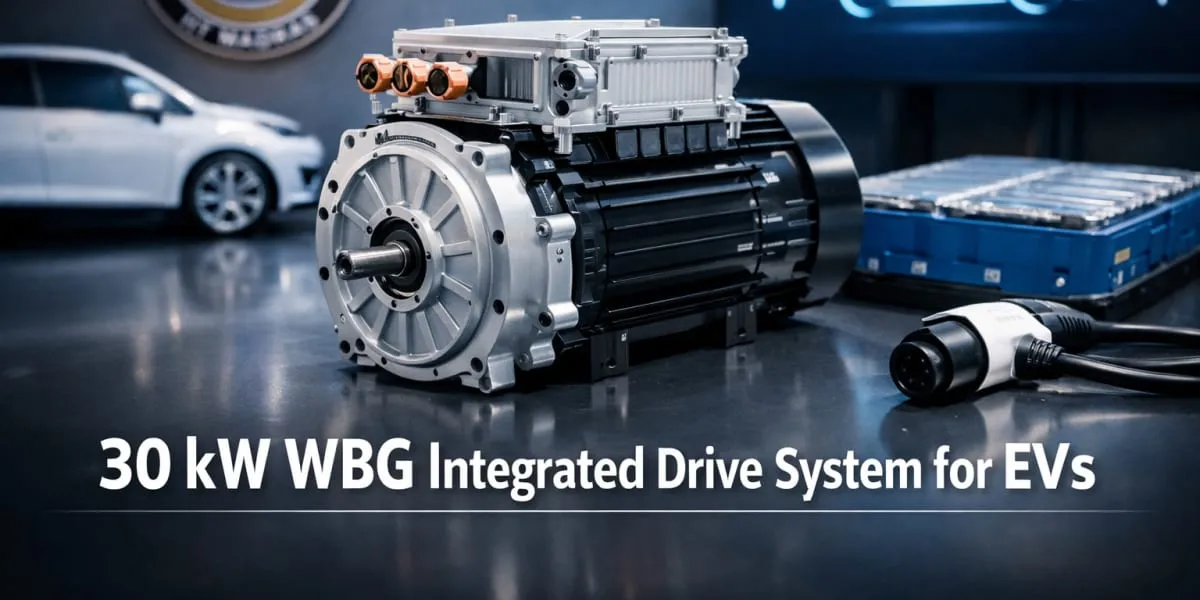
The Ministry of Electronics and Information Technology (MeitY) has launched an indigenously developed 30 kilowatt (kW) Wide Band Gap (WBG)-based Integrated Drive System (IDS) for electric vehicle applications, unveiled at the Indian Institute of Technology Madras. The system was developed by the Centre for Development of Advanced Computing (C-DAC), Thiruvananthapuram, in collaboration with Indian Institute of Technology Madras (IIT Madras) and Lucas TVS under the National Mission on Power Electronics Technology (NaMPET). The launch was presented as a step to strengthen indigenous capabilities in advanced power electronics.

The 30 kW power class is particularly relevant for India's growing electric passenger vehicle segment, including compact cars and fleet mobility platforms, and the IDS integrates the motor and inverter into a single compact, high power-density unit. Indigenous development seeks to reduce import dependency and lower system costs through localisation while supporting scalable manufacturing aligned with Production-Linked Incentive schemes. The move is expected to aid the transition from technology importing to technology development and export.

The technology has been designed, fabricated and validated in partnership with industry and is ready for commercialisation and large-scale deployment, which may strengthen India's electric vehicle supply chain. Successful adoption is likely to create opportunities for micro, small and medium enterprises in power electronics manufacturing, thermal systems and control hardware while enhancing global competitiveness in semiconductor-based electric mobility solutions. Under NaMPET, MeitY intends to catalyse innovation-driven partnerships to build self-reliant power electronics technologies for next-generation mobility and energy systems.

MeitY described the development as advancing the national vision of Make in India and Make for the World by moving towards technology development and exports, and characterised the IDS as a major milestone towards Aatmanirbhar Bharat in electric mobility and strategic electronics. The ministry highlighted that design-led innovation can create domestic intellectual property, accelerate the start-up ecosystem and strengthen high-value manufacturing in the EV sector. Officials from C-DAC, MeitY, IIT Madras and industry partners attended the launch, reflecting collaborative engagement across research, academia and industry.

The Ministry of Electronics and Information Technology (MeitY) has launched an indigenously developed 30 kilowatt (kW) Wide Band Gap (WBG)-based Integrated Drive System (IDS) for electric vehicle applications, unveiled at the Indian Institute of Technology Madras. The system was developed by the Centre for Development of Advanced Computing (C-DAC), Thiruvananthapuram, in collaboration with Indian Institute of Technology Madras (IIT Madras) and Lucas TVS under the National Mission on Power Electronics Technology (NaMPET). The launch was presented as a step to strengthen indigenous capabilities in advanced power electronics. The 30 kW power class is particularly relevant for India's growing electric passenger vehicle segment, including compact cars and fleet mobility platforms, and the IDS integrates the motor and inverter into a single compact, high power-density unit. Indigenous development seeks to reduce import dependency and lower system costs through localisation while supporting scalable manufacturing aligned with Production-Linked Incentive schemes. The move is expected to aid the transition from technology importing to technology development and export. The technology has been designed, fabricated and validated in partnership with industry and is ready for commercialisation and large-scale deployment, which may strengthen India's electric vehicle supply chain. Successful adoption is likely to create opportunities for micro, small and medium enterprises in power electronics manufacturing, thermal systems and control hardware while enhancing global competitiveness in semiconductor-based electric mobility solutions. Under NaMPET, MeitY intends to catalyse innovation-driven partnerships to build self-reliant power electronics technologies for next-generation mobility and energy systems. MeitY described the development as advancing the national vision of Make in India and Make for the World by moving towards technology development and exports, and characterised the IDS as a major milestone towards Aatmanirbhar Bharat in electric mobility and strategic electronics. The ministry highlighted that design-led innovation can create domestic intellectual property, accelerate the start-up ecosystem and strengthen high-value manufacturing in the EV sector. Officials from C-DAC, MeitY, IIT Madras and industry partners attended the launch, reflecting collaborative engagement across research, academia and industry.

Next Story
Infrastructure Transport

Pune To Build Nine Km Link Road Between Highways

The Pune Municipal Corporation (PMC) has decided to appoint an expert to plan the development of a nine km long, 60 metre wide road from Khadi Machine chowk to Wadki chowk as an extension to the Katraj-Kondhwa road to link the Mumbai-Satara and Pune-Solapur national highways. The scheme is intended to divert heavy vehicle traffic away from the city and improve access between the two arterial routes. The project has been prioritised by the PMC and forms part of a larger set of schemes in which 19 roads have been identified for development at a combined cost of Rs 9.82 billion (bn) to address c..

Next Story
Infrastructure Transport

Barabanki Bahraich Six Lane Highway Approved in Uttar Pradesh

The Uttar Pradesh government has approved construction of a new six-lane highway linking Barabanki and Bahraich as part of National Highway 927, and the cabinet has cleared the project. The alignment will pass through Mustafabad and Kaiserganj and extend for about 101.5 km, creating a key corridor for local and long-distance movement. The National Highways Authority of India will oversee the work and has signalled the scheme is intended to strengthen regional connectivity and cross-border access to Nepal. The project carries an estimated total cost of Rs 69,690 million, equivalent to Rs 69.69..

Next Story
Infrastructure Transport

Toll At Kharegaon Likely As Highway Upgrade Nears Completion

A section of the highway at Kharegaon has undergone an upgrade and is approaching completion, and authorities have indicated plans for a toll to be introduced once works finish. The project has focused on strengthening the carriageway, improving drainage and upgrading intersections to enhance safety and capacity. Officials have said the toll will be used to recover construction costs and fund ongoing maintenance. The upgrade included resurfacing of the pavement, widening of certain stretches and installation of modern signage and lighting to reduce accident risk. Contractors completed most ma..

Advertisement

Subscribe to Our Newsletter

Get daily newsletters around different themes from Construction world.

STAY CONNECTED

Advertisement

Advertisement

Advertisement