Gujarat's Ambitious IT/ITES Policy Aims for Rs 25,000 Crore Exports in 5 Years
ECONOMY & POLICY

Gujarat's Ambitious IT/ITES Policy Aims for Rs 25,000 Crore Exports in 5 Years

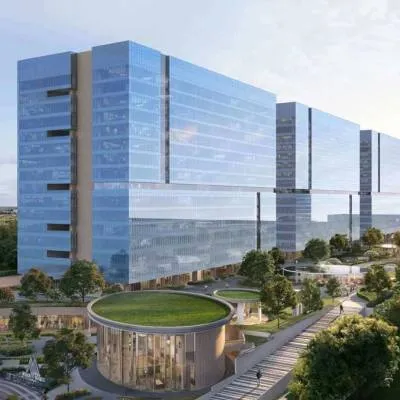
Gujarat has unveiled its forward-looking IT/ITES Policy 2022-27, charting a course for significant economic strides. With an annual growth rate of 14%, the state is poised to become an IT hub, generating over 1 lakh job opportunities. The policy aims to propel Gujarat's IT sector, targeting Rs 25,000 Crore in exports over the next five years. Key features include a robust infrastructure framework, fostering innovation and digitalization. The policy emphasizes skill development, aiming to create a skilled workforce to meet industry demands. Gujarat's strategic geographic location further enhances its potential as a thriving IT destination. This initiative aligns with the broader vision of transforming Gujarat into a knowledge-based economy. The state's commitment to a business-friendly environment, coupled with proactive policies, positions Gujarat as a frontrunner in the Indian IT landscape. As the digital era unfolds, Gujarat's IT/ITES Policy is a testament to its determination to harness technology for sustained economic growth.

Gujarat has unveiled its forward-looking IT/ITES Policy 2022-27, charting a course for significant economic strides. With an annual growth rate of 14%, the state is poised to become an IT hub, generating over 1 lakh job opportunities. The policy aims to propel Gujarat's IT sector, targeting Rs 25,000 Crore in exports over the next five years. Key features include a robust infrastructure framework, fostering innovation and digitalization. The policy emphasizes skill development, aiming to create a skilled workforce to meet industry demands. Gujarat's strategic geographic location further enhances its potential as a thriving IT destination. This initiative aligns with the broader vision of transforming Gujarat into a knowledge-based economy. The state's commitment to a business-friendly environment, coupled with proactive policies, positions Gujarat as a frontrunner in the Indian IT landscape. As the digital era unfolds, Gujarat's IT/ITES Policy is a testament to its determination to harness technology for sustained economic growth.

Next Story
Infrastructure Energy

India Adds Record 44.61 GW Solar Capacity in FY2026

India’s solar sector reached a milestone in FY2026, with cumulative installed capacity crossing 150 GW and annual additions hitting a record 44.61 GW, exceeding the government target of 34 GW and nearly doubling FY2025’s 23.83 GW. Distributed Renewable Energy contributed 16.3 GW, while PPA and C&I segments accounted for 34 per cent and 30 per cent, respectively.India has risen from 9th globally in 2015 to 3rd in cumulative solar capacity by 2025 and is set to become the world’s second-largest solar market in annual installations in 2026. Seven states, led by Rajasthan and Gujarat, ac..

Next Story
Real Estate

Abhee Ventures unveils Scottish-themed 45-acre township in Bengaluru

Abhee Ventures, a leading South Indian real estate developer, has announced “Codename New Dimension,” a 45-acre Scottish-themed residential township at Gunjur on Whitefield–Sarjapur Road, Bengaluru. Strategically located between Whitefield and Sarjapur Road, Gunjur benefits from strong connectivity to the Outer Ring Road IT corridor, ITPL, EPIP, the upcoming Dommasandra Metro Station, and the proposed SWIFT City and Peripheral Ring Road.The township, designed in collaboration with London-based UHA London and India’s RSP Architects, offers low-density living with 85 per cent open spaces..

Next Story
Infrastructure Urban

BPE launches world’s thinnest Active Tile for legacy data centres

Best Power Equipments (India) Pvt Ltd (BPE), a leading provider of power solutions, data centre systems, and Battery Energy Storage Systems (BESS), has launched the BPE Active Tile, the world’s thinnest active tile designed for legacy data centres and telecom infrastructure. At just 65 mm thick, the tile requires significantly less space than conventional active tiles, which need nearly 450 mm floor depth.“Most legacy data centres were built decades ago for lower IT loads and traditional airflow patterns,” said A Prabhu, Executive Director – Technical (Global Operations), BPE. “As ra..

Advertisement

Subscribe to Our Newsletter

Get daily newsletters around different themes from Construction world.

STAY CONNECTED

Advertisement

Advertisement

Advertisement