Haryana Records Record Electricity Supply Amid Peak Demand
ECONOMY & POLICY

Haryana Records Record Electricity Supply Amid Peak Demand

Haryana has achieved a major milestone in power management by meeting its highest electricity demand of the season without major disruption. On July 18 the state's two power distribution utilities—Uttar Haryana Bijli Vitran Nigam (UHBVN) and Dakshin Haryana Bijli Vitran Nigam (DHBVN)—supplied a combined 313.542 million (mn) units of electricity, one of the highest single-day consumptions recorded in Haryana. The achievement came as temperatures soared and industrial and agricultural demand rose.

Of total consumption, Dakshin Haryana Bijli Vitran Nigam (DHBVN) supplied 176.37 million (mn) units and Uttar Haryana Bijli Vitran Nigam (UHBVN) distributed 137.172 million (mn) units. Compared with the same day last year consumption rose by 37.56 per cent in the DHBVN area and by 25.85 per cent in the UHBVN jurisdiction, underlining sharp growth in demand. The highest demand was in the Delhi Zone of DHBVN at 106.553 million (mn) units followed by Hisar Zone at 69.817 million (mn) units.

In northern Haryana Rohtak Zone accounted for 79.366 million (mn) units while Panchkula Zone consumed 57.806 million (mn) units. Both distribution companies recorded their monthly peak on July 18 and consumption remained consistently high throughout the month after a brief weather related dip. The government ensured balanced supply across agriculture, rural households, urban areas and industry through advance procurement and strengthened transmission.

Engineers and field staff were deployed continuously and additional transformers, equipment and manpower were positioned to prevent breakdowns and restore faults rapidly. The state is preparing for further growth in demand by expanding generation, transmission and distribution infrastructure and by commissioning substations, high-capacity lines and smart management technologies while promoting rooftop solar. Authorities appealed for responsible consumption and adoption of energy efficient appliances to conserve resources and support uninterrupted supply.

Haryana has achieved a major milestone in power management by meeting its highest electricity demand of the season without major disruption. On July 18 the state's two power distribution utilities—Uttar Haryana Bijli Vitran Nigam (UHBVN) and Dakshin Haryana Bijli Vitran Nigam (DHBVN)—supplied a combined 313.542 million (mn) units of electricity, one of the highest single-day consumptions recorded in Haryana. The achievement came as temperatures soared and industrial and agricultural demand rose. Of total consumption, Dakshin Haryana Bijli Vitran Nigam (DHBVN) supplied 176.37 million (mn) units and Uttar Haryana Bijli Vitran Nigam (UHBVN) distributed 137.172 million (mn) units. Compared with the same day last year consumption rose by 37.56 per cent in the DHBVN area and by 25.85 per cent in the UHBVN jurisdiction, underlining sharp growth in demand. The highest demand was in the Delhi Zone of DHBVN at 106.553 million (mn) units followed by Hisar Zone at 69.817 million (mn) units. In northern Haryana Rohtak Zone accounted for 79.366 million (mn) units while Panchkula Zone consumed 57.806 million (mn) units. Both distribution companies recorded their monthly peak on July 18 and consumption remained consistently high throughout the month after a brief weather related dip. The government ensured balanced supply across agriculture, rural households, urban areas and industry through advance procurement and strengthened transmission. Engineers and field staff were deployed continuously and additional transformers, equipment and manpower were positioned to prevent breakdowns and restore faults rapidly. The state is preparing for further growth in demand by expanding generation, transmission and distribution infrastructure and by commissioning substations, high-capacity lines and smart management technologies while promoting rooftop solar. Authorities appealed for responsible consumption and adoption of energy efficient appliances to conserve resources and support uninterrupted supply.

Related Stories

Gold Stories

Next Story
Infrastructure Urban

KONE Opens India's First Digital Experience Centre in Pune

KONE, a global elevator and escalator manufacturer, has inaugurated its first Digital Experience Centre (DEC) in India, located in Pune. The facility aims to showcase how artificial intelligence (AI), connectivity and data-driven technologies can enhance customer experiences and improve building operations.The centre was inaugurated by Jussi Herlin, Executive Vice Chair, KONE Corporation; Philippe Delorme, President and CEO, KONE; and Nandan Nilekani, Co-founder and Chairman of the Board, Infosys.Designed as an interactive customer environment, the facility demonstrates digital solutions cover..

Next Story
Infrastructure Urban

CII GreenCo Launches Circularity Guidelines for Indian Industry

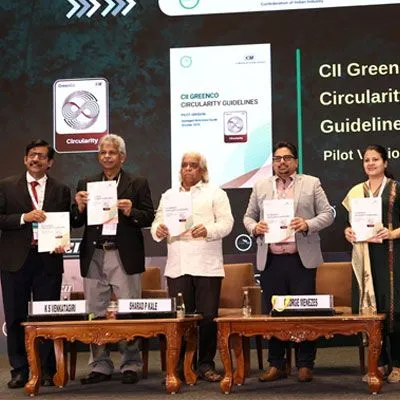
The Confederation of Indian Industry (CII) GreenCo Council has launched the CII GreenCo Circularity Guidelines – Pilot Version at the 17th CII GreenCo Waste & Resource Management Summit 2026 in Chennai. The initiative aims to strengthen resource efficiency, waste reduction and circular economy practices across Indian manufacturing and process industries.The guidelines introduce a structured framework with circularity indices covering raw materials, consumables, packaging and other resource inputs. These indicators will help industries assess existing practices, identify opportunities to ..

Next Story
Infrastructure Energy

Global Electronics Association Launches IPC-1783-CO2E Standard

The Global Electronics Association has introduced IPC-1783-CO2E, a new international standard aimed at improving consistency, transparency and comparability in product carbon footprint reporting across the electronics manufacturing industry.The standard, titled International Standard for Data Collection and Reporting of CO2 Equivalent (CO2e) Emissions for the Electronics Manufacturing Supply Chain, provides industry-specific guidance for collecting, estimating and reporting carbon emissions data.With increasing regulatory requirements and customer expectations, electronics manufacturers face c..

Advertisement

Subscribe to Our Newsletter

Get daily newsletters around different themes from Construction world.

STAY CONNECTED

Advertisement

SPECIAL OFFER
QR Code