+
ICAR, NDDB Forge Strategic Alliance to Boost Dairy R&D Ecosystem
ECONOMY & POLICY

ICAR, NDDB Forge Strategic Alliance to Boost Dairy R&D Ecosystem

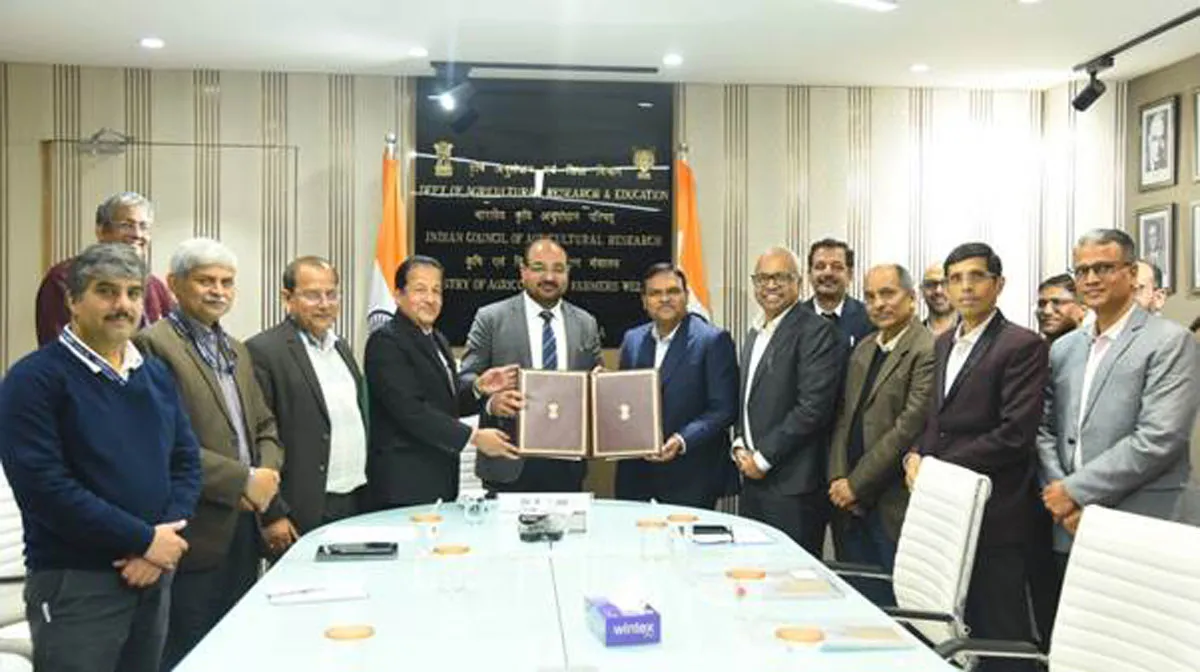
The Indian Council of Agricultural Research (ICAR) has entered into a strategic Memorandum of Understanding (MoU) with the National Dairy Development Board (NDDB) to deepen collaboration in multidisciplinary research, innovation and extension across India’s dairy sector. The partnership is designed to strengthen the entire value chain—from dairy production and processing to value addition—while keeping farmers at the centre of development efforts.

The MoU was signed by Dr Raghavendra Bhatta, Deputy Director General (Animal Science), ICAR, and Shri S. Regupathi, Executive Director (Operations), NDDB, in the presence of Dr. Mangi Lal Jat, Secretary, Department of Agricultural Research and Education (DARE), Government of India and Director General, ICAR, and Dr Meenesh C. Shah, Chairman, NDDB.

Dr Mangi Lal Jat, Secretary, DARE and Director General, ICAR, underscored the need to break institutional silos through complementary research and integrated farming systems. He noted that the structured partnership would help address complex challenges such as climate resilience, low productivity and value chain development. Dr Jat also highlighted the adoption of gaushalas to manage stray cattle and promote sustainable manure management and biogas utilisation, while stressing the critical role of fodder in improving livestock productivity through innovations emerging from ICAR institutes.

Dr Meenesh C Shah, Chairman, NDDB, said the collaboration could evolve into one of the world’s largest integrated scientific platforms aligned with the vision of ‘Viksit Bharat’. He highlighted NDDB’s past collaborations with ICAR on initiatives such as ration balancing, mineral mapping and total mixed ration programmes, and pointed to new opportunities in ethno-veterinary medicine. He also emphasised the development of scalable, replicable models across diverse agro-climatic regions and cooperation across value chains including fruits and vegetables, oilseeds, fodder, milk and milk products.

The MoU aims to combine ICAR’s scientific expertise with NDDB’s strong field presence to accelerate technology development, validation, knowledge sharing and capacity building. Through joint training programmes and human resource development, the partnership seeks to translate research outcomes into practical solutions, enhancing productivity, profitability and sustainability at the grassroots level.

The Indian Council of Agricultural Research (ICAR) has entered into a strategic Memorandum of Understanding (MoU) with the National Dairy Development Board (NDDB) to deepen collaboration in multidisciplinary research, innovation and extension across India’s dairy sector. The partnership is designed to strengthen the entire value chain—from dairy production and processing to value addition—while keeping farmers at the centre of development efforts.The MoU was signed by Dr Raghavendra Bhatta, Deputy Director General (Animal Science), ICAR, and Shri S. Regupathi, Executive Director (Operations), NDDB, in the presence of Dr. Mangi Lal Jat, Secretary, Department of Agricultural Research and Education (DARE), Government of India and Director General, ICAR, and Dr Meenesh C. Shah, Chairman, NDDB.Dr Mangi Lal Jat, Secretary, DARE and Director General, ICAR, underscored the need to break institutional silos through complementary research and integrated farming systems. He noted that the structured partnership would help address complex challenges such as climate resilience, low productivity and value chain development. Dr Jat also highlighted the adoption of gaushalas to manage stray cattle and promote sustainable manure management and biogas utilisation, while stressing the critical role of fodder in improving livestock productivity through innovations emerging from ICAR institutes.Dr Meenesh C Shah, Chairman, NDDB, said the collaboration could evolve into one of the world’s largest integrated scientific platforms aligned with the vision of ‘Viksit Bharat’. He highlighted NDDB’s past collaborations with ICAR on initiatives such as ration balancing, mineral mapping and total mixed ration programmes, and pointed to new opportunities in ethno-veterinary medicine. He also emphasised the development of scalable, replicable models across diverse agro-climatic regions and cooperation across value chains including fruits and vegetables, oilseeds, fodder, milk and milk products.The MoU aims to combine ICAR’s scientific expertise with NDDB’s strong field presence to accelerate technology development, validation, knowledge sharing and capacity building. Through joint training programmes and human resource development, the partnership seeks to translate research outcomes into practical solutions, enhancing productivity, profitability and sustainability at the grassroots level.

Next Story
Infrastructure Urban

IEMI 2026 Boosts India’s Electronics Manufacturing Ecosystem

Integrated Electronics Manufacturing & Interconnections (IEMI) 2026, the flagship platform of the Global Electronics Association, concluded on January 29–30, 2026, at Hotel Taj Yeshwantpur, delivering key outcomes aligned with India’s electronics manufacturing, defence, and global supply-chain ambitions.The two-day conference brought together over 1,800 business delegates from India and more than 100 international participants from Southeast Asia, Japan, the Middle East and Africa, Europe, the UK, and the US, highlighting India’s growing role in the global electronics manufacturing e..

Next Story
Infrastructure Urban

Bhago Mobility, Honda launch EV platform for urban transport

Bhago Mobility has partnered with Honda Motorcycle & Scooter India (HMSI) and Honda Power Pack Energy India (HEID) to launch an integrated electric mobility platform aimed at supporting India’s growing urban transport ecosystem. The initiative will initially deploy electric two-wheelers in Delhi and Bengaluru, with a nationwide rollout planned over the next three years.The platform is designed for delivery partners, ride-hailing drivers, and last-mile logistics workers, offering bundled access to electric vehicles, battery-swapping services, regulatory compliance, and technology support ..

Next Story
Infrastructure Urban

LANXESS CAB 30 Binder Earns EPD Certification for Low Emissions

LANXESS has introduced its calcium sulfate binder CAB 30, a low-emission anhydrite binder designed to support eco-efficient construction projects. The company recently received Environmental Product Declarations (EPDs) for the product and its application in conventional calcium sulfate screeds, confirming its low carbon footprint and environmental performance.The EPDs, issued by Institut Bauen und Umwelt e.V. (IBU), verify the environmental impact of CAB 30 throughout its lifecycle, from raw material extraction to disposal. The certification highlights the binder’s suitability for sustainabl..

Advertisement

Subscribe to Our Newsletter

Get daily newsletters around different themes from Construction world.

STAY CONNECTED

Advertisement

Advertisement

Advertisement

Open In App