
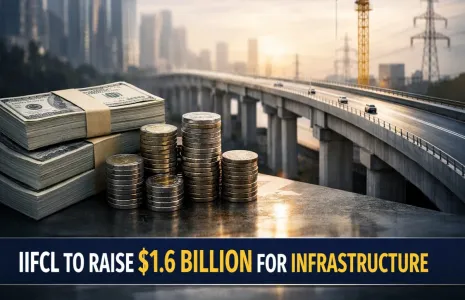
IIFCL To Raise One Point $6 Bn For Infrastructure
ECONOMY & POLICY

IIFCL To Raise One Point $6 Bn For Infrastructure

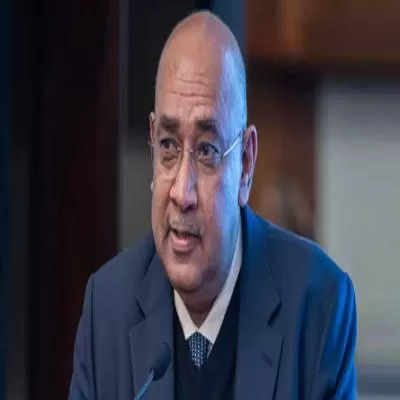
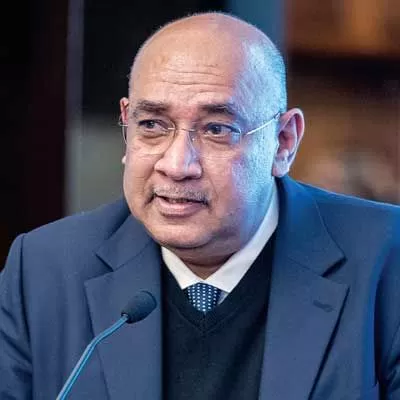
India Infrastructure Finance Company Ltd plans to raise one point six billion US dollars from multilateral agencies and other overseas investors to support infrastructure development across the country. The managing director, Rohit Rishi, said the strategy is to build a diversified and cost-effective long-term funding base aligned with infrastructure financing needs and that the company has mobilised resources from leading multilaterals. The planned mobilisation aims to secure competitive long-tenor funds and channel greater institutional capital into Indian infrastructure.

He noted that until December IIFCL had raised JPY 26 billion from Sumitomo Mitsui Banking Corporation as external commercial borrowing, equating to about Rs15.2 bn. He added that the reasonably low cost of those funds reflects lender confidence in India's growth story.

The company is exploring a US$600 mn blended finance facility and a debut green bond issuance and is seeking approval to raise around US$1 bn as long-term commercial debt without sovereign guarantee in collaboration with the Multilateral Investment Guarantee Agency. The collaboration with MIGA is expected to reduce the financial burden on the public exchequer by providing guarantees against non-commercial risks.

IIFCL has received necessary approvals to proceed with a proposed initial public offering after the Cabinet Committee on Economic Affairs cleared listing on stock exchanges and the Department of Investment and Public Asset Management conveyed approval to the company. The company is preparing requisite details for the government to finalise modalities expected to materialise in the next financial year.

IIFCL remains wholly owned by the central government and was established in 2006 to provide long-term financial assistance to viable infrastructure projects. The authorised and paid-up capital stood at Rs100 bn and Rs99.9992 bn as of 31 March 2025. For the fiscal year ended March 2025 net profit rose 39 per cent to Rs21.65 bn and profit before tax reached Rs27.76 bn; annual sanctions and disbursements stood at Rs511.24 bn and Rs285.01 bn, and by 31 January 2026 sanctions had reached Rs532.17 bn with disbursements at Rs254.7 bn.

India Infrastructure Finance Company Ltd plans to raise one point six billion US dollars from multilateral agencies and other overseas investors to support infrastructure development across the country. The managing director, Rohit Rishi, said the strategy is to build a diversified and cost-effective long-term funding base aligned with infrastructure financing needs and that the company has mobilised resources from leading multilaterals. The planned mobilisation aims to secure competitive long-tenor funds and channel greater institutional capital into Indian infrastructure. He noted that until December IIFCL had raised JPY 26 billion from Sumitomo Mitsui Banking Corporation as external commercial borrowing, equating to about Rs15.2 bn. He added that the reasonably low cost of those funds reflects lender confidence in India's growth story. The company is exploring a US$600 mn blended finance facility and a debut green bond issuance and is seeking approval to raise around US$1 bn as long-term commercial debt without sovereign guarantee in collaboration with the Multilateral Investment Guarantee Agency. The collaboration with MIGA is expected to reduce the financial burden on the public exchequer by providing guarantees against non-commercial risks. IIFCL has received necessary approvals to proceed with a proposed initial public offering after the Cabinet Committee on Economic Affairs cleared listing on stock exchanges and the Department of Investment and Public Asset Management conveyed approval to the company. The company is preparing requisite details for the government to finalise modalities expected to materialise in the next financial year. IIFCL remains wholly owned by the central government and was established in 2006 to provide long-term financial assistance to viable infrastructure projects. The authorised and paid-up capital stood at Rs100 bn and Rs99.9992 bn as of 31 March 2025. For the fiscal year ended March 2025 net profit rose 39 per cent to Rs21.65 bn and profit before tax reached Rs27.76 bn; annual sanctions and disbursements stood at Rs511.24 bn and Rs285.01 bn, and by 31 January 2026 sanctions had reached Rs532.17 bn with disbursements at Rs254.7 bn.

Next Story
Equipment

India CE Industry Ends FY26 on a Steady Recovery Path

India’s construction equipment industry closed FY26 on a stable note, reflecting measured resilience and gradually improving momentum. Total sales in Q4 FY26 rose 4 per cent year on year to 42,906 units, extending the recovery seen over the past two years.Domestic demand for the full year remained under pressure, declining 7 per cent, but exports provided strong support. Overall exports grew 31 per cent, while non-OEM exports increased 13 per cent, highlighting sustained demand from overseas markets.March 2026 further underlined the recovery, with sales rising 6 per cent year on year and 13 ..

Next Story
Infrastructure Urban

Leaders Question FIR Against Anil Agarwal

Several industry and public figures have questioned the FIR filed against Anil Agarwal following the boiler accident in Chhattisgarh, while also expressing condolences over the loss of lives and calling for a thorough investigation.Naveen Jindal said the tragedy was deeply painful and stressed that compensation, livelihood support for affected families and a fair probe were essential. He also questioned naming Agarwal in the FIR before completion of the investigation.Kiran Bedi urged restraint, saying investigations should focus on learning lessons and strengthening systems rather than prematu..

Next Story
Infrastructure Urban

Tier 2, 3 Cities Drive 66% of New D2C Orders

Tier 2 and Tier 3 cities accounted for 66 per cent of new direct-to-consumer (D2C) orders in FY 2026, according to a new analysis by Unicommerce.The report said buyers from smaller cities also contributed 60 per cent of incremental gross merchandise value (GMV) in FY 2026 compared with FY 2025, highlighting rising demand beyond metro markets.Overall, India’s D2C segment recorded strong growth, with order volumes rising 33 per cent and GMV increasing 32 per cent year-on-year. The findings are based on more than 400 million order items processed through brand websites on Unicommerce’s Uniwar..

Advertisement

Subscribe to Our Newsletter

Get daily newsletters around different themes from Construction world.

STAY CONNECTED

Advertisement

Advertisement

Advertisement