India Needs 2.4 Trillion To Build Future Ready Cities By 2050
ECONOMY & POLICY

India Needs 2.4 Trillion To Build Future Ready Cities By 2050

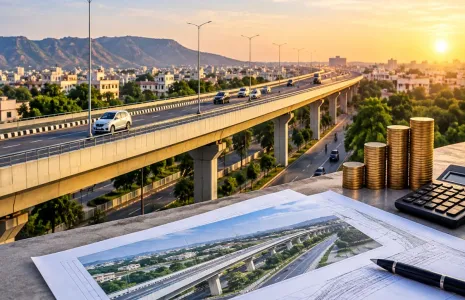
The report finds India needs two point four trillion (tn) dollars to build future ready cities by 2050. India's cities are already home to around one third of the country's population yet municipal corporations generate revenues equivalent to zero point six per cent of national gross domestic product. Urbanisation is set to accelerate, with urban population projected to reach nearly 600 million (mn) by 2036 and 877 mn by 2050 and cities expected to contribute almost 75 per cent of GDP by mid century.

To support this growth the report estimates financing needs of 840 bn dollars in urban infrastructure over the next 15 years, or roughly 55 bn dollars annually. It notes that nearly 70 per cent of the urban infrastructure required by 2047 has not yet been built, highlighting the scale of development that remains. The authors point to the concentration of economic activity in a handful of metropolitan centres and the underutilisation of many Tier-II and Tier-III cities.

The report recommends a range of measures to strengthen urban financing and governance, including building investment ready cities with stronger financial management, improving institutional capacity, using data driven planning, expanding economic growth beyond major metropolitan areas and promoting climate resilient sustainable development. It advocates adoption of a polycentric urban growth model that would see multiple cities develop as economic hubs rather than concentrating growth in a few large metros, supported by economic corridors and initiatives such as PM Gati Shakti which could unlock new engines of growth.

The report identifies the Centre's Rs one tn Urban Challenge Fund as a key step to strengthen municipal finances and expects cities to mobilise 50 per cent of project costs through capital markets which could catalyse nearly Rs four tn in urban investments. It records progress under flagship programmes with over 8,000 projects worth over Rs one point six four tn completed under the Smart Cities Mission and Rs two point seven tn committed under AMRUT. Ultimately it finds urban transformation will depend on stronger municipal finances and sustained long term investment.

The report finds India needs two point four trillion (tn) dollars to build future ready cities by 2050. India's cities are already home to around one third of the country's population yet municipal corporations generate revenues equivalent to zero point six per cent of national gross domestic product. Urbanisation is set to accelerate, with urban population projected to reach nearly 600 million (mn) by 2036 and 877 mn by 2050 and cities expected to contribute almost 75 per cent of GDP by mid century. To support this growth the report estimates financing needs of 840 bn dollars in urban infrastructure over the next 15 years, or roughly 55 bn dollars annually. It notes that nearly 70 per cent of the urban infrastructure required by 2047 has not yet been built, highlighting the scale of development that remains. The authors point to the concentration of economic activity in a handful of metropolitan centres and the underutilisation of many Tier-II and Tier-III cities. The report recommends a range of measures to strengthen urban financing and governance, including building investment ready cities with stronger financial management, improving institutional capacity, using data driven planning, expanding economic growth beyond major metropolitan areas and promoting climate resilient sustainable development. It advocates adoption of a polycentric urban growth model that would see multiple cities develop as economic hubs rather than concentrating growth in a few large metros, supported by economic corridors and initiatives such as PM Gati Shakti which could unlock new engines of growth. The report identifies the Centre's Rs one tn Urban Challenge Fund as a key step to strengthen municipal finances and expects cities to mobilise 50 per cent of project costs through capital markets which could catalyse nearly Rs four tn in urban investments. It records progress under flagship programmes with over 8,000 projects worth over Rs one point six four tn completed under the Smart Cities Mission and Rs two point seven tn committed under AMRUT. Ultimately it finds urban transformation will depend on stronger municipal finances and sustained long term investment.

Next Story
Infrastructure Transport

Adani Eyes UK Port Operator Associated British Ports

Adani Ports and Special Economic Zone is evaluating a potential bid for Associated British Ports, the United Kingdom’s largest port operator, people aware of the discussions told Moneycontrol. A spokesperson said the company does not comment on market speculation and continuously evaluates opportunities that align with its long-term strategy. The spokesperson added that the approach aims to create sustainable value for stakeholders. The discussions remain at an early stage and may not result in a formal offer. Associated British Ports operates 21 ports across England, Scotland and Wales, inc..

Next Story
Infrastructure Urban

NPCIL Seeks Bids For Engineering And 3D Design Of Bharat Small Reactors

The Nuclear Power Corporation of India (NPCIL) has floated a tender for plant engineering and three-dimensional (3D) modelling of its 220 megawatt (MW) Bharat Small Reactors (BSRs). The reactors are based on proven 220 megawatt (MW) pressurised heavy water reactor (PHWR) technology and bids are to be submitted by August 10. The move marks a further step in India's plan to expand nuclear power capacity. The scope calls for generic design and engineering for civil, process, mechanical, piping, electrical and control and instrumentation systems, together with ventilation and air conditioning, pip..

Next Story
Infrastructure Urban

Supreme Court Quashes 2021 OM Allowing Retrospective Clearances

The Supreme Court quashed the 2021 Office Memorandum allowing retrospective environmental clearances for projects commenced without approval. A bench of Chief Justice Surya Kant and Justices Joymalya Bagchi and Vipul M Pancholi delivered a unanimous verdict applying prospectively to protect projects that had already received retrospective clearances from demolition and punitive measures. The court cited examples such as an AIIMS in Odisha, a greenfield airport in Vijayanagar in Karnataka and several common effluent treatment plants central to pollution control. The court held that post-facto c..

Advertisement

Subscribe to Our Newsletter

Get daily newsletters around different themes from Construction world.

STAY CONNECTED

Advertisement

Advertisement

Advertisement