

India Post, MoRD Tie Up to Boost Rural Inclusion
ECONOMY & POLICY

India Post, MoRD Tie Up to Boost Rural Inclusion

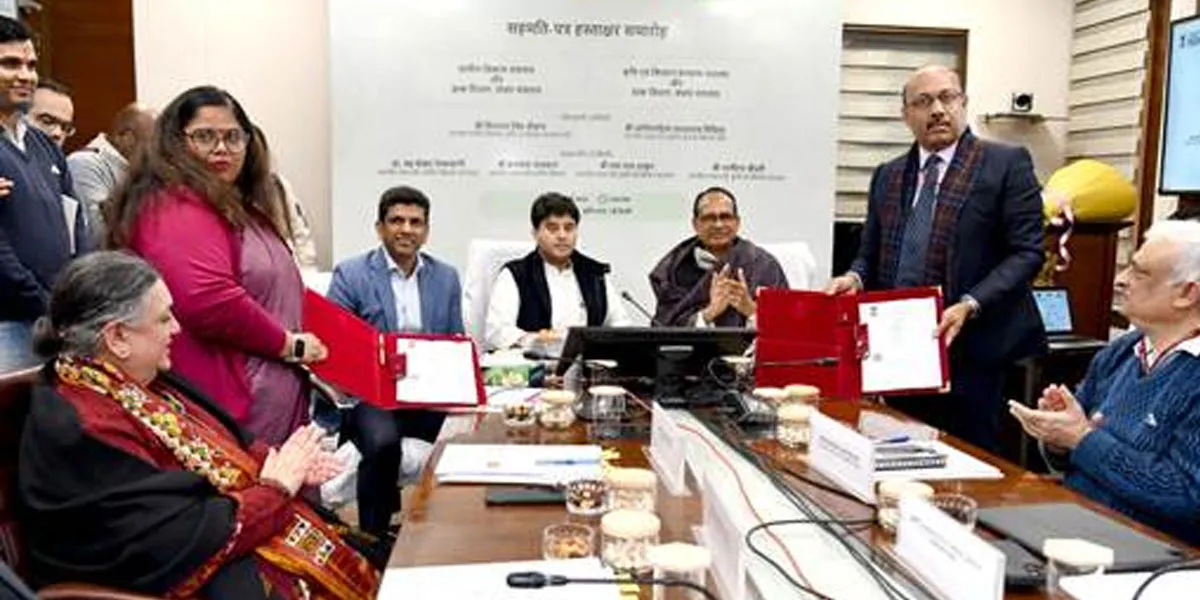
The Department of Posts and the Ministry of Rural Development have signed a Memorandum of Understanding to accelerate rural transformation and expand financial, digital and logistics services for Self-Help Groups (SHGs) and rural households across India. The agreement was signed in the presence of Union Minister of Communications and Development of North Eastern Region Jyotiraditya M. Scindia and Union Minister of Rural Development and Agriculture and Farmers’ Welfare Shivraj Singh Chouhan. The collaboration aligns with the government’s “Dak Sewa, Jan Sewa” vision and seeks to reposition India Post as a key driver of the rural economy, in line with the priorities set out in the Union Budget 2025–26 to leverage the postal network for financial inclusion, digital empowerment and livelihood creation.

With a nationwide network of more than 150,000 rural post offices, India Post Payments Bank and nearly 240,000 Gramin Dak Sevaks, the Department of Posts will enable last-mile delivery of services, particularly in remote and underserved regions. The partnership aims to deepen financial inclusion, promote entrepreneurship, strengthen digital capabilities and improve market access for rural women, SHGs and community institutions. Under the MoU, IPPB will provide doorstep banking services, including savings, payments and remittances, through its digital platform, while electronic tablets and Point of Sale machines will be deployed to support cashless transactions and better record-keeping at the grassroots. Certificates will be issued to SHG members to formally recognise participation and enhance credibility for financial and market linkages.

The Department of Posts will also strengthen market access for SHG products through Dak Ghar Niryat Kendras, enabling domestic and international marketing and export opportunities. Aadhaar enrolment and updation support in rural areas will ease beneficiary verification for various schemes, while insurance coverage will be expanded through Postal Life Insurance and Rural Postal Life Insurance, including avenues for SHG members to work as insurance agents. IPPB will further support capacity building by onboarding and training women from SHGs as Business Correspondents, creating new livelihoods while improving financial literacy and accelerating digital adoption. The inter-ministerial partnership highlights the Department of Posts’ evolving role as a technology-enabled, citizen-centric institution contributing to inclusive growth, women-led development and rural prosperity.

The Department of Posts and the Ministry of Rural Development have signed a Memorandum of Understanding to accelerate rural transformation and expand financial, digital and logistics services for Self-Help Groups (SHGs) and rural households across India. The agreement was signed in the presence of Union Minister of Communications and Development of North Eastern Region Jyotiraditya M. Scindia and Union Minister of Rural Development and Agriculture and Farmers’ Welfare Shivraj Singh Chouhan. The collaboration aligns with the government’s “Dak Sewa, Jan Sewa” vision and seeks to reposition India Post as a key driver of the rural economy, in line with the priorities set out in the Union Budget 2025–26 to leverage the postal network for financial inclusion, digital empowerment and livelihood creation. With a nationwide network of more than 150,000 rural post offices, India Post Payments Bank and nearly 240,000 Gramin Dak Sevaks, the Department of Posts will enable last-mile delivery of services, particularly in remote and underserved regions. The partnership aims to deepen financial inclusion, promote entrepreneurship, strengthen digital capabilities and improve market access for rural women, SHGs and community institutions. Under the MoU, IPPB will provide doorstep banking services, including savings, payments and remittances, through its digital platform, while electronic tablets and Point of Sale machines will be deployed to support cashless transactions and better record-keeping at the grassroots. Certificates will be issued to SHG members to formally recognise participation and enhance credibility for financial and market linkages. The Department of Posts will also strengthen market access for SHG products through Dak Ghar Niryat Kendras, enabling domestic and international marketing and export opportunities. Aadhaar enrolment and updation support in rural areas will ease beneficiary verification for various schemes, while insurance coverage will be expanded through Postal Life Insurance and Rural Postal Life Insurance, including avenues for SHG members to work as insurance agents. IPPB will further support capacity building by onboarding and training women from SHGs as Business Correspondents, creating new livelihoods while improving financial literacy and accelerating digital adoption. The inter-ministerial partnership highlights the Department of Posts’ evolving role as a technology-enabled, citizen-centric institution contributing to inclusive growth, women-led development and rural prosperity.

Next Story
Infrastructure Transport

MMRDA: Engineering Mumbai’s Underground Future

Somewhere beneath Mumbai’s restless surface, a second city is being built into existence.In the late afternoon, as the day leaned towards evening, Dr Sanjay Mukherjee, Metropolitan Commissioner (MMRDA), led us into a realm that very few ever enter—the active heart of one of Mumbai’s most ambitious underground road projects. While the city surges forward in familiar chaos above the ground, another Mumbai is taking shape below: quietly, methodically, irrevocably. The metal lift doors clo..

Next Story
Building Material

Steel: Shielded or Strengthened?

Going forward, domestic steel mills are targeting capacity expansion of nearly 40 per cent through till FY31, adding 80-85 mt, translating into an investment pipeline of $ 45-50 billion. So, Jhunjhunwala points out that continuing the safeguard duty will be vital to prevent a surge in imports and protect domestic prices from external shocks. While in FY26, the industry operating profit per tonne is expected to hold at around $ 108, similar to last year, the industry’s earnings must meaningfully improve from hereon to sustain large-scale investments. Else, domestic mills could..

Next Story
Infrastructure Transport

Metro Moves: From Expansion to System Integration

India’s metro rail programme has entered a new phase—one where the focus is no longer only on adding kilometres, but on building integrated, reliable and financially sustainable urban transit systems. With more than 1,000 km of metro lines already operational and daily ridership exceeding 10 million, the challenge now lies in execution quality, underground risk management, multimodal integration, viable funding structures, and large-scale digital adoption. These themes framed deliber..

Advertisement

Subscribe to Our Newsletter

Get daily newsletters around different themes from Construction world.

STAY CONNECTED

Advertisement

Advertisement

Advertisement

Advertisement

Open In App