India Sets AI Priorities For Manufacturing Engineering Technology
ECONOMY & POLICY

India Sets AI Priorities For Manufacturing Engineering Technology

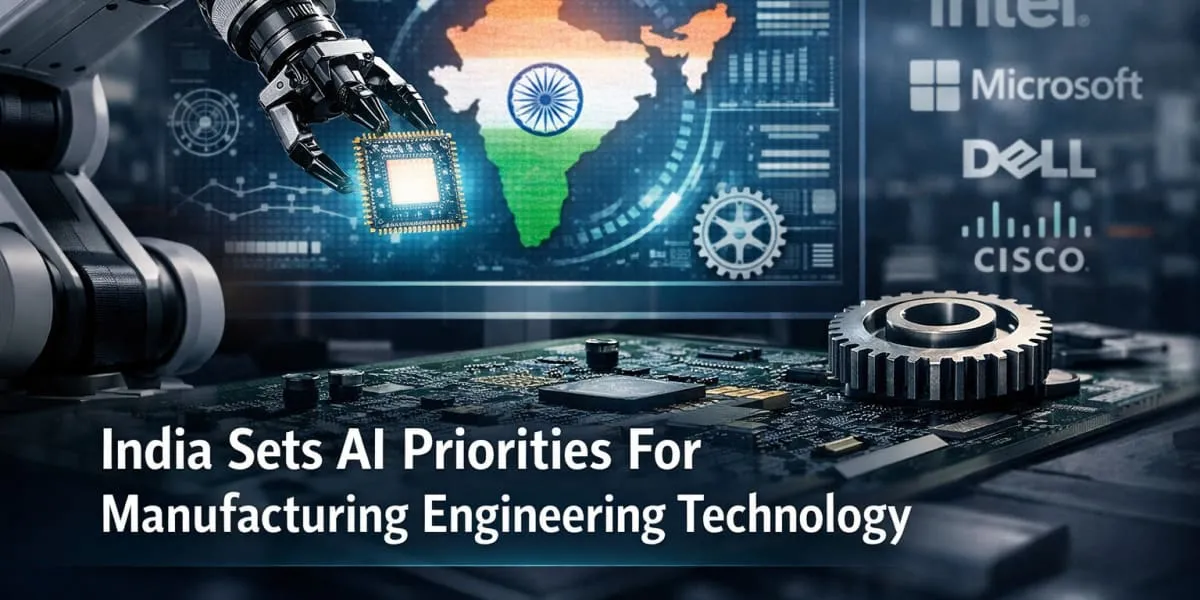
At India AI Impact Summit 2026, Union Minister for Electronics and IT Ashwini Vaishnaw chaired a strategic convening of industry, academia and policymakers to set AI priorities for the Manufacturing Engineering Technology (MET) ecosystem. The meeting included academicians from Massachusetts Institute of Technology and Indian Institute of Technology Madras and executives from firms including Microsoft India, Dell, Cisco, Hitachi and Intel. The minister outlined priorities on adoption, skills development and inclusive growth, linking the agenda to the national vision of Viksit Bharat 2047.

The event marked the launch of a White Paper Concept on AI for MET, presenting a strategic framework to embed AI across manufacturing value chains to drive productivity, sustainability and global competitiveness. The concept proposes coordinated pathways for industry, academia and policymakers and envisages a MET platform convened by NAMTECH to provide shared governance and execution. It builds on an Industry-Academia Roundtable held in May 2025 and aims to place manufacturing at the core of growth and decarbonisation plans.

Participants emphasised that AI is a foundational enabler of productivity, competitiveness and innovation and that progress requires moving from capability to application through sustained collaboration. Industry leaders highlighted the importance of shop floor deployment and targeted skilling to enable MSMEs and strengthen resilient manufacturing value chains. Cybersecurity specialists urged attention to operational technology security and to integrating modern network security principles into education to ready students for workplace deployment.

NAMTECH signalled that it will mobilise industry, academia and government through the MET platform to accelerate adoption and talent development and to enable day zero deployment of trained personnel. The minister urged NAMTECH to develop advanced talent to help India emerge as a major manufacturer of precision equipment and to translate technological capability into industrial outcomes on the ground. The convening set out a mission driven, collaborative approach to translate research and innovation into real world production benefits.

At India AI Impact Summit 2026, Union Minister for Electronics and IT Ashwini Vaishnaw chaired a strategic convening of industry, academia and policymakers to set AI priorities for the Manufacturing Engineering Technology (MET) ecosystem. The meeting included academicians from Massachusetts Institute of Technology and Indian Institute of Technology Madras and executives from firms including Microsoft India, Dell, Cisco, Hitachi and Intel. The minister outlined priorities on adoption, skills development and inclusive growth, linking the agenda to the national vision of Viksit Bharat 2047. The event marked the launch of a White Paper Concept on AI for MET, presenting a strategic framework to embed AI across manufacturing value chains to drive productivity, sustainability and global competitiveness. The concept proposes coordinated pathways for industry, academia and policymakers and envisages a MET platform convened by NAMTECH to provide shared governance and execution. It builds on an Industry-Academia Roundtable held in May 2025 and aims to place manufacturing at the core of growth and decarbonisation plans. Participants emphasised that AI is a foundational enabler of productivity, competitiveness and innovation and that progress requires moving from capability to application through sustained collaboration. Industry leaders highlighted the importance of shop floor deployment and targeted skilling to enable MSMEs and strengthen resilient manufacturing value chains. Cybersecurity specialists urged attention to operational technology security and to integrating modern network security principles into education to ready students for workplace deployment. NAMTECH signalled that it will mobilise industry, academia and government through the MET platform to accelerate adoption and talent development and to enable day zero deployment of trained personnel. The minister urged NAMTECH to develop advanced talent to help India emerge as a major manufacturer of precision equipment and to translate technological capability into industrial outcomes on the ground. The convening set out a mission driven, collaborative approach to translate research and innovation into real world production benefits.

Next Story
Equipment

MYCRANE Crosses 1,000 Customers in India

MYCRANE, the global platform for crane rental and purchase, has achieved major commercial milestones in India, reinforcing the country’s position as one of its fastest-growing strategic markets. The company has surpassed 1,000 registered customers and 1,000 crane suppliers nationwide, while completing more than 100 paid orders.The growth reflects rising adoption of digital procurement solutions across India’s construction, infrastructure, energy and industrial sectors. Equipment sourced through the platform is supporting projects across the country, with several leading contractors and EPC..

Next Story
Infrastructure Urban

AMTOE 2026 Opens Global Machine Tool Sourcing Hub

The Asian Machine Tool Online Exhibition 2026 (AMTOE 2026) has officially opened as a B2B sourcing platform connecting global buyers with verified Asian suppliers across the machine tool and manufacturing sector. The exhibition will run until 31 October 2026 through a hybrid online and offline model, offering extended sourcing and business networking opportunities.Co-organised by AsianNet and TradeAsia, the event aims to strengthen links between Asian manufacturers and international importers while improving cross-border procurement efficiency and supplier matching.Since launching in 2022, AMT..

Next Story
Infrastructure Energy

Vedanta Lifts Renewable Energy Use by Over 50%

On World Earth Day, Vedanta Limited announced that its renewable energy usage rose by over 50 per cent year on year to 3.97 billion units in FY26, helping avoid 3 million tonnes of carbon dioxide emissions.The company said its portfolio of metals, minerals, power, and oil & gas continues to support advanced manufacturing, electrification, energy transition and clean technology. Aluminium, copper and silver remain critical for applications such as mobility, power transmission, renewable infrastructure and solar photovoltaics, while iron, steel and zinc continue to support energy infrastruct..

Advertisement

Subscribe to Our Newsletter

Get daily newsletters around different themes from Construction world.

STAY CONNECTED

Advertisement

Advertisement

Advertisement