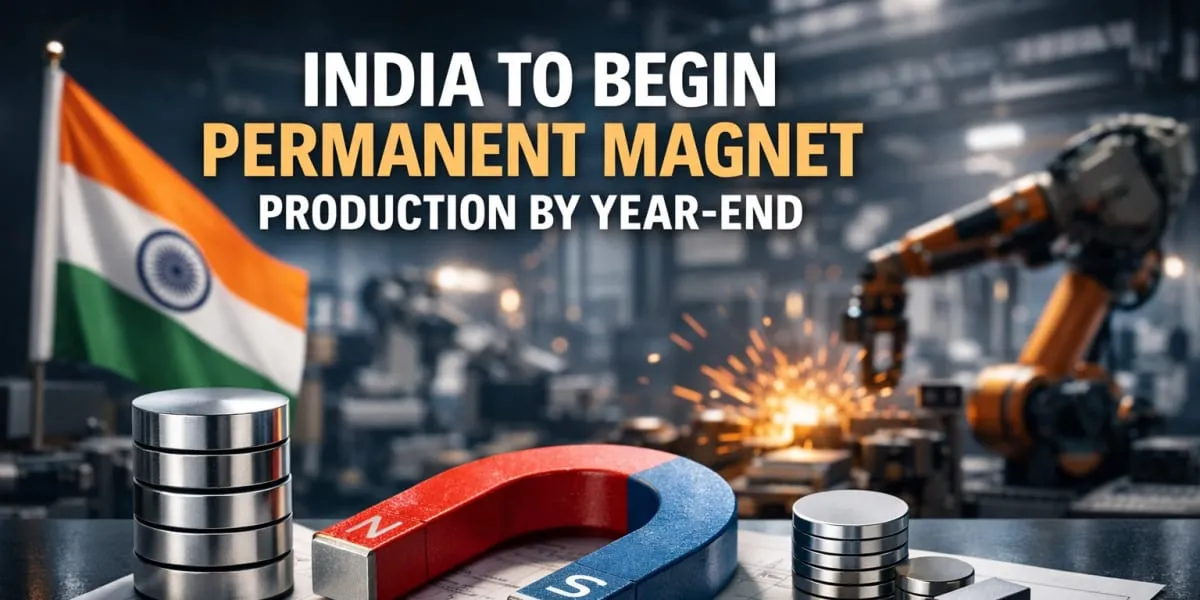
India To Begin Permanent Magnet Production By Year-End
ECONOMY & POLICY

India To Begin Permanent Magnet Production By Year-End

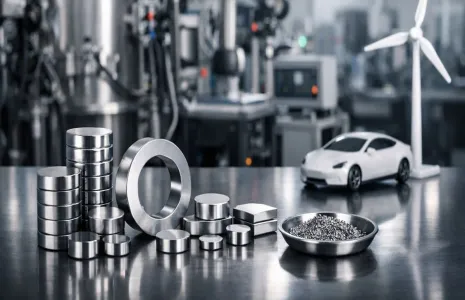
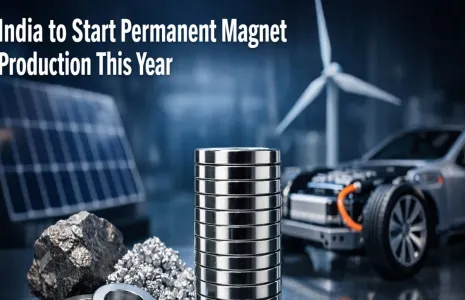
Union minister G Kishan Reddy said India will begin commercial production of permanent magnets by the year-end. The announcement signals a government push to establish domestic manufacturing capacity for a material that is central to many modern industries. It aims to reduce dependence on imports and strengthen the supply chain for strategic components. The minister framed the initiative as part of broader efforts to build manufacturing self-reliance and officials will need to coordinate permitting and infrastructure to bring plants online within the stated timeframe.

Permanent magnets are used in electric motors, generators and a range of consumer and industrial devices, and domestic production could support manufacturers across sectors. Establishing production locally is expected to encourage investment in upstream and downstream activities, including raw material processing, component manufacturing and assembly. Industry observers note that creating an integrated ecosystem will be important to sustain production and meet quality standards. Local production could also reduce supply chain disruptions that have affected global trade in recent years.

The move could have broader economic implications, potentially supporting job creation and fostering skill development in specialised manufacturing. It may also attract technology partnerships and foreign investment if policy and infrastructure incentives are aligned. Analysts caution that scaling production involves overcoming technical and logistical challenges, such as securing raw material supplies and building processing capacity. The minister indicated a commitment to work with industry stakeholders to address these challenges, noting that training programmes and technical collaboration will be necessary to develop the specialised workforce required for magnet fabrication.

Implementation will require coordinated efforts between public agencies, private firms and research institutions to move from announcement to operational plants. Timelines for capacity expansion and commercial output remain subject to planning and investment decisions. Observers will watch for announcements on capacity targets, investment commitments and timelines that will determine the pace of implementation. The minister said progress will be monitored as India seeks to enhance its capabilities in strategic manufacturing.

Union minister G Kishan Reddy said India will begin commercial production of permanent magnets by the year-end. The announcement signals a government push to establish domestic manufacturing capacity for a material that is central to many modern industries. It aims to reduce dependence on imports and strengthen the supply chain for strategic components. The minister framed the initiative as part of broader efforts to build manufacturing self-reliance and officials will need to coordinate permitting and infrastructure to bring plants online within the stated timeframe. Permanent magnets are used in electric motors, generators and a range of consumer and industrial devices, and domestic production could support manufacturers across sectors. Establishing production locally is expected to encourage investment in upstream and downstream activities, including raw material processing, component manufacturing and assembly. Industry observers note that creating an integrated ecosystem will be important to sustain production and meet quality standards. Local production could also reduce supply chain disruptions that have affected global trade in recent years. The move could have broader economic implications, potentially supporting job creation and fostering skill development in specialised manufacturing. It may also attract technology partnerships and foreign investment if policy and infrastructure incentives are aligned. Analysts caution that scaling production involves overcoming technical and logistical challenges, such as securing raw material supplies and building processing capacity. The minister indicated a commitment to work with industry stakeholders to address these challenges, noting that training programmes and technical collaboration will be necessary to develop the specialised workforce required for magnet fabrication. Implementation will require coordinated efforts between public agencies, private firms and research institutions to move from announcement to operational plants. Timelines for capacity expansion and commercial output remain subject to planning and investment decisions. Observers will watch for announcements on capacity targets, investment commitments and timelines that will determine the pace of implementation. The minister said progress will be monitored as India seeks to enhance its capabilities in strategic manufacturing.

Next Story
Infrastructure Urban

MIDC and Ramky Unit Sign Concession for Life Sciences Park

Maharashtra Industrial Development Corporation has signed a concession agreement with Maha Integrated Life Sciences City Limited (MILeS City), a wholly owned subsidiary of Ramky Infrastructure Limited (RIL), to develop a high-tech pharmaceutical park at Dighi Port Industrial Area in Raigad. The project will follow a public-private partnership under a DBFOT model and has an estimated cost of Rs 30 billion (Rs 30 bn). The concession will run for 95 years, including a five-year construction phase, with MILeS City responsible for development and management. The development will occupy approximatel..

Next Story
Real Estate

BuzzWorks Leases Hyderabad Office to MyComplianceOffice

Brigade Group’s managed workspace provider BuzzWorks has leased 550 seats at Mindspace Business Park in Hyderabad to Dublin based MyComplianceOffice, in what is the company’s largest office in India. With this signing, BuzzWorks' total leased office space in Hyderabad stands at zero point one one million (mn) square feet. The new premises will house core functions including product engineering, product management, customer success and global operations. Artificial intelligence enabled compliance technology initiatives will also be part of the local delivery model. BuzzWorks will provide wo..

Next Story
Infrastructure Transport

Jindal Stainless Flags Operational Strain From Middle East Crisis

Jindal Stainless warned that the Middle East war crisis has affected its operations because of dependence on industrial gases such as propane and LPG and on natural gas. The scrap-based production route used by the stainless steel maker does not generate blast furnace or coke oven gases internally, unlike the conventional steel industry. Several plant processes have been adversely impacted and production is being run at rationalised capacity. Disruptions in global shipping routes have resulted in vessel diversions, longer transit times and cargo delays, adding pressure to supply chains and to ..

Advertisement

Subscribe to Our Newsletter

Get daily newsletters around different themes from Construction world.

STAY CONNECTED

Advertisement

Advertisement

Advertisement