Japan Backs 2027 MAHSR Timeline, India Targets 7,000-km Network
ECONOMY & POLICY

Japan Backs 2027 MAHSR Timeline, India Targets 7,000-km Network

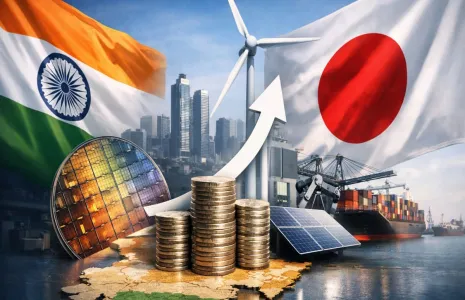
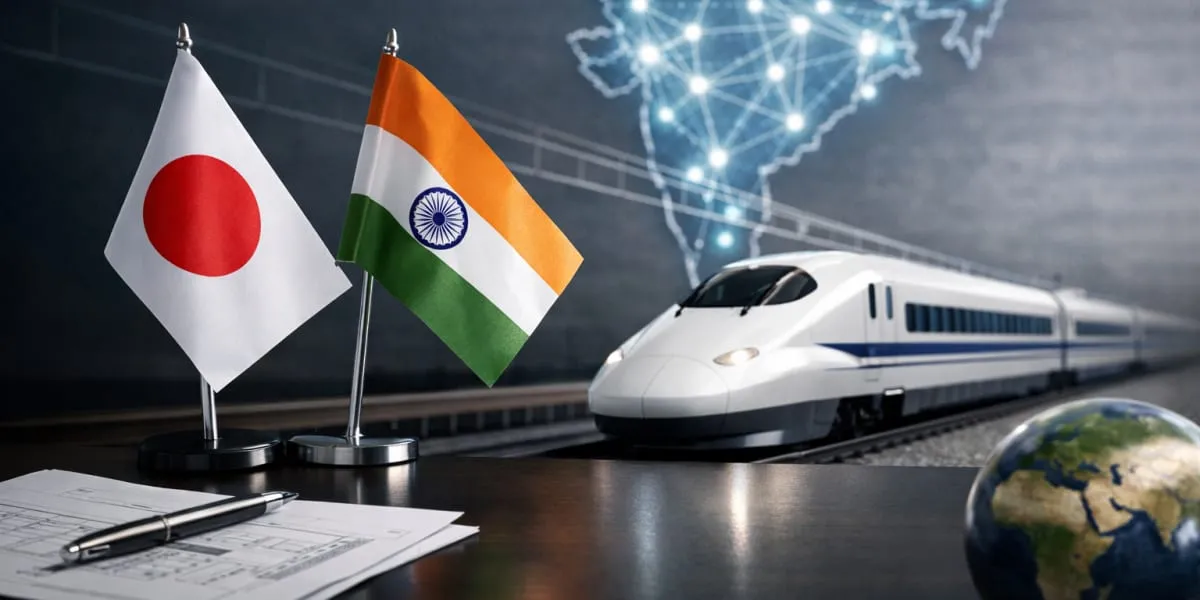
Japan has reaffirmed its commitment to extend cooperation to meet India's target of commencing commercial operations on priority sections of the Mumbai-Ahmedabad High-Speed Rail (MAHSR) Project by 2027, a joint statement said after bilateral talks in New Delhi between Prime Minister Narendra Modi and his Japanese counterpart Sanae Takaichi. The leaders highlighted plans to introduce E10 trains to the MAHSR network and the prime minister invited Japanese firms to explore roles in future high-speed corridors to realise a 7,000-kilometre national high-speed rail network.

The summit saw signing of a Memorandum of Cooperation on the Next-Generation Mobility Partnership to combine Japan's mobility technologies with India's market potential and human resources. The MAHSR is being developed using Japanese Shinkansen technology and operational standards and incorporates advanced traction, electrification, track infrastructure and operational systems. Officials described the corridor as a milestone in railway modernisation that will transform inter-city mobility and build domestic capabilities and technical skills development.

Beyond rail infrastructure the leaders prioritised India's North Eastern Region to support a resilient Indo-Pacific under the Act East Policy, and Japan pledged assistance for road networks, bridges and disaster risk reduction. They committed to developing value chains linking the region with the Bay of Bengal and noted progress on four Japanese assistance projects. These projects include Mumbai Metro Line 11, Bengaluru Metro Phase 3, healthcare and education infrastructure in Maharashtra and horticulture in Punjab.

The two nations agreed to expand people to people exchanges and talent circulation to address domestic challenges, noting that visitors between them crossed 540,000 in 2025 and pledging promotion of two way tourism alongside enhanced consular dialogue. They welcomed promotion of Japanese language education through the Nihongo Partners programme and highlighted the role of creative industries in deepening cultural connections among youth. Sub-national diplomacy noted the India Japan Governors' Network and prefecture collaborations across states.

Japan has reaffirmed its commitment to extend cooperation to meet India's target of commencing commercial operations on priority sections of the Mumbai-Ahmedabad High-Speed Rail (MAHSR) Project by 2027, a joint statement said after bilateral talks in New Delhi between Prime Minister Narendra Modi and his Japanese counterpart Sanae Takaichi. The leaders highlighted plans to introduce E10 trains to the MAHSR network and the prime minister invited Japanese firms to explore roles in future high-speed corridors to realise a 7,000-kilometre national high-speed rail network. The summit saw signing of a Memorandum of Cooperation on the Next-Generation Mobility Partnership to combine Japan's mobility technologies with India's market potential and human resources. The MAHSR is being developed using Japanese Shinkansen technology and operational standards and incorporates advanced traction, electrification, track infrastructure and operational systems. Officials described the corridor as a milestone in railway modernisation that will transform inter-city mobility and build domestic capabilities and technical skills development. Beyond rail infrastructure the leaders prioritised India's North Eastern Region to support a resilient Indo-Pacific under the Act East Policy, and Japan pledged assistance for road networks, bridges and disaster risk reduction. They committed to developing value chains linking the region with the Bay of Bengal and noted progress on four Japanese assistance projects. These projects include Mumbai Metro Line 11, Bengaluru Metro Phase 3, healthcare and education infrastructure in Maharashtra and horticulture in Punjab. The two nations agreed to expand people to people exchanges and talent circulation to address domestic challenges, noting that visitors between them crossed 540,000 in 2025 and pledging promotion of two way tourism alongside enhanced consular dialogue. They welcomed promotion of Japanese language education through the Nihongo Partners programme and highlighted the role of creative industries in deepening cultural connections among youth. Sub-national diplomacy noted the India Japan Governors' Network and prefecture collaborations across states.

Next Story
Real Estate

AI: The New Recruit

From getting ideas to evaluating designs, presenting concepts to clients and tracking projects, artificial intelligence (AI) is helping architects work better and faster.“AI allows architects to spend more time doing what only they can do: think critically, synthesise complexity and design with intent,” says Dikshu C Kukreja, Managing Principal, CP Kukreja Architects. “Every minute reclaimed from repetitive processes can be invested in creativity, contextual understanding, interdisciplinary collaboration and innovation – the qualities that define meaningful architecture.”To read the ..

Next Story
Real Estate

Redevelopment 2.0

In 2017, Mumbai identified 160,000 ageing buildings due for structural audit. Close to half of these were in the Western Suburbs. Redeveloping the oldest and structurally weakest of these would help unlock new housing, much needed given the city’s growing population density and constant developed area of 437.7 sq km. At 30,600 people per sq km in 2024, Mumbai’s density was almost thrice that of Gurugram, and 60 per cent higher than Bengaluru’s.Essentially, Mumbai’s realty market has demand. It has capital. It has realty development potential.Fast forward to 2026. Mumbai has 1,094 regis..

Next Story
Technology

Cost intelligence will become a strategic contributor to project success

As India's construction industry accelerates its digital transformation, integrated platforms, AI and connected data are becoming essential to improving cost certainty, project efficiency and sustainability. Ravi Kumar, Sales Director – India, RIB Software India, shares how digital workflows are reshaping project planning, commercial management and decision-making across the construction value chain.India's construction sector is embracing digital technologies at an unprecedented pace. From your perspective, what are the biggest shifts driving this transformation and how is RIB Software enab..

Advertisement

Subscribe to Our Newsletter

Get daily newsletters around different themes from Construction world.

STAY CONNECTED

Advertisement

Advertisement

Advertisement