+
Kochi Biennale Murals Turn Streets Into Open Art Spaces
ECONOMY & POLICY

Kochi Biennale Murals Turn Streets Into Open Art Spaces

Widely known as a “people’s biennale” since its first edition in 2012, the Kochi-Muziris Biennale continues to involve communities at every level, from student volunteers to residents of Fort Kochi and Mattancherry, where many of its venues are located.

As the Biennale unfolds, art extends far beyond gallery walls. Streets across Kochi are being transformed through graffiti and murals under the Island Mural Project, an initiative operating under the aegis of the Kochi Biennale Foundation. Over the three-month duration of the event, artists and collectives are reimagining public walls across the city, making art an everyday encounter for residents and visitors alike.

The first set of murals has been created by the Aravani Art Project, Trespassers, and artists Osheen Siva and Munir Kabani. In February, interdisciplinary artist Pradip Das will begin work on the Simi Warehouse wall in Mattancherry. The Kochi Biennale Foundation said the Island Mural Project invites people to see their neighbourhoods afresh, with works that respond to local histories, textures and living communities.

Outside Cube Art Spaces on Bazaar Road, where the late artist Vivan Sundaram’s final work is on display, the collective Trespassers has painted a large mural blending everyday life with fantastical imagery. The eight-member group—Vishnupriyan K, Ambadi Kannan, Jinil Manikandan, Bashar UK, Sreerag P, Arjun Gopi, Jatin Shaji and Pranav Prabhakaran—depicts scenes ranging from workers at labour to flying cows and monkeys perched on balconies. Vishnupriyan K said the mural reflects the collective’s shared artistic evolution and layered ideas of “trespassing”, where viewers themselves enter and inhabit the artwork.

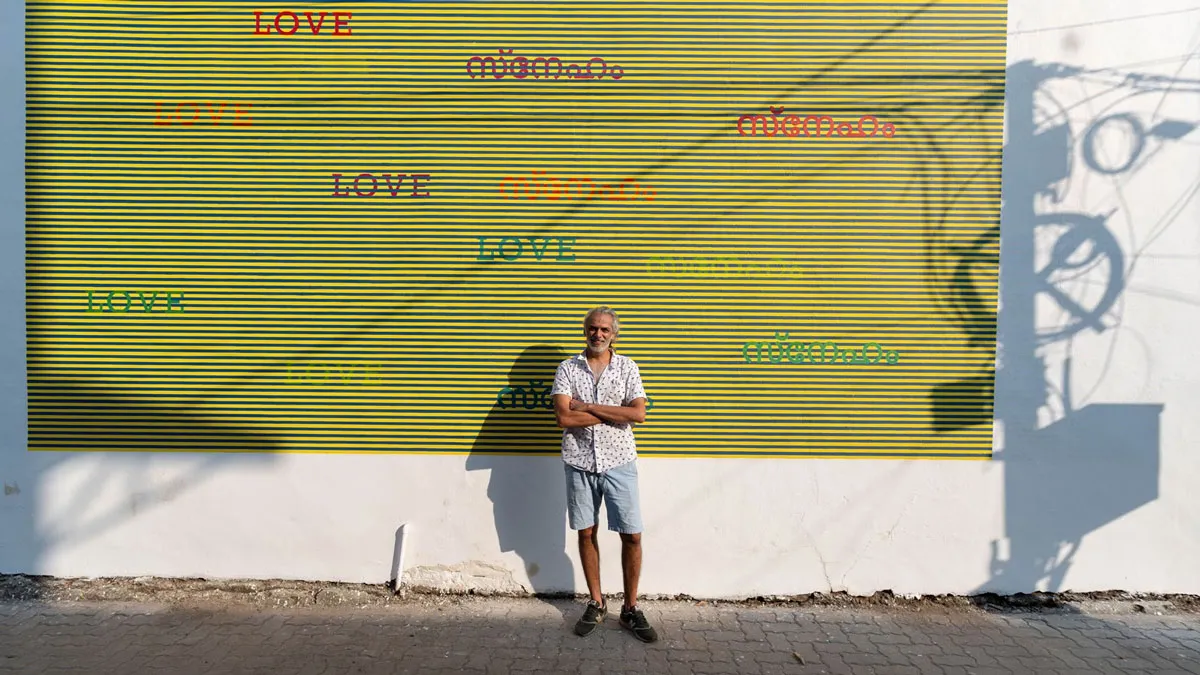
At the Arthshila wall in Fort Kochi, Munir Kabani’s mural centres on warmth and positivity, featuring the word “Love” in both English and Malayalam. Kabani said his work invites viewers to engage with simple yet emotionally charged words, allowing their meanings to shift through distance and intimacy.

Meanwhile, the Aravani Art Project—comprising transgender and cisgender individuals and recently acclaimed at the 2024 Venice Biennale—has created a mural at the Government Women and Children’s Hospital on Bazaar Road in Mattancherry. Drawing from Kochi’s social fabric, the work reflects themes of resistance, belonging and lived experience within the city.

Through these public interventions, the Kochi-Muziris Biennale continues to dissolve boundaries between art and everyday life, turning the city itself into an open, accessible exhibition.

Widely known as a “people’s biennale” since its first edition in 2012, the Kochi-Muziris Biennale continues to involve communities at every level, from student volunteers to residents of Fort Kochi and Mattancherry, where many of its venues are located. As the Biennale unfolds, art extends far beyond gallery walls. Streets across Kochi are being transformed through graffiti and murals under the Island Mural Project, an initiative operating under the aegis of the Kochi Biennale Foundation. Over the three-month duration of the event, artists and collectives are reimagining public walls across the city, making art an everyday encounter for residents and visitors alike. The first set of murals has been created by the Aravani Art Project, Trespassers, and artists Osheen Siva and Munir Kabani. In February, interdisciplinary artist Pradip Das will begin work on the Simi Warehouse wall in Mattancherry. The Kochi Biennale Foundation said the Island Mural Project invites people to see their neighbourhoods afresh, with works that respond to local histories, textures and living communities. Outside Cube Art Spaces on Bazaar Road, where the late artist Vivan Sundaram’s final work is on display, the collective Trespassers has painted a large mural blending everyday life with fantastical imagery. The eight-member group—Vishnupriyan K, Ambadi Kannan, Jinil Manikandan, Bashar UK, Sreerag P, Arjun Gopi, Jatin Shaji and Pranav Prabhakaran—depicts scenes ranging from workers at labour to flying cows and monkeys perched on balconies. Vishnupriyan K said the mural reflects the collective’s shared artistic evolution and layered ideas of “trespassing”, where viewers themselves enter and inhabit the artwork. At the Arthshila wall in Fort Kochi, Munir Kabani’s mural centres on warmth and positivity, featuring the word “Love” in both English and Malayalam. Kabani said his work invites viewers to engage with simple yet emotionally charged words, allowing their meanings to shift through distance and intimacy. Meanwhile, the Aravani Art Project—comprising transgender and cisgender individuals and recently acclaimed at the 2024 Venice Biennale—has created a mural at the Government Women and Children’s Hospital on Bazaar Road in Mattancherry. Drawing from Kochi’s social fabric, the work reflects themes of resistance, belonging and lived experience within the city. Through these public interventions, the Kochi-Muziris Biennale continues to dissolve boundaries between art and everyday life, turning the city itself into an open, accessible exhibition.

Next Story
Infrastructure Transport

Second Mountain Tunnel Breakthrough in Palghar Advances High Speed Rail

The Mumbai-Ahmedabad high speed rail (MAHSR) project reached a milestone with the breakthrough of a mountain tunnel in Palghar, Maharashtra. Mountain tunnel MT-six measures 454 metres long and 14.4 metres wide and will accommodate up and down tracks. The breakthrough follows MT-five near Saphale on second January 2026 and the MT-six excavation was completed from both ends using the New Austrian Tunnelling Method. The ministry reported that the tunnelling was completed within 12 months. The New Austrian Tunnelling Method is favoured for its flexibility in complex geology and irregular tunnel s..

Next Story
Infrastructure Transport

Modi Government Pushes Atmanirbhar Container Drive With BCSL MoU

The Union Government advanced a plan to create an integrated, domestically anchored container ecosystem with the signing of a Memorandum of Understanding to establish the Bharat Container Shipping Line (BCSL). The MoU was signed by key agencies including the Shipping Corporation of India and Container Corporation of India alongside major port authorities and Sagarmala Finance Corporation Limited under the Ministry of Ports, Shipping and Waterways, in the presence of senior ministers. The initiative aligns with the Container Manufacturing Assistance Scheme announced in the Union Budget 2026–2..

Next Story
Infrastructure Urban

Ministry Reports Gains In Mobility For Marginalised Communities

The Ministry of Social Justice and Empowerment is implementing skill development, education and rehabilitation schemes to promote socio-economic mobility and sustainable livelihoods for marginalised and disadvantaged communities across the country. Programmes target Scheduled Castes, Other Backward Classes, Economically Weaker Sections, De-notified Tribes and Safai Karamcharis through specialised implementing corporations and empanelled training institutes. Pradhan Mantri Dakshata Aur Kushalta Sampann Hitgrahi Yojana, or PM-DAKSH, provided skill training and placement support through the Nati..

Advertisement

Subscribe to Our Newsletter

Get daily newsletters around different themes from Construction world.

STAY CONNECTED

Advertisement

Advertisement

Advertisement

Open In App