+
MeitY Launches Blockchain India Challenge for Digital Governance
ECONOMY & POLICY

MeitY Launches Blockchain India Challenge for Digital Governance

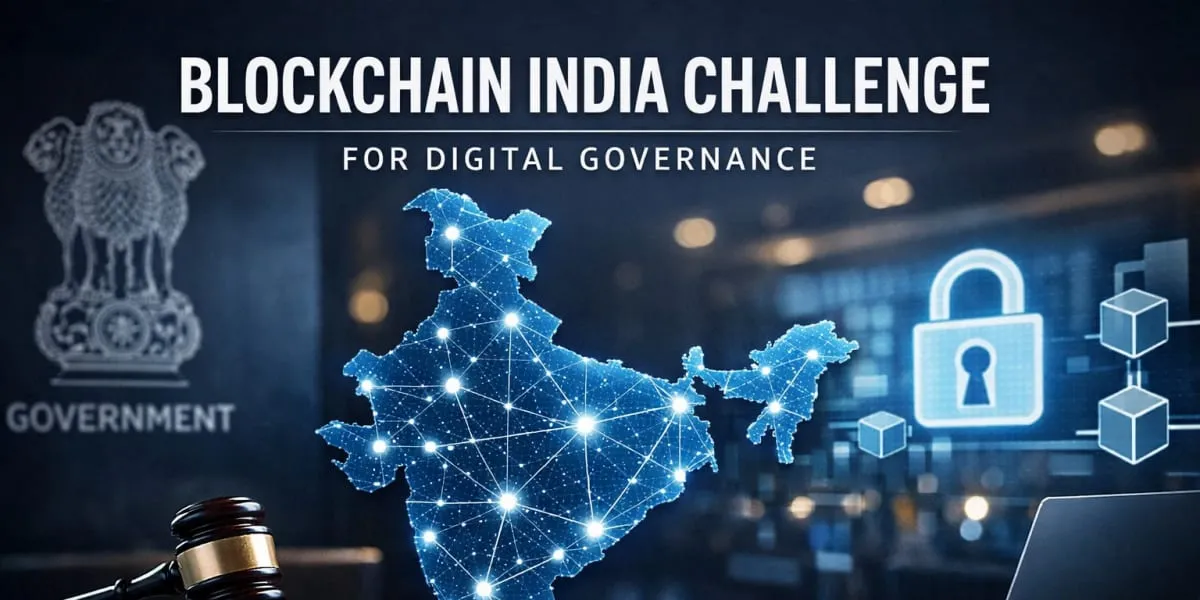
The Ministry of Electronics and Information Technology (MeitY) launched the Blockchain India Challenge on 23 February 2026 in New Delhi, supported by the Centre for Development of Advanced Computing (C-DAC).

The event convened senior MeitY and C-DAC officials alongside representatives from government departments and startups.

The national initiative seeks visionary startups to pilot permissioned blockchain solutions for public sector use.

The challenge will emphasise interoperable, permissioned architectures suited to regulatory requirements.

The challenge prioritises regulatory control and security, including trust, auditability and tamper proof records, and aims to address governance and service delivery challenges across sectors.

Indicative domains include e-procurement, supply chain management, public distribution, education, healthcare, agriculture, power, Internet of Things (IoT), land records, and environment and sustainability.

The list is illustrative rather than exhaustive, allowing startups to propose additional impactful use cases in collaboration with government departments.

MeitY instructed teams to expand outreach across the startup community to develop field ready, deployable solutions that can scale nationwide.

The Department for Promotion of Industry and Internal Trade (DPIIT) will recognise eligible startups, which in collaboration with government departments will have opportunities to translate ideas into high impact solutions.

Selected startups will receive stage-wise funding support to develop 10 blockchain-based use cases across 10 categories for government departments.

Startups are invited to register on the official challenge website for details on eligibility, intellectual property rights and guidelines.

Guidance on collaboration mechanisms will be provided to shortlisted teams.

C-DAC will implement the challenge with support from MeitY and coordinate engagements with government departments and the startup ecosystem.

Interested teams are encouraged to sign up promptly to receive updates and engagement opportunities through the challenge portal.

MeitY expects the initiative to produce field ready and deployable pilots that address public service challenges and can be scaled across India.

Updates will follow.

The Ministry of Electronics and Information Technology (MeitY) launched the Blockchain India Challenge on 23 February 2026 in New Delhi, supported by the Centre for Development of Advanced Computing (C-DAC). The event convened senior MeitY and C-DAC officials alongside representatives from government departments and startups. The national initiative seeks visionary startups to pilot permissioned blockchain solutions for public sector use. The challenge will emphasise interoperable, permissioned architectures suited to regulatory requirements. The challenge prioritises regulatory control and security, including trust, auditability and tamper proof records, and aims to address governance and service delivery challenges across sectors. Indicative domains include e-procurement, supply chain management, public distribution, education, healthcare, agriculture, power, Internet of Things (IoT), land records, and environment and sustainability. The list is illustrative rather than exhaustive, allowing startups to propose additional impactful use cases in collaboration with government departments. MeitY instructed teams to expand outreach across the startup community to develop field ready, deployable solutions that can scale nationwide. The Department for Promotion of Industry and Internal Trade (DPIIT) will recognise eligible startups, which in collaboration with government departments will have opportunities to translate ideas into high impact solutions. Selected startups will receive stage-wise funding support to develop 10 blockchain-based use cases across 10 categories for government departments. Startups are invited to register on the official challenge website for details on eligibility, intellectual property rights and guidelines. Guidance on collaboration mechanisms will be provided to shortlisted teams. C-DAC will implement the challenge with support from MeitY and coordinate engagements with government departments and the startup ecosystem. Interested teams are encouraged to sign up promptly to receive updates and engagement opportunities through the challenge portal. MeitY expects the initiative to produce field ready and deployable pilots that address public service challenges and can be scaled across India. Updates will follow.

Next Story
Infrastructure Urban

Implementation Status of Jal Jeevan Mission

Since August 2019 the Government has implemented Jal Jeevan Mission to provide assured potable water through household tap connections in rural India. At the start of the mission only 32.3 million (mn) rural households, representing 16.7 per cent, were reported to have tap water connections. States and union territories have reported that 125.8 mn additional rural households have since been provided with tap connections. As a result, of about 193.6 mn rural households roughly 158.2 mn, or 81.71 per cent, are reported to have tap water supply at home.\n\nThe State, district and village level st..

Next Story
Infrastructure Urban

Jal Jeevan Mission Reaches Eighty One Per Cent Rural Coverage

The Government reported substantial progress under the Jal Jeevan Mission, launched in August 2019 to provide tap water to every rural household. At launch only 32.3 million (mn) rural households had tap connections and states and Union territories reported provision of 125.8 mn additional households by March 2026. Consequently, out of about 193.6 mn rural households around 158.2 mn, or 81.71 per cent, are reported to have tap water at home. The Finance Minister announced extension of the mission until 2028 in the 2025-26 budget speech. The Swachh Bharat Mission Grameen, launched in October 20..

Next Story
Infrastructure Urban

Empowering Local Governance for Sustainable Rural Water Supply

The Ministry of Jal Shakti has aligned the Jal Jeevan Mission (JJM) with the 73rd Amendment to strengthen village level planning and community ownership of water supply. Gram Panchayats, village water and sanitation committees and Pani Samitis are to plan, implement, manage and maintain piped water systems, with gram sabha processes formalising handover and oversight. Implementation support agencies including non government organisations, community based organisations and self help groups have been empanelled to train local committees and promote women participation. Under JJM, the department ..

Advertisement

Subscribe to Our Newsletter

Get daily newsletters around different themes from Construction world.

STAY CONNECTED

Advertisement

Advertisement

Advertisement