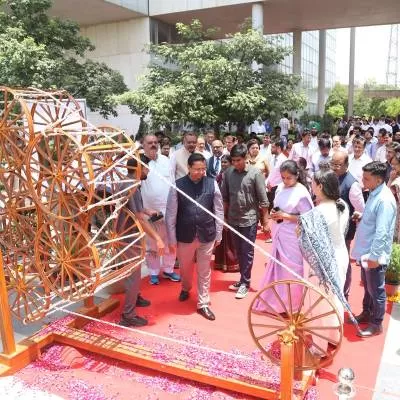
Ministry of Steel and PSUs Observe Swachhata Pakhwada Nationwide
ECONOMY & POLICY

Ministry of Steel and PSUs Observe Swachhata Pakhwada Nationwide

Ministry of Steel (the Ministry) and public sector undertakings (PSUs) under its administrative control such as SAIL, NMDC, RINL, KIOCL, MOIL, MECON, MSTC, NISST, JPC and BPNSI observed Swachhata Pakhwada from 16 to 31 March 2026 across the country. The campaign followed the calendar released by the Department of Drinking Water and Sanitation and saw participation by officers and employees at plants and units nationwide. Activities were organised in both ministry offices and industrial townships. The programme aimed to strengthen routine cleanliness and waste management practices.

The pakhwada commenced with administration of the Swachhata pledge in the Ministry and the display of banners and standees at prominent locations to raise awareness. Thorough cleaning of office premises was carried out and a team of officers completed cleanliness inspections of rooms, the library and the record cell. Public sector undertakings organised Steel Safety Day on 28 March and the pakhwada concluded on 31 March with a determination to continue cleaning activities throughout the year.

During the fortnight, the Ministry and its PSUs organised an array of interventions including fire safety drills and workshops on solid waste management. Cleanliness drives reached townships, factory premises, nearby villages, informal settlements and schools managed by the organisations. Awareness programmes were delivered to discourage single-use plastics and to promote segregation of waste at source.

Looking ahead, PSUs under the Ministry are preparing detailed plans for FY 2026–27 under the Swachhata Action Plan to embed environmental sustainability measures. The plans prioritise reducing and removing slag, minimising iron ore fines and recycling gaseous waste for power generation. Officers and employees across the Ministry and PSUs remain committed to implementing the action plan and sustaining cleanliness efforts.

Ministry of Steel (the Ministry) and public sector undertakings (PSUs) under its administrative control such as SAIL, NMDC, RINL, KIOCL, MOIL, MECON, MSTC, NISST, JPC and BPNSI observed Swachhata Pakhwada from 16 to 31 March 2026 across the country. The campaign followed the calendar released by the Department of Drinking Water and Sanitation and saw participation by officers and employees at plants and units nationwide. Activities were organised in both ministry offices and industrial townships. The programme aimed to strengthen routine cleanliness and waste management practices. The pakhwada commenced with administration of the Swachhata pledge in the Ministry and the display of banners and standees at prominent locations to raise awareness. Thorough cleaning of office premises was carried out and a team of officers completed cleanliness inspections of rooms, the library and the record cell. Public sector undertakings organised Steel Safety Day on 28 March and the pakhwada concluded on 31 March with a determination to continue cleaning activities throughout the year. During the fortnight, the Ministry and its PSUs organised an array of interventions including fire safety drills and workshops on solid waste management. Cleanliness drives reached townships, factory premises, nearby villages, informal settlements and schools managed by the organisations. Awareness programmes were delivered to discourage single-use plastics and to promote segregation of waste at source. Looking ahead, PSUs under the Ministry are preparing detailed plans for FY 2026–27 under the Swachhata Action Plan to embed environmental sustainability measures. The plans prioritise reducing and removing slag, minimising iron ore fines and recycling gaseous waste for power generation. Officers and employees across the Ministry and PSUs remain committed to implementing the action plan and sustaining cleanliness efforts.

Next Story
Real Estate

AI: The New Recruit

From getting ideas to evaluating designs, presenting concepts to clients and tracking projects, artificial intelligence (AI) is helping architects work better and faster.“AI allows architects to spend more time doing what only they can do: think critically, synthesise complexity and design with intent,” says Dikshu C Kukreja, Managing Principal, CP Kukreja Architects. “Every minute reclaimed from repetitive processes can be invested in creativity, contextual understanding, interdisciplinary collaboration and innovation – the qualities that define meaningful architecture.”To read the ..

Next Story
Real Estate

Redevelopment 2.0

In 2017, Mumbai identified 160,000 ageing buildings due for structural audit. Close to half of these were in the Western Suburbs. Redeveloping the oldest and structurally weakest of these would help unlock new housing, much needed given the city’s growing population density and constant developed area of 437.7 sq km. At 30,600 people per sq km in 2024, Mumbai’s density was almost thrice that of Gurugram, and 60 per cent higher than Bengaluru’s.Essentially, Mumbai’s realty market has demand. It has capital. It has realty development potential.Fast forward to 2026. Mumbai has 1,094 regis..

Next Story
Technology

Cost intelligence will become a strategic contributor to project success

As India's construction industry accelerates its digital transformation, integrated platforms, AI and connected data are becoming essential to improving cost certainty, project efficiency and sustainability. Ravi Kumar, Sales Director – India, RIB Software India, shares how digital workflows are reshaping project planning, commercial management and decision-making across the construction value chain.India's construction sector is embracing digital technologies at an unprecedented pace. From your perspective, what are the biggest shifts driving this transformation and how is RIB Software enab..

Advertisement

Subscribe to Our Newsletter

Get daily newsletters around different themes from Construction world.

STAY CONNECTED

Advertisement

Advertisement

Advertisement