NCRTC Plans 417-Metre Skywalk With Travelators at Anand Vihar
ECONOMY & POLICY

NCRTC Plans 417-Metre Skywalk With Travelators at Anand Vihar

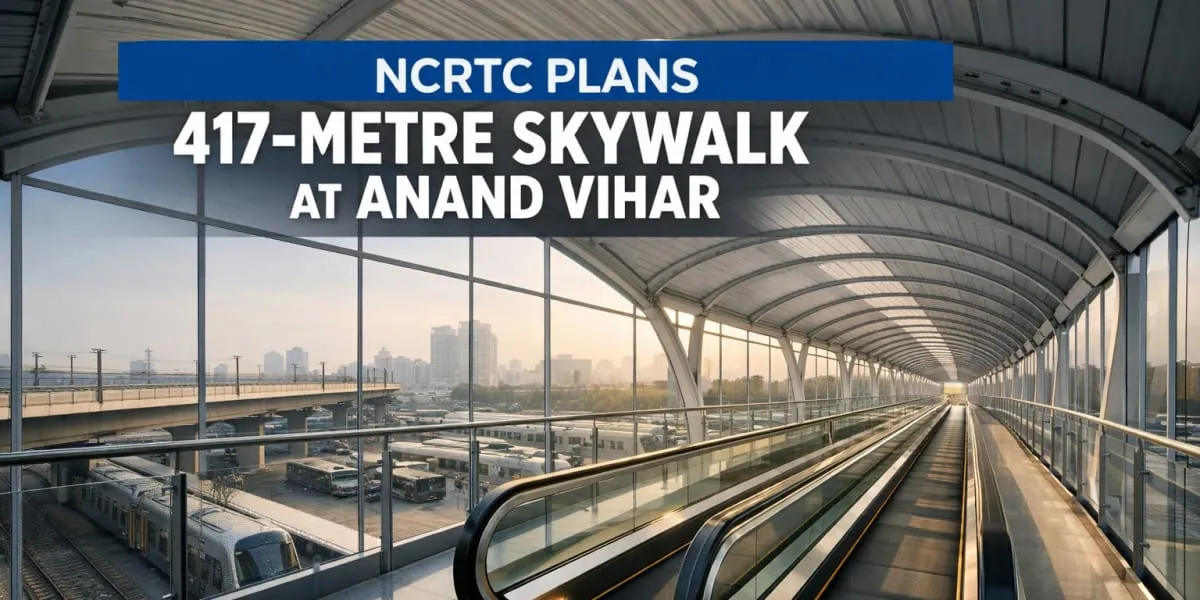
The National Capital Region Transport Corporation (NCRTC) has floated a tender for a 417-metre skywalk at Anand Vihar to strengthen multi-modal connectivity across the Delhi-NCR region. The elevated pedestrian corridor is intended to provide a weather-protected alternative to the existing foot overbridge and to streamline movement between major transport nodes. The project is designed to serve thousands of daily commuters at one of the region's most congested transit hubs.

The corridor will link Anand Vihar Railway Station, the Delhi Metro station serving the Pink and Blue lines, the Namo Bharat regional rapid transit system (RRTS) station, and the twin inter-state bus terminals at Anand Vihar and Kaushambi, creating an integrated interchange for five transport systems. By bringing these modes into a shared circulation spine the scheme aims to reduce transfer times and improve passenger flows across state borders. The design emphasises accessibility and operational continuity during peak hours.

Commuter amenities will include automated travelators, escalators and high-capacity lifts to assist senior citizens, families with luggage and passengers with reduced mobility. A single-point security arrangement will be introduced between the RRTS and the Delhi Metro networks to allow transfers without repetitive screenings. The comprehensive scope of work covers the main structural framework, roofing, dedicated drainage, extensive CCTV surveillance and deployment of energy-efficient solar panels. These measures are intended to enhance safety and reduce maintenance-related disruptions.

Once the tender is awarded the NCRTC aims to complete construction within a 15-month window and will supervise integration with surrounding traffic management works. The existing foot overbridge frequently faces vendor encroachments and non-operational escalators which aggravate crowding during peak periods. To segregate flows at ground level the RRTS station is being connected to Chaudhary Charan Singh Marg through three dedicated bridges over the Ghazipur drain separating incoming and outgoing vehicular traffic and pedestrian channels. The combined interventions are expected to create structured, unhindered circulation and to ease pressure on the precinct.

The National Capital Region Transport Corporation (NCRTC) has floated a tender for a 417-metre skywalk at Anand Vihar to strengthen multi-modal connectivity across the Delhi-NCR region. The elevated pedestrian corridor is intended to provide a weather-protected alternative to the existing foot overbridge and to streamline movement between major transport nodes. The project is designed to serve thousands of daily commuters at one of the region's most congested transit hubs. The corridor will link Anand Vihar Railway Station, the Delhi Metro station serving the Pink and Blue lines, the Namo Bharat regional rapid transit system (RRTS) station, and the twin inter-state bus terminals at Anand Vihar and Kaushambi, creating an integrated interchange for five transport systems. By bringing these modes into a shared circulation spine the scheme aims to reduce transfer times and improve passenger flows across state borders. The design emphasises accessibility and operational continuity during peak hours. Commuter amenities will include automated travelators, escalators and high-capacity lifts to assist senior citizens, families with luggage and passengers with reduced mobility. A single-point security arrangement will be introduced between the RRTS and the Delhi Metro networks to allow transfers without repetitive screenings. The comprehensive scope of work covers the main structural framework, roofing, dedicated drainage, extensive CCTV surveillance and deployment of energy-efficient solar panels. These measures are intended to enhance safety and reduce maintenance-related disruptions. Once the tender is awarded the NCRTC aims to complete construction within a 15-month window and will supervise integration with surrounding traffic management works. The existing foot overbridge frequently faces vendor encroachments and non-operational escalators which aggravate crowding during peak periods. To segregate flows at ground level the RRTS station is being connected to Chaudhary Charan Singh Marg through three dedicated bridges over the Ghazipur drain separating incoming and outgoing vehicular traffic and pedestrian channels. The combined interventions are expected to create structured, unhindered circulation and to ease pressure on the precinct.

Related Stories

Gold Stories

Next Story
Infrastructure Urban

KONE Opens India's First Digital Experience Centre in Pune

KONE, a global elevator and escalator manufacturer, has inaugurated its first Digital Experience Centre (DEC) in India, located in Pune. The facility aims to showcase how artificial intelligence (AI), connectivity and data-driven technologies can enhance customer experiences and improve building operations.The centre was inaugurated by Jussi Herlin, Executive Vice Chair, KONE Corporation; Philippe Delorme, President and CEO, KONE; and Nandan Nilekani, Co-founder and Chairman of the Board, Infosys.Designed as an interactive customer environment, the facility demonstrates digital solutions cover..

Next Story
Infrastructure Urban

CII GreenCo Launches Circularity Guidelines for Indian Industry

The Confederation of Indian Industry (CII) GreenCo Council has launched the CII GreenCo Circularity Guidelines – Pilot Version at the 17th CII GreenCo Waste & Resource Management Summit 2026 in Chennai. The initiative aims to strengthen resource efficiency, waste reduction and circular economy practices across Indian manufacturing and process industries.The guidelines introduce a structured framework with circularity indices covering raw materials, consumables, packaging and other resource inputs. These indicators will help industries assess existing practices, identify opportunities to ..

Next Story
Infrastructure Energy

Global Electronics Association Launches IPC-1783-CO2E Standard

The Global Electronics Association has introduced IPC-1783-CO2E, a new international standard aimed at improving consistency, transparency and comparability in product carbon footprint reporting across the electronics manufacturing industry.The standard, titled International Standard for Data Collection and Reporting of CO2 Equivalent (CO2e) Emissions for the Electronics Manufacturing Supply Chain, provides industry-specific guidance for collecting, estimating and reporting carbon emissions data.With increasing regulatory requirements and customer expectations, electronics manufacturers face c..

Advertisement

Subscribe to Our Newsletter

Get daily newsletters around different themes from Construction world.

STAY CONNECTED

Advertisement

SPECIAL OFFER
QR Code