NITI Aayog Unveils Industry Decarbonisation Roadmaps
ECONOMY & POLICY

NITI Aayog Unveils Industry Decarbonisation Roadmaps

India’s ambition of becoming a developed nation by 2047 and building a USD 30 trillion economy will be driven by rapid industrial expansion and large-scale infrastructure development. Increasing the share of manufacturing from 17 per cent to 25 per cent of gross domestic product is a key national objective aligned with the country’s long-term development goals. At the same time, India has committed to achieving net-zero greenhouse gas emissions by 2070, highlighting the need for sector-specific green transition strategies that support both economic growth and climate objectives.

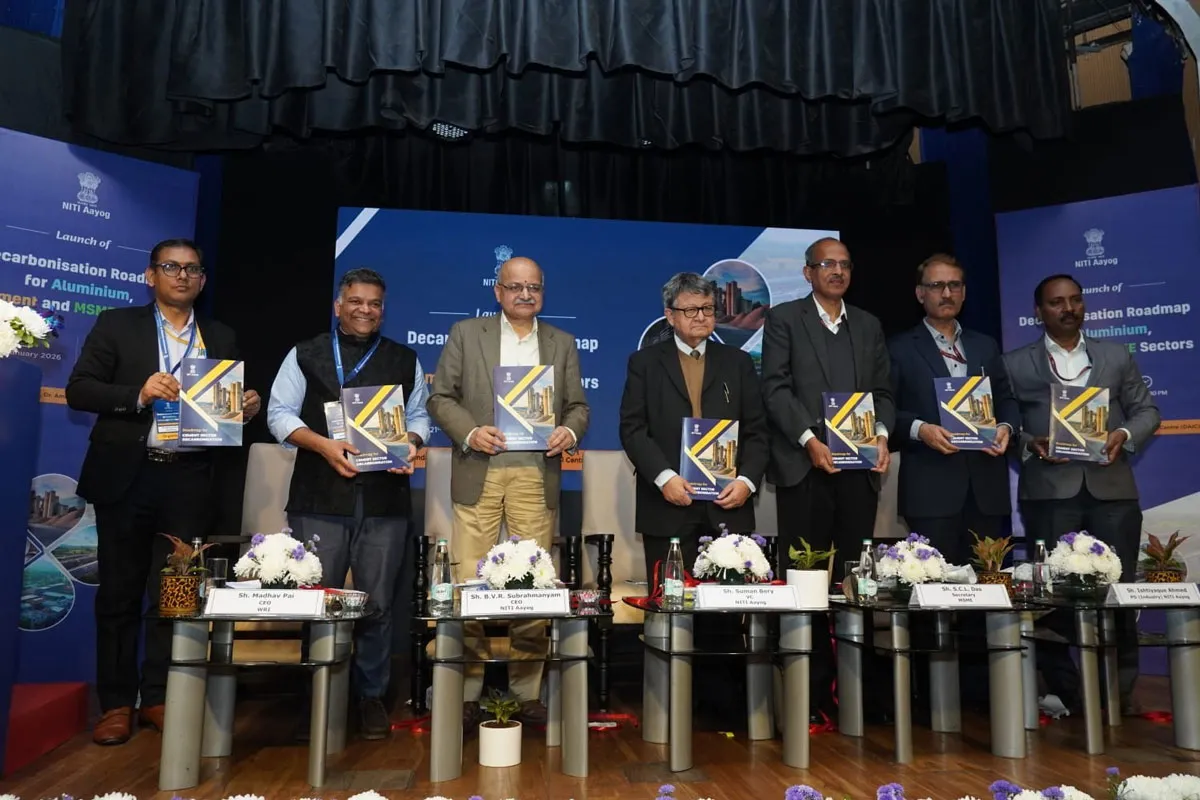
In this context, NITI Aayog has released three comprehensive reports outlining decarbonisation roadmaps for the cement, aluminium and micro, small and medium enterprises (MSME) sectors. These reports were prepared in consultation with line ministries and departments, industry stakeholders, research institutions and knowledge partners to ensure practical and scalable pathways for industrial transformation.

Cement Sector: The report projects that cement production could rise nearly sevenfold to around 2.1 billion tonnes by 2070, compared with 391 million tonnes in 2023. Under the proposed decarbonisation strategy, the sector must reduce carbon intensity from 0.63 tonnes of CO? equivalent per tonne of cement to approximately 0.09–0.13 tonnes by 2070. Key measures include prioritising refuse-derived fuels, increasing clinker substitution, scaling up carbon capture, utilisation and storage (CCUS) and strengthening the implementation of the carbon credit trading scheme to enable deep decarbonisation.

Aluminium Sector: Aluminium production is expected to expand from 4 million tonnes in 2023 to 37 million tonnes by 2070. The roadmap identifies a phased transition strategy, beginning with the adoption of renewable energy round-the-clock power and improved grid connectivity in the short term, followed by the integration of nuclear energy in the medium term and long-term deployment of CCUS technologies.

MSME Sector: India’s MSME sector forms the backbone of the industrial ecosystem, contributing nearly 30 per cent to national GDP, employing over 250 million people and accounting for around 46 per cent of exports. The MSME green transition roadmap focuses on three core levers: deployment of energy-efficient equipment, adoption of alternative fuels and integration of green electricity across enterprises.

Speaking on the occasion, Suman Bery, Vice Chairperson of NITI Aayog, emphasised that MSMEs play a critical role in domestic and global supply chains and called for prioritising technology adoption, access to affordable finance, skills development, regulatory reforms and greater participation of women in the workforce to enhance competitiveness.

B. V. R. Subrahmanyam, Chief Executive Officer of NITI Aayog, noted that the roadmaps would serve as reference frameworks to help India achieve its dual objectives of becoming a developed economy while decarbonising its industrial base. S. C. L. Das, Secretary, Ministry of MSME, highlighted that the cluster-based approach outlined in the reports would support effective implementation of the roadmap. Madhav Pai, Chief Executive Officer of WRI India, underscored the relevance of the roadmaps in light of India’s development ambitions and climate commitments. Ishtiyaque Ahmed, Programme Director at NITI Aayog, added that the cement, aluminium and MSME sectors can be decarbonised through levers such as energy efficiency, round-the-clock renewables, CCUS and nuclear energy.

With these sector-specific strategies, India aims to accelerate industrial growth while advancing its long-term climate transition, reinforcing the alignment between economic development and environmental sustainability.

India’s ambition of becoming a developed nation by 2047 and building a USD 30 trillion economy will be driven by rapid industrial expansion and large-scale infrastructure development. Increasing the share of manufacturing from 17 per cent to 25 per cent of gross domestic product is a key national objective aligned with the country’s long-term development goals. At the same time, India has committed to achieving net-zero greenhouse gas emissions by 2070, highlighting the need for sector-specific green transition strategies that support both economic growth and climate objectives. In this context, NITI Aayog has released three comprehensive reports outlining decarbonisation roadmaps for the cement, aluminium and micro, small and medium enterprises (MSME) sectors. These reports were prepared in consultation with line ministries and departments, industry stakeholders, research institutions and knowledge partners to ensure practical and scalable pathways for industrial transformation. Cement Sector: The report projects that cement production could rise nearly sevenfold to around 2.1 billion tonnes by 2070, compared with 391 million tonnes in 2023. Under the proposed decarbonisation strategy, the sector must reduce carbon intensity from 0.63 tonnes of CO? equivalent per tonne of cement to approximately 0.09–0.13 tonnes by 2070. Key measures include prioritising refuse-derived fuels, increasing clinker substitution, scaling up carbon capture, utilisation and storage (CCUS) and strengthening the implementation of the carbon credit trading scheme to enable deep decarbonisation. Aluminium Sector: Aluminium production is expected to expand from 4 million tonnes in 2023 to 37 million tonnes by 2070. The roadmap identifies a phased transition strategy, beginning with the adoption of renewable energy round-the-clock power and improved grid connectivity in the short term, followed by the integration of nuclear energy in the medium term and long-term deployment of CCUS technologies. MSME Sector: India’s MSME sector forms the backbone of the industrial ecosystem, contributing nearly 30 per cent to national GDP, employing over 250 million people and accounting for around 46 per cent of exports. The MSME green transition roadmap focuses on three core levers: deployment of energy-efficient equipment, adoption of alternative fuels and integration of green electricity across enterprises. Speaking on the occasion, Suman Bery, Vice Chairperson of NITI Aayog, emphasised that MSMEs play a critical role in domestic and global supply chains and called for prioritising technology adoption, access to affordable finance, skills development, regulatory reforms and greater participation of women in the workforce to enhance competitiveness. B. V. R. Subrahmanyam, Chief Executive Officer of NITI Aayog, noted that the roadmaps would serve as reference frameworks to help India achieve its dual objectives of becoming a developed economy while decarbonising its industrial base. S. C. L. Das, Secretary, Ministry of MSME, highlighted that the cluster-based approach outlined in the reports would support effective implementation of the roadmap. Madhav Pai, Chief Executive Officer of WRI India, underscored the relevance of the roadmaps in light of India’s development ambitions and climate commitments. Ishtiyaque Ahmed, Programme Director at NITI Aayog, added that the cement, aluminium and MSME sectors can be decarbonised through levers such as energy efficiency, round-the-clock renewables, CCUS and nuclear energy. With these sector-specific strategies, India aims to accelerate industrial growth while advancing its long-term climate transition, reinforcing the alignment between economic development and environmental sustainability.

Next Story
Infrastructure Urban

9th India–Myanmar Joint Trade Committee Meeting Held in Nay Pyi Taw

The ninth meeting of the India–Myanmar Joint Trade Committee (JTC) was held in Nay Pyi Taw, Myanmar, with a focus on strengthening bilateral trade and deepening economic cooperation. The meeting was co-chaired by U Minn Minn, Deputy Minister, Ministry of Commerce of the Republic of the Union of Myanmar, and Nitin Kumar Yadav, Additional Secretary, Department of Commerce, Ministry of Commerce and Industry, Government of India.Representatives from relevant ministries and stakeholder departments from both countries participated in the discussions. The meeting covered a broad range of issues aim..

Next Story
Infrastructure Urban

DGCA Launches Digital Pilot Licence Services for ATPL

The Directorate General of Civil Aviation (DGCA) has launched Electronic Personnel Licence (EPL) services for the Airline Transport Pilot Licence (ATPL), marking a significant step in the regulator’s ongoing digital transformation of aviation licensing in India. The service was inaugurated at an event held at the DGCA headquarters.Inaugurating the EPL ATPL service, Director General of Civil Aviation Faiz Ahmed Kidwai said the initiative represents a major advancement in strengthening India’s civil aviation regulatory framework through secure, modern and future-ready digital systems. He con..

Next Story
Infrastructure Urban

Cabinet Extends Atal Pension Yojana and Support Till 2030–31

The Union Cabinet, chaired by Prime Minister Narendra Modi, has approved the continuation of the Atal Pension Yojana (APY) up to the financial year 2030–31, along with the extension of government funding support for promotional and developmental activities and gap funding to ensure the scheme’s long-term sustainability.Under the approved framework, APY will continue to receive government support aimed at expanding its reach among unorganised and low-income workers. This includes funding for awareness campaigns, capacity-building initiatives and other developmental activities to strengthen ..

Advertisement

Subscribe to Our Newsletter

Get daily newsletters around different themes from Construction world.

STAY CONNECTED

Advertisement

Advertisement

Advertisement

Advertisement

Open In App