Output-Outcome Monitoring Framework to Oversee Central Schemes
ECONOMY & POLICY

Output-Outcome Monitoring Framework to Oversee Central Schemes

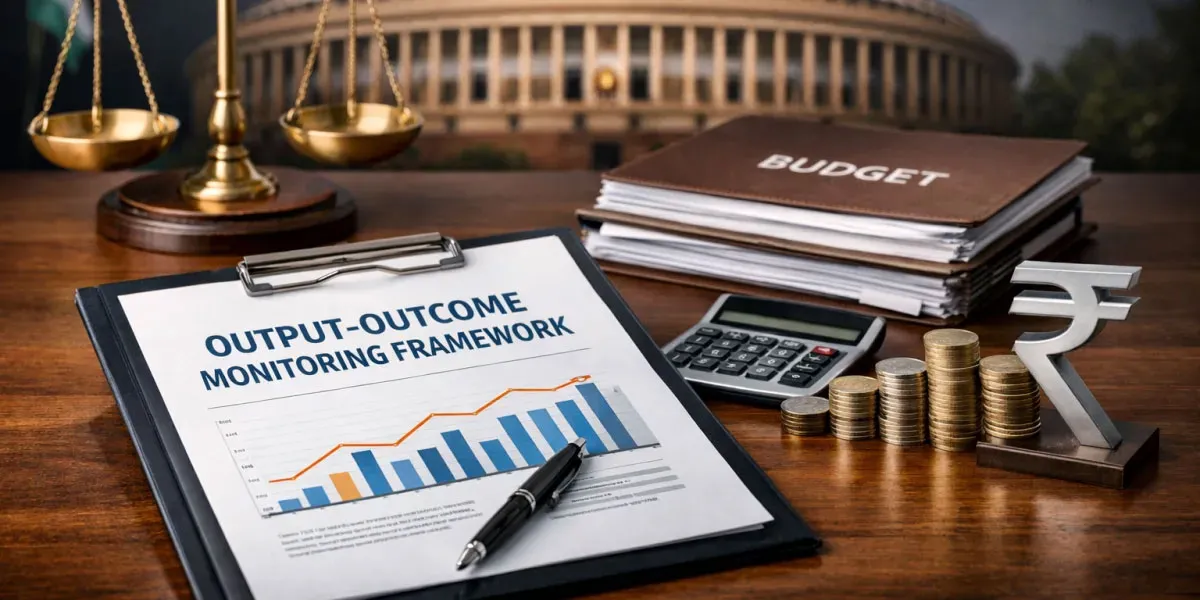
The Output-Outcome Monitoring Framework (OOMF) is the performance monitoring framework for Government of India schemes and is coordinated by the Development Monitoring and Evaluation Office (DMEO), NITI Aayog. The office works with Ministries and Departments to prepare the annual OOMF for their schemes. The document is presented in Parliament alongside the Union Budget each year as an Outcome Budget for all schemes with an annual outlay of Rs five billion (bn) or more. The respective Ministry or Department lays before Parliament the OOMF for schemes with a budget outlay of less than Rs five billion (bn) along with their Detailed Demand for Grants.

Targets and progress of Central Sector (CS) and Centrally Sponsored Schemes (CSS) outputs and outcomes are tracked by the respective Ministries and Departments. OOMF based monitoring enables Ministries and Departments to review scheme performance against key performance indicators and to take appropriate actions to improve implementation strategies. The arrangement aims to strengthen accountability and to provide a structured basis for assessing delivery of outcomes.

Ministries and Departments are guided by recommendations from evaluation study reports to strengthen the design and delivery mechanisms of their schemes. The use of evaluation findings is intended to inform corrective measures and to refine scheme architecture over time. The framework also supports a common methodology for outcome reporting across different sectors and programmes.

The information was provided in a written reply to a question in the Rajya Sabha by the Minister of State, Independent Charge, of the Ministry of Statistics and Programme Implementation; the Minister of State, Independent Charge, of the Ministry of Planning; and the Minister of State in the Ministry of Culture, Rao Inderjit Singh. The reply outlined the routine preparation and parliamentary laying of the OOMF and the role of the DMEO in coordinating with line Ministries and Departments. Officials indicated that the framework will continue to be presented alongside the Union Budget to support outcome based budgeting and scheme oversight.

The Output-Outcome Monitoring Framework (OOMF) is the performance monitoring framework for Government of India schemes and is coordinated by the Development Monitoring and Evaluation Office (DMEO), NITI Aayog. The office works with Ministries and Departments to prepare the annual OOMF for their schemes. The document is presented in Parliament alongside the Union Budget each year as an Outcome Budget for all schemes with an annual outlay of Rs five billion (bn) or more. The respective Ministry or Department lays before Parliament the OOMF for schemes with a budget outlay of less than Rs five billion (bn) along with their Detailed Demand for Grants. Targets and progress of Central Sector (CS) and Centrally Sponsored Schemes (CSS) outputs and outcomes are tracked by the respective Ministries and Departments. OOMF based monitoring enables Ministries and Departments to review scheme performance against key performance indicators and to take appropriate actions to improve implementation strategies. The arrangement aims to strengthen accountability and to provide a structured basis for assessing delivery of outcomes. Ministries and Departments are guided by recommendations from evaluation study reports to strengthen the design and delivery mechanisms of their schemes. The use of evaluation findings is intended to inform corrective measures and to refine scheme architecture over time. The framework also supports a common methodology for outcome reporting across different sectors and programmes. The information was provided in a written reply to a question in the Rajya Sabha by the Minister of State, Independent Charge, of the Ministry of Statistics and Programme Implementation; the Minister of State, Independent Charge, of the Ministry of Planning; and the Minister of State in the Ministry of Culture, Rao Inderjit Singh. The reply outlined the routine preparation and parliamentary laying of the OOMF and the role of the DMEO in coordinating with line Ministries and Departments. Officials indicated that the framework will continue to be presented alongside the Union Budget to support outcome based budgeting and scheme oversight.

Next Story
Resources

RR Kabel Appoints Kamaljeet Kaur as CHRO

RR Kabel has appointed Kamaljeet Kaur as Chief Human Resources Officer (CHRO), reinforcing its focus on strategic talent management, organisational effectiveness, and HR transformation. In her new role, Kaur will lead the company’s HR function, focusing on leadership development, employee engagement, and building a high-performance, people-centric culture aligned with the company’s growth ambitions. With over 22 years of experience, she brings expertise across industrial relations, talent management, learning and development, performance management, compensation and benefits, compliance,..

Next Story
Infrastructure Energy

Repos Energy Signs MoU with DPIIT to Boost Fuel-Tech Innovation

Repos Energy has signed a non-binding Memorandum of Understanding (MoU) with the Department for Promotion of Industry and Internal Trade (DPIIT), Government of India, to advance the country’s technology and innovation ecosystem. The agreement was formalised on 25 March 2026 in the presence of senior DPIIT officials.Amid rising geopolitical tensions and supply chain disruptions, the partnership highlights the growing importance of efficient last-mile fuel distribution. The collaboration aims to support startups, innovators and entrepreneurs, while promoting technology-led solutions in critica..

Next Story
Infrastructure Energy

CALB Reports 60% Revenue Growth in 2025

CALB Group reported strong financial performance for the year ended 31 December 2025, with revenue reaching RMB 44,400.07 million, up 60 per cent year-on-year. Profit surged over 140 per cent to RMB 2,095.22 million, reflecting significant improvement in profitability.The company strengthened its position across power batteries and energy storage, with market share gains in both segments. In October 2025, its power battery installations ranked among the global top three on a monthly basis, while the commercial EV segment recorded 630 per cent year-on-year growth in early 2026.CALB expanded its..

Advertisement

Subscribe to Our Newsletter

Get daily newsletters around different themes from Construction world.

STAY CONNECTED

Advertisement

Advertisement

Advertisement