Overpass Connecting Wildlife Habitats Opened Near Ranthambore
ECONOMY & POLICY

Overpass Connecting Wildlife Habitats Opened Near Ranthambore

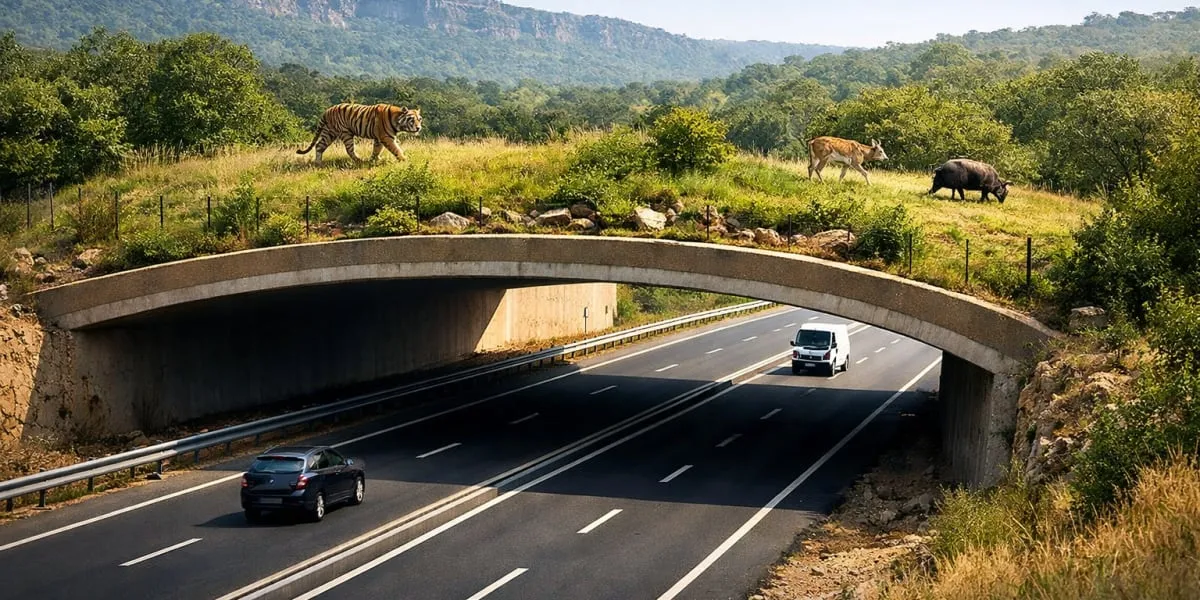
A major overpass along a stretch of the Delhi-Mumbai Expressway near Ranthambore National Park has been opened for one-sided traffic, officials said. The project has been designed to ensure the safe movement of animals and reduce human-wildlife conflict while maintaining vehicular connectivity. Authorities described the structure as a significant step in integrating infrastructure development with habitat conservation. Officials indicated that the measure aims to balance conservation requirements with regional transport needs.

The overpass spans an 11.5 kilometre (km) stretch where special engineering measures have been implemented to allow wildlife and traffic to coexist with minimal disturbance. The measures include noise-reduction surfacing, vegetated corridors and fencing to funnel animals towards safe crossing points. Traffic management arrangements have been introduced to regulate vehicle speeds and timing on the one-sided section. Design features are intended to minimise noise and light intrusion into adjacent habitat.

At the core of the design is a three and a half kilometre animal overpass system comprising five segments of around 500 metre (m) lengths each. Dedicated underpasses have been provided exclusively for wildlife movement to supplement the overpass and to offer alternative crossing options for different species. The segmented design is intended to accommodate the movement ecology of large mammals and smaller fauna alike. Segmentation allows for vegetation cover between spans to encourage wildlife use.

Officials indicated that the opening for one-sided traffic will be monitored closely and adjusted as necessary to balance conservation objectives with transportation needs. The initiative forms part of a broader effort to mitigate road impacts on protected areas and is expected to reduce incidents of roadkill and human-animal encounters. Continued monitoring and adaptive management will be used to assess effectiveness and inform future projects. Data gathered from monitoring will be used to refine operational protocols and inform maintenance.

A major overpass along a stretch of the Delhi-Mumbai Expressway near Ranthambore National Park has been opened for one-sided traffic, officials said. The project has been designed to ensure the safe movement of animals and reduce human-wildlife conflict while maintaining vehicular connectivity. Authorities described the structure as a significant step in integrating infrastructure development with habitat conservation. Officials indicated that the measure aims to balance conservation requirements with regional transport needs. The overpass spans an 11.5 kilometre (km) stretch where special engineering measures have been implemented to allow wildlife and traffic to coexist with minimal disturbance. The measures include noise-reduction surfacing, vegetated corridors and fencing to funnel animals towards safe crossing points. Traffic management arrangements have been introduced to regulate vehicle speeds and timing on the one-sided section. Design features are intended to minimise noise and light intrusion into adjacent habitat. At the core of the design is a three and a half kilometre animal overpass system comprising five segments of around 500 metre (m) lengths each. Dedicated underpasses have been provided exclusively for wildlife movement to supplement the overpass and to offer alternative crossing options for different species. The segmented design is intended to accommodate the movement ecology of large mammals and smaller fauna alike. Segmentation allows for vegetation cover between spans to encourage wildlife use. Officials indicated that the opening for one-sided traffic will be monitored closely and adjusted as necessary to balance conservation objectives with transportation needs. The initiative forms part of a broader effort to mitigate road impacts on protected areas and is expected to reduce incidents of roadkill and human-animal encounters. Continued monitoring and adaptive management will be used to assess effectiveness and inform future projects. Data gathered from monitoring will be used to refine operational protocols and inform maintenance.

Next Story
Infrastructure Energy

India Adds Record 44.61 GW Solar Capacity in FY2026

India’s solar sector reached a milestone in FY2026, with cumulative installed capacity crossing 150 GW and annual additions hitting a record 44.61 GW, exceeding the government target of 34 GW and nearly doubling FY2025’s 23.83 GW. Distributed Renewable Energy contributed 16.3 GW, while PPA and C&I segments accounted for 34 per cent and 30 per cent, respectively.India has risen from 9th globally in 2015 to 3rd in cumulative solar capacity by 2025 and is set to become the world’s second-largest solar market in annual installations in 2026. Seven states, led by Rajasthan and Gujarat, ac..

Next Story
Real Estate

Abhee Ventures unveils Scottish-themed 45-acre township in Bengaluru

Abhee Ventures, a leading South Indian real estate developer, has announced “Codename New Dimension,” a 45-acre Scottish-themed residential township at Gunjur on Whitefield–Sarjapur Road, Bengaluru. Strategically located between Whitefield and Sarjapur Road, Gunjur benefits from strong connectivity to the Outer Ring Road IT corridor, ITPL, EPIP, the upcoming Dommasandra Metro Station, and the proposed SWIFT City and Peripheral Ring Road.The township, designed in collaboration with London-based UHA London and India’s RSP Architects, offers low-density living with 85 per cent open spaces..

Next Story
Infrastructure Urban

BPE launches world’s thinnest Active Tile for legacy data centres

Best Power Equipments (India) Pvt Ltd (BPE), a leading provider of power solutions, data centre systems, and Battery Energy Storage Systems (BESS), has launched the BPE Active Tile, the world’s thinnest active tile designed for legacy data centres and telecom infrastructure. At just 65 mm thick, the tile requires significantly less space than conventional active tiles, which need nearly 450 mm floor depth.“Most legacy data centres were built decades ago for lower IT loads and traditional airflow patterns,” said A Prabhu, Executive Director – Technical (Global Operations), BPE. “As ra..

Advertisement

Subscribe to Our Newsletter

Get daily newsletters around different themes from Construction world.

STAY CONNECTED

Advertisement

Advertisement

Advertisement