PM Modi to Unveil Rs. 130 bn Projects in Tamil Nadu
ECONOMY & POLICY

PM Modi to Unveil Rs. 130 bn Projects in Tamil Nadu

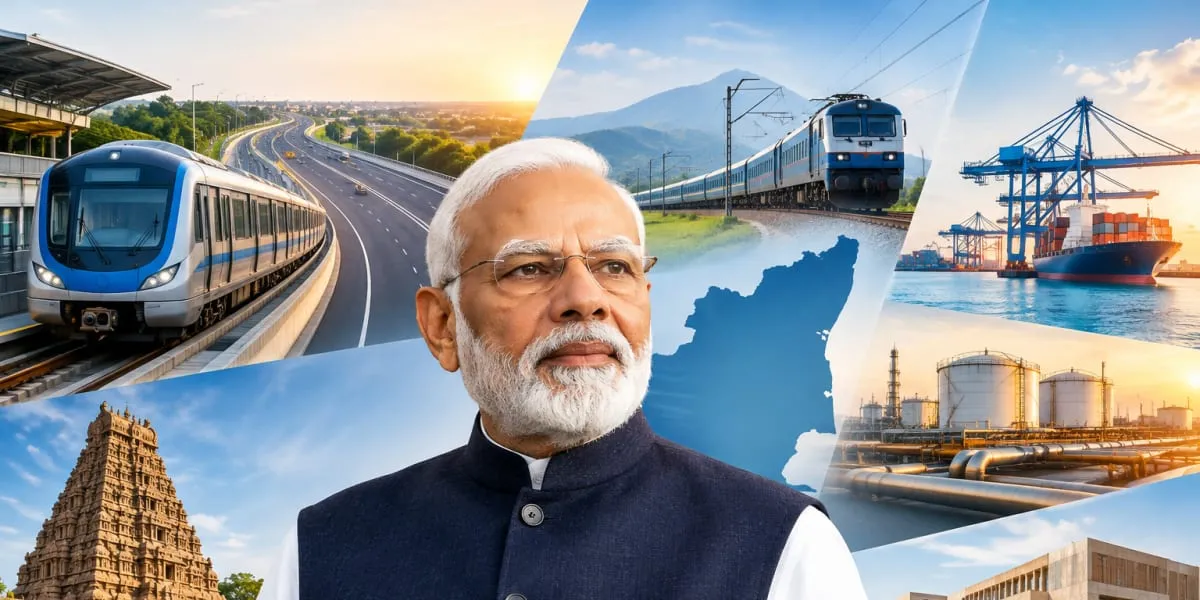
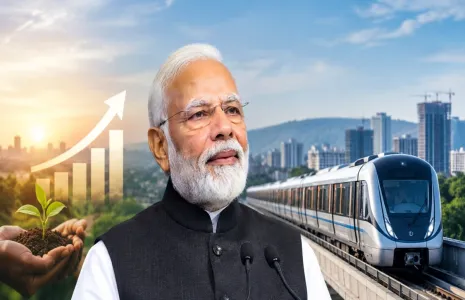
Prime Minister Narendra Modi will visit Chennai on October 11 to inaugurate, dedicate to the nation and lay foundation stones for development projects valued at more than Rs. 130 bn across Tamil Nadu. The projects cover metro rail, highways, railways, ports, petroleum and education.

During the visit, Modi will travel on the Chennai Metro between Porur Bypass Station and Poonamallee Bypass Station, visit the Jalakandeswarar Temple and inspect the Sudha Gopalakrishnan Brain Centre at IIT Madras. He will later inaugurate projects and address a gathering before attending the golden jubilee celebrations of Jaigopal Garodia Hindu Vidyalaya Matriculation Higher Secondary School.

The Poonamallee–Vadapalani stretch of Phase 2 of the Chennai Metro Rail Project, built at a cost of about Rs. 49 bn, will be inaugurated. The corridor includes a 3.7-km double-decker structure and signalling systems designed to support driverless operations. Highway projects worth about Rs. 37 bn include sections of NH-744, the Madurai Ring Road section of NH-744A and the Thiruvarur Bypass on NH-83.

Railway projects valued at more than Rs. 7.5 bn include the Karaikal–Peralam line and three rail flyovers in and around Coimbatore. Five redeveloped Amrit stations at Palani, Vellore Cantonment, Ambasamudram, Paramakkudi and Namakkal will also be inaugurated. At Chennai Port and V.O. Chidambaranar Port, the projects will expand storage, cargo and container-handling capacity, while facilities at Kamarajar Port will support additional maritime infrastructure.

Modi will lay the foundation stone for the Group II/III Lube Oil Base Stocks project at Chennai Petroleum Corporation’s Manali refinery. The Rs. 16.2 bn project will produce 270,000 t a year for premium lubricants. At IIT Madras, he will dedicate the brain centre, launch a mission to map more than 100 human brains in three-dimensional cellular atlases and release C-STROKE, an atlas containing more than 1,000 annotated sections from a stroke-affected brain. The visit will conclude with the school’s 50-year education celebration.

Prime Minister Narendra Modi will visit Chennai on October 11 to inaugurate, dedicate to the nation and lay foundation stones for development projects valued at more than Rs. 130 bn across Tamil Nadu. The projects cover metro rail, highways, railways, ports, petroleum and education. During the visit, Modi will travel on the Chennai Metro between Porur Bypass Station and Poonamallee Bypass Station, visit the Jalakandeswarar Temple and inspect the Sudha Gopalakrishnan Brain Centre at IIT Madras. He will later inaugurate projects and address a gathering before attending the golden jubilee celebrations of Jaigopal Garodia Hindu Vidyalaya Matriculation Higher Secondary School. The Poonamallee–Vadapalani stretch of Phase 2 of the Chennai Metro Rail Project, built at a cost of about Rs. 49 bn, will be inaugurated. The corridor includes a 3.7-km double-decker structure and signalling systems designed to support driverless operations. Highway projects worth about Rs. 37 bn include sections of NH-744, the Madurai Ring Road section of NH-744A and the Thiruvarur Bypass on NH-83. Railway projects valued at more than Rs. 7.5 bn include the Karaikal–Peralam line and three rail flyovers in and around Coimbatore. Five redeveloped Amrit stations at Palani, Vellore Cantonment, Ambasamudram, Paramakkudi and Namakkal will also be inaugurated. At Chennai Port and V.O. Chidambaranar Port, the projects will expand storage, cargo and container-handling capacity, while facilities at Kamarajar Port will support additional maritime infrastructure. Modi will lay the foundation stone for the Group II/III Lube Oil Base Stocks project at Chennai Petroleum Corporation’s Manali refinery. The Rs. 16.2 bn project will produce 270,000 t a year for premium lubricants. At IIT Madras, he will dedicate the brain centre, launch a mission to map more than 100 human brains in three-dimensional cellular atlases and release C-STROKE, an atlas containing more than 1,000 annotated sections from a stroke-affected brain. The visit will conclude with the school’s 50-year education celebration.

Related Stories

Gold Stories
Next Story
Infrastructure Energy

DMRC Invites Bids for Solar-Linked BESS Power Procurement

Delhi Metro Rail Corporation (DMRC) has invited bids for renewable energy from an Inter-State Transmission System (ISTS)-connected generating plant combining a solar photovoltaic (PV) system with a co-located Battery Energy Storage System (BESS). The procurement will be conducted through competitive bidding followed by an e-reverse auction. The last date for submitting online bids is December 10, 2026, at 3 PM. DMRC will open the technical bids on December 11, 2026, at 3 PM. The opening of financial bids and the e-reverse auction will be scheduled after completion of the technical evaluation. ..

Next Story
Infrastructure Energy

Solar Growth May Slow Beyond FY28 on Awards, Grid Constraints

India’s solar capacity growth could face headwinds beyond FY28 as slower renewable energy project awards, delays in signing power agreements and transmission constraints threaten expansion, according to a report by Yes Securities. Near-term additions remain supported by a construction pipeline exceeding 150 GW and rising rooftop installations, but weaker award activity could affect capacity additions and industry volumes in FY29 and FY30. Solar capacity additions nearly doubled to 44.61 GW in FY26 from 23.83 GW in FY25. Installations remained strong in the first half of FY27, when 21 GW of s..

Next Story
Infrastructure Transport

India’s First High-Speed Rail Service to Begin in 2027

India’s first high-speed rail service will commence in 2027, with the Surat-Vapi section of the Mumbai-Ahmedabad High-Speed Rail corridor scheduled to open first, Railway Minister Ashwini Vaishnaw said. The remaining sections to Mumbai will be opened in phases. Vaishnaw said 456 km of pier work and 371 km of viaduct construction had been completed by September. About 600,000 noise barriers had been installed along a 299 km stretch, while 9,300 overhead equipment masts had been erected across a 206 km viaduct. Four mountain tunnels have been excavated, and 5 km of the 21 km Maharashtra tunnel..

Advertisement

Subscribe to Our Newsletter

Get daily newsletters around different themes from Construction world.

STAY CONNECTED

Advertisement

SPECIAL OFFER
QR Code