Andhra Pradesh Approves Small Modular Reactors as Thermal Alternative
POWER & RENEWABLE ENERGY

Andhra Pradesh Approves Small Modular Reactors as Thermal Alternative

The Andhra Pradesh government has approved the exploration of nuclear power generation using Small Modular Reactors (SMRs) as an alternative to thermal power. The decision was announced on November 20 by K Vijayanand, special chief secretary for Energy, following a request from Andhra Pradesh Power Generation Corporation (APGENCO).

The state will examine the establishment of SMR-based nuclear power plants at retiring thermal power units or other suitable locations. The initiative will proceed after the technology has stabilised, according to the government order approving the proposal.

Vijayanand said the private sector would be permitted to participate in Andhra Pradesh’s effort to establish SMR nuclear power plants. The government has therefore opened the exploration process to potential private participation while assessing locations and the suitability of the technology for the state’s energy requirements.

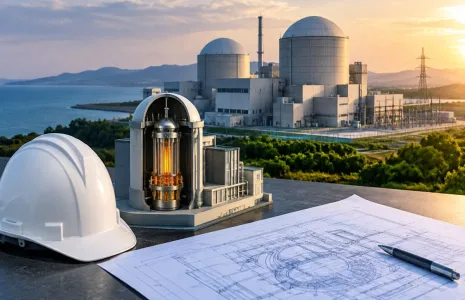
Unlike conventional nuclear power plants with capacity of around 700 MW(e), SMRs generally have capacity of about 300 MW(e), or approximately one-third of the output. Their smaller and modular design allows systems and components to be assembled in factories and transported as units for installation at selected sites.

The International Atomic Energy Agency (IAEA) describes SMRs as a low-carbon electricity option with a smaller physical footprint than conventional nuclear reactors. The technology uses nuclear fission to generate heat for power production and is designed to support more affordable construction, shorter building schedules and incremental deployment as electricity demand rises.

SMRs also require less fuel and typically need refuelling every three to seven years, compared with every one to two years for conventional nuclear plants. The IAEA has said some designs can operate for up to 30 years without refuelling, while SMRs can also be integrated with wind and solar generation in hybrid energy systems.

The Andhra Pradesh government has approved the exploration of nuclear power generation using Small Modular Reactors (SMRs) as an alternative to thermal power. The decision was announced on November 20 by K Vijayanand, special chief secretary for Energy, following a request from Andhra Pradesh Power Generation Corporation (APGENCO). The state will examine the establishment of SMR-based nuclear power plants at retiring thermal power units or other suitable locations. The initiative will proceed after the technology has stabilised, according to the government order approving the proposal. Vijayanand said the private sector would be permitted to participate in Andhra Pradesh’s effort to establish SMR nuclear power plants. The government has therefore opened the exploration process to potential private participation while assessing locations and the suitability of the technology for the state’s energy requirements. Unlike conventional nuclear power plants with capacity of around 700 MW(e), SMRs generally have capacity of about 300 MW(e), or approximately one-third of the output. Their smaller and modular design allows systems and components to be assembled in factories and transported as units for installation at selected sites. The International Atomic Energy Agency (IAEA) describes SMRs as a low-carbon electricity option with a smaller physical footprint than conventional nuclear reactors. The technology uses nuclear fission to generate heat for power production and is designed to support more affordable construction, shorter building schedules and incremental deployment as electricity demand rises. SMRs also require less fuel and typically need refuelling every three to seven years, compared with every one to two years for conventional nuclear plants. The IAEA has said some designs can operate for up to 30 years without refuelling, while SMRs can also be integrated with wind and solar generation in hybrid energy systems.

Related Stories

Gold Stories

Next Story
Infrastructure Energy

DMRC Invites Bids for Solar-Linked BESS Power Procurement

Delhi Metro Rail Corporation (DMRC) has invited bids for renewable energy from an Inter-State Transmission System (ISTS)-connected generating plant combining a solar photovoltaic (PV) system with a co-located Battery Energy Storage System (BESS). The procurement will be conducted through competitive bidding followed by an e-reverse auction. The last date for submitting online bids is December 10, 2026, at 3 PM. DMRC will open the technical bids on December 11, 2026, at 3 PM. The opening of financial bids and the e-reverse auction will be scheduled after completion of the technical evaluation. ..

Next Story
Infrastructure Energy

Solar Growth May Slow Beyond FY28 on Awards, Grid Constraints

India’s solar capacity growth could face headwinds beyond FY28 as slower renewable energy project awards, delays in signing power agreements and transmission constraints threaten expansion, according to a report by Yes Securities. Near-term additions remain supported by a construction pipeline exceeding 150 GW and rising rooftop installations, but weaker award activity could affect capacity additions and industry volumes in FY29 and FY30. Solar capacity additions nearly doubled to 44.61 GW in FY26 from 23.83 GW in FY25. Installations remained strong in the first half of FY27, when 21 GW of s..

Next Story
Infrastructure Transport

India’s First High-Speed Rail Service to Begin in 2027

India’s first high-speed rail service will commence in 2027, with the Surat-Vapi section of the Mumbai-Ahmedabad High-Speed Rail corridor scheduled to open first, Railway Minister Ashwini Vaishnaw said. The remaining sections to Mumbai will be opened in phases. Vaishnaw said 456 km of pier work and 371 km of viaduct construction had been completed by September. About 600,000 noise barriers had been installed along a 299 km stretch, while 9,300 overhead equipment masts had been erected across a 206 km viaduct. Four mountain tunnels have been excavated, and 5 km of the 21 km Maharashtra tunnel..

Advertisement

Subscribe to Our Newsletter

Get daily newsletters around different themes from Construction world.

STAY CONNECTED

Advertisement

SPECIAL OFFER
QR Code