


Pragati Platform Speeds Rs 85tn Infra Projects
ECONOMY & POLICY

Pragati Platform Speeds Rs 85tn Infra Projects

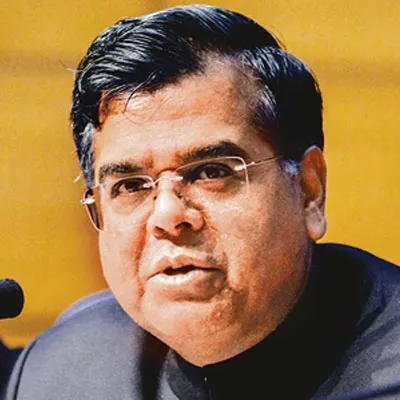
The Union government’s Pragati platform has accelerated the execution of critical infrastructure projects worth Rs 85 trillion nationwide since its launch in 2015, helping resolve, on average, one issue every working day, Cabinet Secretary T V Somanathan said while briefing reporters. The system, chaired by Prime Minister Narendra Modi, has also reduced cost and time overruns for some of the country’s most complex projects, many of which would otherwise have stretched well into the late 2030s.

According to the presentation, nearly 93 per cent of 3,187 issues across 382 projects were escalated and resolved directly at the Prime Minister’s level, significantly speeding up commissioning. Mr Somanathan cited the Jammu–Udhampur–Srinagar–Baramulla rail link as a key example. Conceived in January 1994, the 272-km link—built across some of the most challenging terrain—was opened on 6 June 2025 at a cost of Rs 427.6 billion. Without Pragati’s interventions, a simulation suggested completion would have slipped to January 2038. The project features the world’s highest railway bridge with a deck height of 1,178 feet, along with 38 tunnels spanning 119 km and 943 bridges over deep ravines.

At the apex of the system, the Prime Minister chairs Pragati review meetings with state chief secretaries and Union ministry secretaries to address project-specific bottlenecks. In the 50th meeting held on Wednesday, five critical projects across five states—together costing more than Rs 400 billion—were reviewed.

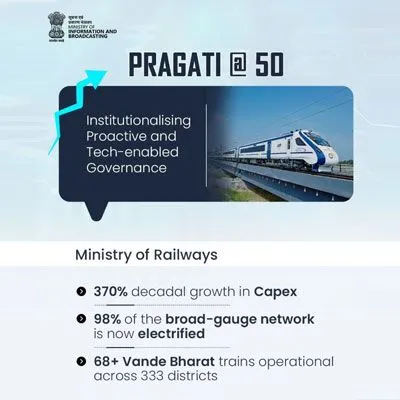
Large projects in India have long been hampered by cost and time overruns. An analysis of 7,156 issues resolved through Pragati shows nearly three-quarters related to land acquisition, forest clearances and right-of-use disputes, particularly in road and railway projects. Pragati continuously monitors projects valued at Rs 5 billion or more through a five-tier escalation mechanism up to the Prime Minister, supporting higher infrastructure spending. Capital expenditure has risen 3.6 times, from Rs 4.26 trillion in 2014–15 to Rs 15.53 trillion in 2025–26 (budget estimates).

Mr Somanathan said the platform addresses three core coordination gaps—horizontal coordination among Union ministries, vertical coordination between the Centre, states and local bodies, and coordination within state governments. By improving collaboration across tiers, Pragati has helped remove hurdles across more than 3,300 projects, he added.

The Union government’s Pragati platform has accelerated the execution of critical infrastructure projects worth Rs 85 trillion nationwide since its launch in 2015, helping resolve, on average, one issue every working day, Cabinet Secretary T V Somanathan said while briefing reporters. The system, chaired by Prime Minister Narendra Modi, has also reduced cost and time overruns for some of the country’s most complex projects, many of which would otherwise have stretched well into the late 2030s. According to the presentation, nearly 93 per cent of 3,187 issues across 382 projects were escalated and resolved directly at the Prime Minister’s level, significantly speeding up commissioning. Mr Somanathan cited the Jammu–Udhampur–Srinagar–Baramulla rail link as a key example. Conceived in January 1994, the 272-km link—built across some of the most challenging terrain—was opened on 6 June 2025 at a cost of Rs 427.6 billion. Without Pragati’s interventions, a simulation suggested completion would have slipped to January 2038. The project features the world’s highest railway bridge with a deck height of 1,178 feet, along with 38 tunnels spanning 119 km and 943 bridges over deep ravines. At the apex of the system, the Prime Minister chairs Pragati review meetings with state chief secretaries and Union ministry secretaries to address project-specific bottlenecks. In the 50th meeting held on Wednesday, five critical projects across five states—together costing more than Rs 400 billion—were reviewed. Large projects in India have long been hampered by cost and time overruns. An analysis of 7,156 issues resolved through Pragati shows nearly three-quarters related to land acquisition, forest clearances and right-of-use disputes, particularly in road and railway projects. Pragati continuously monitors projects valued at Rs 5 billion or more through a five-tier escalation mechanism up to the Prime Minister, supporting higher infrastructure spending. Capital expenditure has risen 3.6 times, from Rs 4.26 trillion in 2014–15 to Rs 15.53 trillion in 2025–26 (budget estimates). Mr Somanathan said the platform addresses three core coordination gaps—horizontal coordination among Union ministries, vertical coordination between the Centre, states and local bodies, and coordination within state governments. By improving collaboration across tiers, Pragati has helped remove hurdles across more than 3,300 projects, he added.

Next Story
Infrastructure Urban

Turning environmental challenges into recoverable value streams.

The lack of scalable, scientific solutions capable of handling legacy waste and complex urban waste streams led to the establishment of Blue Planet Environmental Solutions. In conversation with CW, Prashant Singh, Co-Founder & CEO, shares the company’s journey from a startup to a city-scale environmental infrastructure player, detailing large municipal projects, decades-old legacy waste remediation, land recovery outcomes and its expanding circular economy footprint.How has the visio..

Next Story
Infrastructure Transport

India's Highway Crisis!

Massive spending, inflated metrics, systemic delays and deep-rooted corruption now threaten the credibility of India’s highway expansion, observes  LT GEN RAJEEV CHAUDHRY (Retd), former DG Border Roads.India is spending more on national highways than ever before. With Rs 2.72 lakh crore earmarked for FY 2025–26 and ambitious targets under the Amrit Kaal vision, the narrative is one of speed, scale and transformation. Yet, beneath the headline numbers lies an uncomfortable realit..

Next Story
Infrastructure Urban

Audit: Time to Elevate

The year 2026 got off to a sorry start for the elevator industry with a 31-year-old security guard crushed to death when a lift collapsed on him in a Mulund East (Mumbai) housing society, and two boys, aged 11, grievously injured by falling into a lift duct when the third floor lift door in their Goregaon (Mumbai) building gave way. Faulty door-lock wiring and poor maintenance by the vendor are most probably behind these tragic accidents.No month goes by without a fatal elevator accident in some city across India. CW asks why?To read the full story Click Here ..

Advertisement

Subscribe to Our Newsletter

Get daily newsletters around different themes from Construction world.

STAY CONNECTED

Advertisement

Advertisement

Advertisement

Advertisement

Open In App















