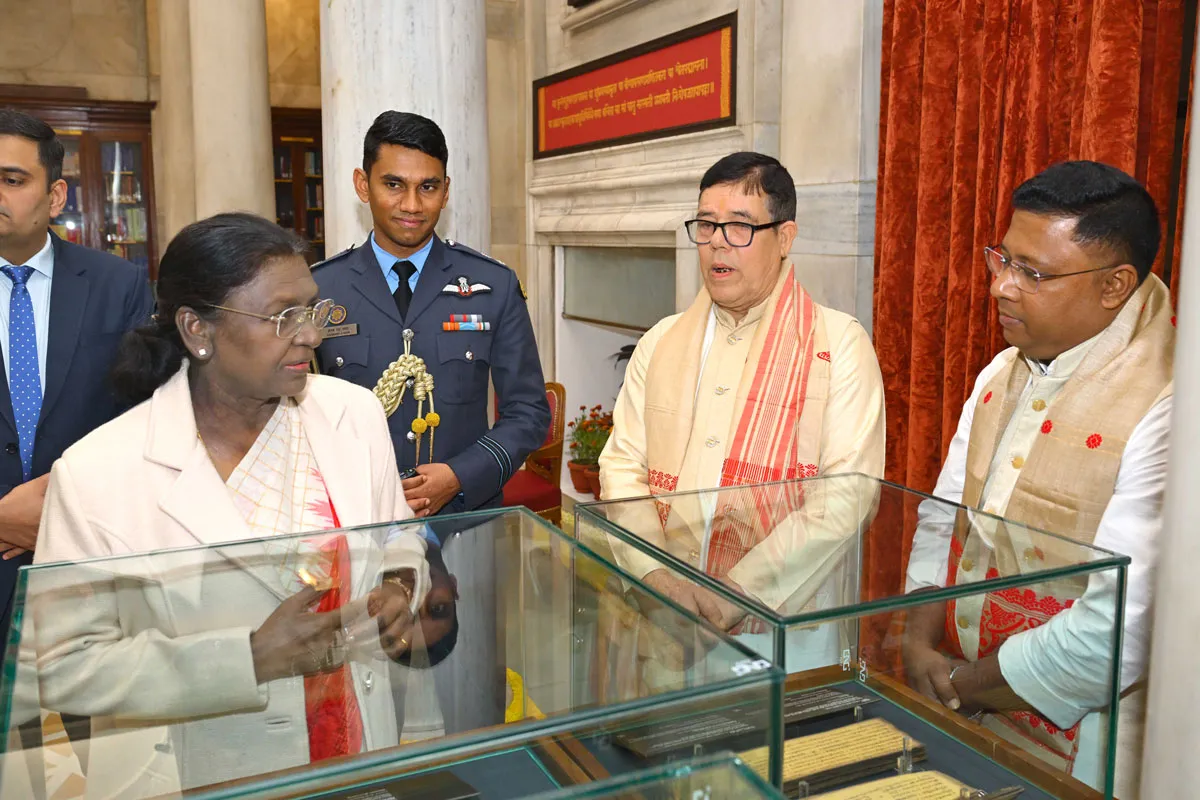
President Murmu Inaugurates Granth Kutir at Rashtrapati Bhavan
ECONOMY & POLICY

President Murmu Inaugurates Granth Kutir at Rashtrapati Bhavan

The President of India, Droupadi Murmu, recently inaugurated Granth Kutir at Rashtrapati Bhavan, a dedicated space showcasing India’s rich classical language heritage through rare books and manuscripts. The collection comprises around 2,300 books and nearly 50 manuscripts across 11 classical languages, including Tamil, Sanskrit, Kannada, Telugu, Malayalam, Odia, Marathi, Pali, Prakrit, Assamese and Bengali.
The Granth Kutir brings together India’s philosophical, literary, scientific and cultural traditions, with works spanning epics, linguistics, governance, history, devotional literature and science. Several manuscripts are handwritten on traditional materials such as palm leaf, bark, cloth and paper. The collection also includes the Constitution of India translated into these classical languages.
In October 2024, the Government of India accorded classical language status to Marathi, Pali, Prakrit, Assamese and Bengali, expanding the list from the earlier six languages. Ancient texts that contributed to this recognition include the Vedas, Upanishads and Puranas in Sanskrit; Tirukkural in Tamil; Gathasaptasati in Marathi; Vinaya Pitaka in Pali; Jain Agamas and Prakrit inscriptions; Charyapadas in Assamese, Bengali and Odia; Kavirajamarga in Kannada; Ramacharitam in Malayalam; and the Mahabharata in Telugu.
Developed through collaboration with central and state governments, universities, cultural institutions and individual donors, Granth Kutir has received support from the Ministries of Education and Culture. The Indira Gandhi National Centre for the Arts has provided professional expertise in manuscript conservation, documentation and display.
The initiative aligns with the Gyan Bharatam Mission, aimed at preserving, digitising and disseminating India’s manuscript heritage by integrating tradition with technology. Earlier archival collections housed at the site have been relocated, digitised and will be made available online for researchers.
Visitors can view selected works during guided tours of Rashtrapati Bhavan, while researchers may access the collection digitally or apply for physical access through an online portal.
Addressing the gathering, the President highlighted that classical languages form the foundation of Indian civilisation, contributing to advances in mathematics, astronomy, Ayurveda, grammar and philosophy. She emphasised that the accumulated knowledge in these languages inspires society to draw from its past while building a progressive future. The President also called upon educational institutions and citizens to actively promote and preserve classical languages, particularly by encouraging youth engagement. 

The President of India, Droupadi Murmu, recently inaugurated Granth Kutir at Rashtrapati Bhavan, a dedicated space showcasing India’s rich classical language heritage through rare books and manuscripts. The collection comprises around 2,300 books and nearly 50 manuscripts across 11 classical languages, including Tamil, Sanskrit, Kannada, Telugu, Malayalam, Odia, Marathi, Pali, Prakrit, Assamese and Bengali.The Granth Kutir brings together India’s philosophical, literary, scientific and cultural traditions, with works spanning epics, linguistics, governance, history, devotional literature and science. Several manuscripts are handwritten on traditional materials such as palm leaf, bark, cloth and paper. The collection also includes the Constitution of India translated into these classical languages.In October 2024, the Government of India accorded classical language status to Marathi, Pali, Prakrit, Assamese and Bengali, expanding the list from the earlier six languages. Ancient texts that contributed to this recognition include the Vedas, Upanishads and Puranas in Sanskrit; Tirukkural in Tamil; Gathasaptasati in Marathi; Vinaya Pitaka in Pali; Jain Agamas and Prakrit inscriptions; Charyapadas in Assamese, Bengali and Odia; Kavirajamarga in Kannada; Ramacharitam in Malayalam; and the Mahabharata in Telugu.Developed through collaboration with central and state governments, universities, cultural institutions and individual donors, Granth Kutir has received support from the Ministries of Education and Culture. The Indira Gandhi National Centre for the Arts has provided professional expertise in manuscript conservation, documentation and display.The initiative aligns with the Gyan Bharatam Mission, aimed at preserving, digitising and disseminating India’s manuscript heritage by integrating tradition with technology. Earlier archival collections housed at the site have been relocated, digitised and will be made available online for researchers.Visitors can view selected works during guided tours of Rashtrapati Bhavan, while researchers may access the collection digitally or apply for physical access through an online portal.Addressing the gathering, the President highlighted that classical languages form the foundation of Indian civilisation, contributing to advances in mathematics, astronomy, Ayurveda, grammar and philosophy. She emphasised that the accumulated knowledge in these languages inspires society to draw from its past while building a progressive future. The President also called upon educational institutions and citizens to actively promote and preserve classical languages, particularly by encouraging youth engagement. 

Next Story
Infrastructure Transport

Amrit Kaal or Asphault Illusion

Massive spending, inflated metrics, systemic delays and deep-rooted corruption now threaten the credibility of India’s highway expansion, observes  LT GEN RAJEEV CHAUDHRY (Retd), former DG Border Roads.India is spending more on national highways than ever before. With Rs 2.72 lakh crore earmarked for FY 2025–26 and ambitious targets under the Amrit Kaal vision, the narrative is one of speed, scale and transformation. Yet, beneath the headline numbers lies an uncomfortable reality: highways that crack under monsoons, projects that spiral into delays and arbitration, and a system where ..

Next Story
Infrastructure Transport

Executing 37,000 Crore Road Projects With Speed And Accountability

With Rs.37,000 crore worth of road projects under execution across Maharashtra, Maharashtra State Infrastructure Development Corporation (MSIDC) is driving one of the state’s largest infrastructure programmes. Dr Brijesh Dixit, Managing Director, discusses the institutional reforms, execution frameworks, financing strategies and technology adoption enabling timely, high-quality delivery, in conversation with PRATAP PADODE, Editor-in-Chief, CW.With over Rs.37,000 crore worth of road projects underway across districts – many under tight timelines – what institutional and executio..

Next Story
Infrastructure Urban

Technology-Focused Environmental Infrastructure For Sustainable Cities

The lack of scalable, scientific solutions capable of handling legacy waste and complex urban waste streams led to the establishment of Blue Planet Environmental Solutions. In conversation with CW, Prashant Singh, Co-Founder & CEO, shares the company’s journey from a startup to a city-scale environmental infrastructure player, detailing large municipal projects, decades-old legacy waste remediation, land recovery outcomes and its expanding circular economy footprint.How has the vision of Blue Planet Environmental Solutions evolved?Blue Planet was founded to address a fundamenta..

Advertisement

Subscribe to Our Newsletter

Get daily newsletters around different themes from Construction world.

STAY CONNECTED

Advertisement

Advertisement

Advertisement

Advertisement

Open In App