Seventh All India Conference of Railway Police Chiefs
ECONOMY & POLICY

Seventh All India Conference of Railway Police Chiefs

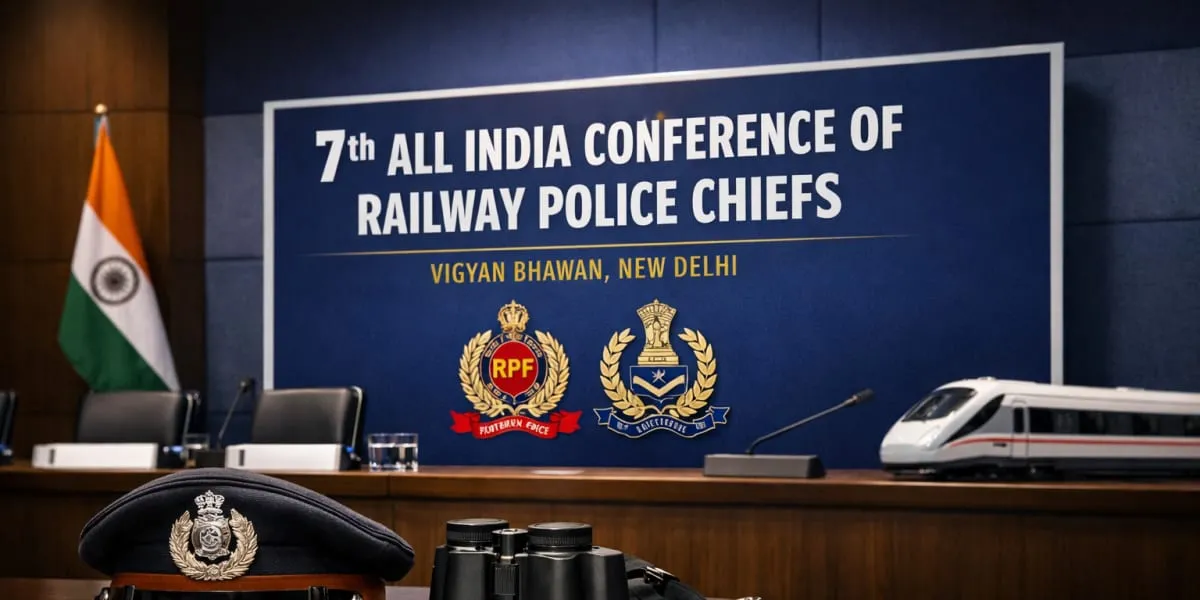
The seventh All India conference of Government Railway Police (GRP) chiefs was convened by the Railway Protection Force (RPF) at Vigyan Bhawan in New Delhi. The meeting was presided over by the Director General of the Railway Protection Force, Sonali Mishra, and attended by Director Generals of Police, Additional Director Generals of Police and senior officers from the GRP of various states and union territories. The gathering also included the Chairman-cum-CEO of the Railway Board, Satish Kumar, and other members of the Railway Board.

Participants engaged in comprehensive discussions to frame a coordinated programme of action and a procedural framework to strengthen passenger safety and protection of railway infrastructure. Deliberations covered measures to improve basic facilities for GRP personnel and to foster closer coordination and joint operations between state police forces and central security agencies. Emphasis was placed on developing a holistic security architecture combining technology, intelligence, field coordination and community outreach.

Delegates noted that the Indian railway network, owing to its vast geographical spread and high passenger footfall, remains vulnerable to a spectrum of threats including organised crime, trafficking of narcotics, vandalism, stone pelting and potential acts of sabotage. The conference recommended wider adoption of FRS-based CCTV systems, artificial intelligence driven video analytics and drone surveillance to enhance detection and identification capabilities. The Narcotics Control Bureau (NCB) outlined the need for proactive surveillance and real time intelligence sharing to disrupt drug trafficking networks.

The chiefs endorsed regular mock drills and scenario based training modules to improve first response, evacuation, crowd control and incident management. The conference also urged stronger community outreach and awareness programmes in vulnerable localities alongside strict legal measures to deter offenders. The outcomes are expected to align RPF and GRP strategies, to enable more resilient, responsive and technology enabled railway security.

The seventh All India conference of Government Railway Police (GRP) chiefs was convened by the Railway Protection Force (RPF) at Vigyan Bhawan in New Delhi. The meeting was presided over by the Director General of the Railway Protection Force, Sonali Mishra, and attended by Director Generals of Police, Additional Director Generals of Police and senior officers from the GRP of various states and union territories. The gathering also included the Chairman-cum-CEO of the Railway Board, Satish Kumar, and other members of the Railway Board. Participants engaged in comprehensive discussions to frame a coordinated programme of action and a procedural framework to strengthen passenger safety and protection of railway infrastructure. Deliberations covered measures to improve basic facilities for GRP personnel and to foster closer coordination and joint operations between state police forces and central security agencies. Emphasis was placed on developing a holistic security architecture combining technology, intelligence, field coordination and community outreach. Delegates noted that the Indian railway network, owing to its vast geographical spread and high passenger footfall, remains vulnerable to a spectrum of threats including organised crime, trafficking of narcotics, vandalism, stone pelting and potential acts of sabotage. The conference recommended wider adoption of FRS-based CCTV systems, artificial intelligence driven video analytics and drone surveillance to enhance detection and identification capabilities. The Narcotics Control Bureau (NCB) outlined the need for proactive surveillance and real time intelligence sharing to disrupt drug trafficking networks. The chiefs endorsed regular mock drills and scenario based training modules to improve first response, evacuation, crowd control and incident management. The conference also urged stronger community outreach and awareness programmes in vulnerable localities alongside strict legal measures to deter offenders. The outcomes are expected to align RPF and GRP strategies, to enable more resilient, responsive and technology enabled railway security.

Next Story
Infrastructure Transport

Sector 51-52 Metro skywalk in Noida remains shut despite being ready for over a year

Thousands of commuters travelling between Delhi Metro Rail Corporation’s (DMRC) Sector 52 station and Noida Metro Rail Corporation’s (NMRC) Sector 51 station continue to face daily inconvenience as the 300-metre air-conditioned skywalk connecting the two stations remains closed, despite being completed over a year ago, according to a report.The Noida Metro Rail Corporation built the foot overbridge to enable a seamless interchange between the Delhi Metro and Noida Metro networks. However, pending finishing work and a structural obstruction have delayed its opening.Krishna Karunesh, Chief E..

Next Story
Infrastructure Transport

Maharashtra clears Metro Line 5A, expansion of Mumbai Metro Line 5

The Maharashtra government has approved the expansion of Mumbai Metro Line 5 along with a new integrated corridor, Metro Line 5A, forming a combined 34.2-km metro network across the Thane-Bhiwandi-Kalyan-Ulhasnagar belt. The integrated project has been cleared at an estimated cost of ₹18,130.55 crore, according to a government resolution (GR).Metro Line 5 was originally approved in October 2017 as a 24.9-km fully elevated corridor with 17 stations connecting Thane, Bhiwandi and Kalyan, with an initial project cost of ₹8,416.51 crore. The corridor is being developed in two phases.The first ..

Next Story
Infrastructure Transport

Bengaluru Metro expansion seen driving office demand

Bengaluru’s expanding metro network is expected to emerge as a major catalyst for real estate growth, with the Yellow and Pink Lines likely to boost both office demand and residential prices across key micro-markets, according to a report by Colliers India.The report estimates that over the next two years, Bengaluru could witness an additional 5–7 million sq ft of Grade A office space demand across the Central Business District (CBD), Secondary Business District (SBD) and Electronic City. Improved metro connectivity and reduced commute times are expected to drive higher occupier interest a..

Advertisement

Subscribe to Our Newsletter

Get daily newsletters around different themes from Construction world.

STAY CONNECTED

Advertisement

Advertisement

Advertisement