



SKUAST-K Launches E-Commerce Programme for MSMEs
ECONOMY & POLICY

SKUAST-K Launches E-Commerce Programme for MSMEs

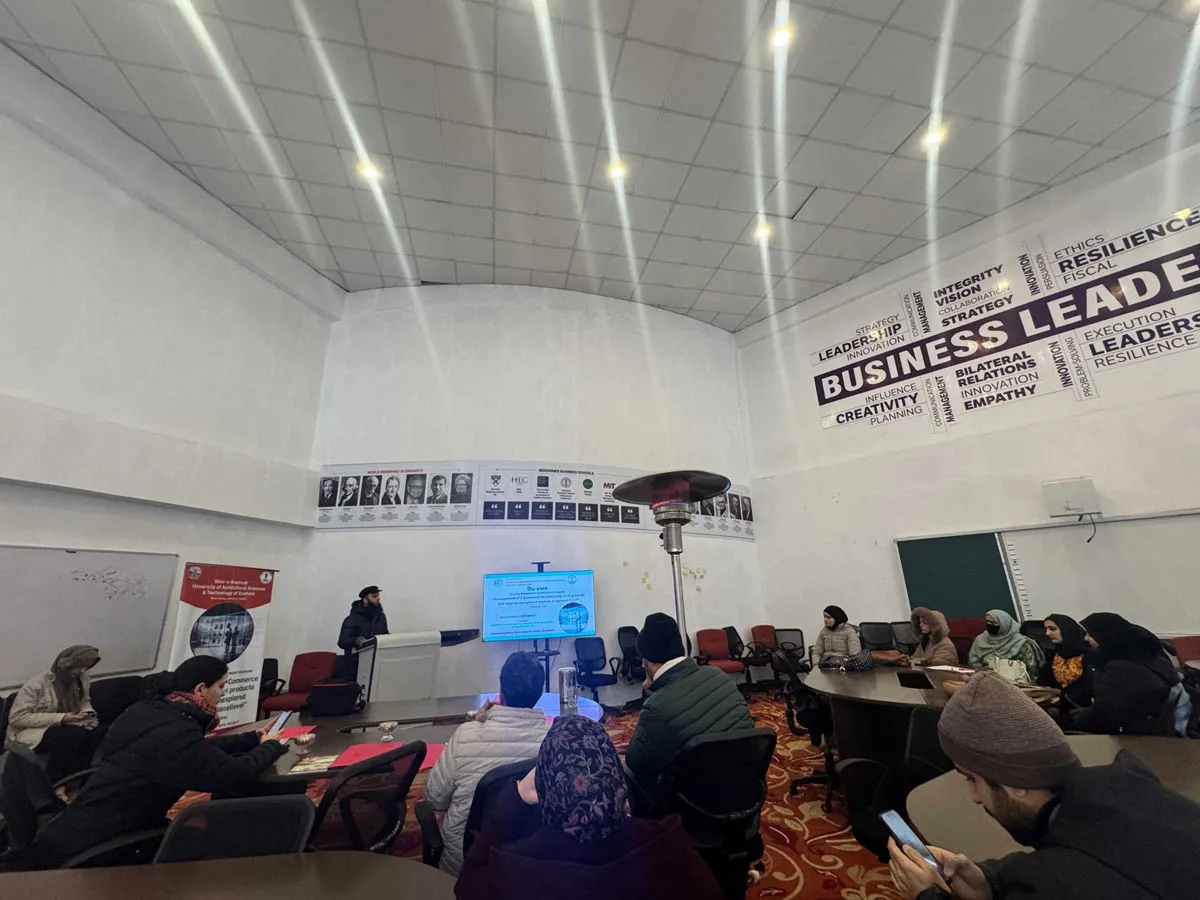
Sher-e-Kashmir University of Agricultural Sciences and Technology of Kashmir (SKUAST-K) has launched a week-long Management Development Programme to strengthen the digital capabilities of regional entrepreneurs and micro, small and medium enterprises.

The programme, titled Management of E-Commerce for Promoting Local Products and Tapping Unexplored National Markets, is organised by the university’s Institute of Business and Policy Research. It is designed to equip participants with digital tools and managerial skills to bridge the gap between local production and national consumer demand.

In his keynote address, Dr S. H. Baba, Professor at IBPR, outlined contemporary e-commerce strategies and managerial frameworks required to remain competitive in the digital economy. He emphasised that effective use of digital platforms has become essential for promoting local products in an increasingly competitive national marketplace.

Earlier, Dr Omar Fayaz Khan, Assistant Professor at IBPR and organiser of the programme, highlighted the role of e-commerce in expanding market visibility and enabling businesses to reach wider consumer segments. Dr Ashiq H. Lone, Co-Coordinator of the programme, stressed the importance of collaborative networks and linked the initiative’s objectives with the National Education Policy’s focus on skill development.

Sponsored by the Ministry of Micro, Small and Medium Enterprises, Government of India, the training programme aims to strengthen the local business ecosystem by empowering participants with practical managerial and digital skills to support sustainable business growth and market expansion.

Sher-e-Kashmir University of Agricultural Sciences and Technology of Kashmir (SKUAST-K) has launched a week-long Management Development Programme to strengthen the digital capabilities of regional entrepreneurs and micro, small and medium enterprises. The programme, titled Management of E-Commerce for Promoting Local Products and Tapping Unexplored National Markets, is organised by the university’s Institute of Business and Policy Research. It is designed to equip participants with digital tools and managerial skills to bridge the gap between local production and national consumer demand. In his keynote address, Dr S. H. Baba, Professor at IBPR, outlined contemporary e-commerce strategies and managerial frameworks required to remain competitive in the digital economy. He emphasised that effective use of digital platforms has become essential for promoting local products in an increasingly competitive national marketplace. Earlier, Dr Omar Fayaz Khan, Assistant Professor at IBPR and organiser of the programme, highlighted the role of e-commerce in expanding market visibility and enabling businesses to reach wider consumer segments. Dr Ashiq H. Lone, Co-Coordinator of the programme, stressed the importance of collaborative networks and linked the initiative’s objectives with the National Education Policy’s focus on skill development. Sponsored by the Ministry of Micro, Small and Medium Enterprises, Government of India, the training programme aims to strengthen the local business ecosystem by empowering participants with practical managerial and digital skills to support sustainable business growth and market expansion.

Next Story
Real Estate

Union Budge: Infra-Led Urban Shift

The Union Budget FY27 reinforces infrastructure-led urbanisation as the backbone of India’s real estate and housing growth. Higher public capital expenditure, City Economic Regions, risk-mitigation mechanisms and REIT-led asset monetisation are being widely viewed as long-term enablers, even as the industry continues to seek sharper supply-side reforms and affordability-focused measures. Here are a few industry insights:Dr Niranjan Hiranandani, Chairman, NAREDCO & Hiranandani Group“The Union Budget 2026-27 is growth-oriented and stability-focused, supporting consumption and aiming to s..

Next Story
Infrastructure Urban

Budget 2026 Charts Path for Infrastructure-Led, Tech-Driven Growth

The Union Budget 2026–27 signals strong continuity in India’s macroeconomic strategy, anchored in elevated public capital expenditure, fiscal discipline, and a sharper focus on manufacturing, infrastructure, and regional development. With capital outlay pegged at ₹12.2 lakh crore and a fiscal deficit target of around 4.3 per cent, the Budget balances growth ambition with stability, offering long-term visibility to investors and project developers.A dominant theme is the centrality of infrastructure as a multiplier for economic expansion. Public capex now accounts for over 3.3 per cent of..

Next Story
Infrastructure Energy

Tata Power Arm Crosses 10 GW EPC Milestone

Tata Power Renewable Energy Ltd (TPREL) has achieved a major milestone by executing 10 gigawatts of engineering, procurement and construction (EPC) renewable energy projects to date, reinforcing its position in India’s clean energy infrastructure sector. According to the company, the executed portfolio comprises 4.2 gigawatts of in-house projects and 5.8 gigawatts of third-party projects. Of the total 10 gigawatts commissioned so far, 9.7 gigawatts are solar projects and 290 megawatts are wind projects. In the first nine months of FY26, TPREL commissioned 1.88 gigawatts of EPC renewable en..

Advertisement

Subscribe to Our Newsletter

Get daily newsletters around different themes from Construction world.

STAY CONNECTED

Advertisement

Advertisement

Advertisement

Advertisement

Open In App














