TDB Supports Commercialisation Of Indigenous Renewable Diesel
ECONOMY & POLICY

TDB Supports Commercialisation Of Indigenous Renewable Diesel

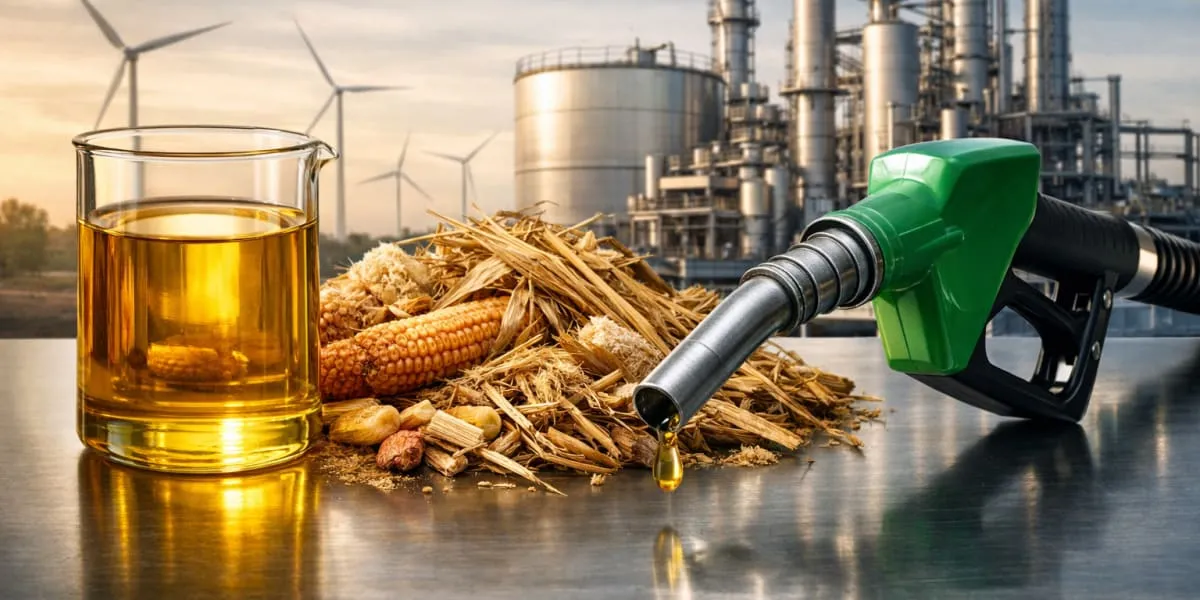
The Technology Development Board of the Department of Science and Technology has extended support to M/s Greenjoules Private Limited, Pune, to commercialise a second generation diesel equivalent biofuel at commercial scale. The project aims to establish a greenfield manufacturing facility for advanced biofuels derived from agricultural waste and agro processing residues and to contribute to India's energy security, waste to wealth mission and net zero aspirations. The assistance is intended to accelerate technology deployment and rural value creation.

The product, marketed as Abhilasha Biofuels, is a next generation renewable diesel and naphtha alternative developed through indigenous technology and designed as a drop-in fuel that can replace conventional fossil diesel without modifications to existing engines, fuel systems or distribution infrastructure. The indigenous process integrates thermochemical conversion with thermal cracking, catalytic upgrading and downstream refining to produce fuels that meet established quality specifications. The company reports successful production from nearly 40 feedstocks.

Greenjoules has developed proprietary capabilities in identifying optimal biomass blends and in matching them with customised catalyst systems to maximise fuel yields and production efficiency. While individual process steps reflect known industrial practices, the unique integration of feedstock selection, catalyst optimisation and process engineering constitutes the firm's core intellectual property and enables commercially viable conversion of low value agricultural waste. The project will also expand production of renewable naphtha, biochar and gaseous fuels within a circular ecosystem.

The initiative aligns with the National Biofuel Policy and circular economy objectives and supports efforts to strengthen domestic capabilities in advanced biofuels and alternative energy solutions. The TDB secretary said that advanced biofuels from agricultural residues represented a critical pathway to energy security, environmental sustainability and rural economic development and that the board would support technologies that strengthen the clean energy ecosystem. Company leaders conveyed that the support would hasten scale up and wider deployment of sustainable fuel solutions.

The Technology Development Board of the Department of Science and Technology has extended support to M/s Greenjoules Private Limited, Pune, to commercialise a second generation diesel equivalent biofuel at commercial scale. The project aims to establish a greenfield manufacturing facility for advanced biofuels derived from agricultural waste and agro processing residues and to contribute to India's energy security, waste to wealth mission and net zero aspirations. The assistance is intended to accelerate technology deployment and rural value creation. The product, marketed as Abhilasha Biofuels, is a next generation renewable diesel and naphtha alternative developed through indigenous technology and designed as a drop-in fuel that can replace conventional fossil diesel without modifications to existing engines, fuel systems or distribution infrastructure. The indigenous process integrates thermochemical conversion with thermal cracking, catalytic upgrading and downstream refining to produce fuels that meet established quality specifications. The company reports successful production from nearly 40 feedstocks. Greenjoules has developed proprietary capabilities in identifying optimal biomass blends and in matching them with customised catalyst systems to maximise fuel yields and production efficiency. While individual process steps reflect known industrial practices, the unique integration of feedstock selection, catalyst optimisation and process engineering constitutes the firm's core intellectual property and enables commercially viable conversion of low value agricultural waste. The project will also expand production of renewable naphtha, biochar and gaseous fuels within a circular ecosystem. The initiative aligns with the National Biofuel Policy and circular economy objectives and supports efforts to strengthen domestic capabilities in advanced biofuels and alternative energy solutions. The TDB secretary said that advanced biofuels from agricultural residues represented a critical pathway to energy security, environmental sustainability and rural economic development and that the board would support technologies that strengthen the clean energy ecosystem. Company leaders conveyed that the support would hasten scale up and wider deployment of sustainable fuel solutions.

Next Story
Real Estate

AI: The New Recruit

From getting ideas to evaluating designs, presenting concepts to clients and tracking projects, artificial intelligence (AI) is helping architects work better and faster.“AI allows architects to spend more time doing what only they can do: think critically, synthesise complexity and design with intent,” says Dikshu C Kukreja, Managing Principal, CP Kukreja Architects. “Every minute reclaimed from repetitive processes can be invested in creativity, contextual understanding, interdisciplinary collaboration and innovation – the qualities that define meaningful architecture.”To read the ..

Next Story
Real Estate

Redevelopment 2.0

In 2017, Mumbai identified 160,000 ageing buildings due for structural audit. Close to half of these were in the Western Suburbs. Redeveloping the oldest and structurally weakest of these would help unlock new housing, much needed given the city’s growing population density and constant developed area of 437.7 sq km. At 30,600 people per sq km in 2024, Mumbai’s density was almost thrice that of Gurugram, and 60 per cent higher than Bengaluru’s.Essentially, Mumbai’s realty market has demand. It has capital. It has realty development potential.Fast forward to 2026. Mumbai has 1,094 regis..

Next Story
Technology

Cost intelligence will become a strategic contributor to project success

As India's construction industry accelerates its digital transformation, integrated platforms, AI and connected data are becoming essential to improving cost certainty, project efficiency and sustainability. Ravi Kumar, Sales Director – India, RIB Software India, shares how digital workflows are reshaping project planning, commercial management and decision-making across the construction value chain.India's construction sector is embracing digital technologies at an unprecedented pace. From your perspective, what are the biggest shifts driving this transformation and how is RIB Software enab..

Advertisement

Subscribe to Our Newsletter

Get daily newsletters around different themes from Construction world.

STAY CONNECTED

Advertisement

Advertisement

Advertisement