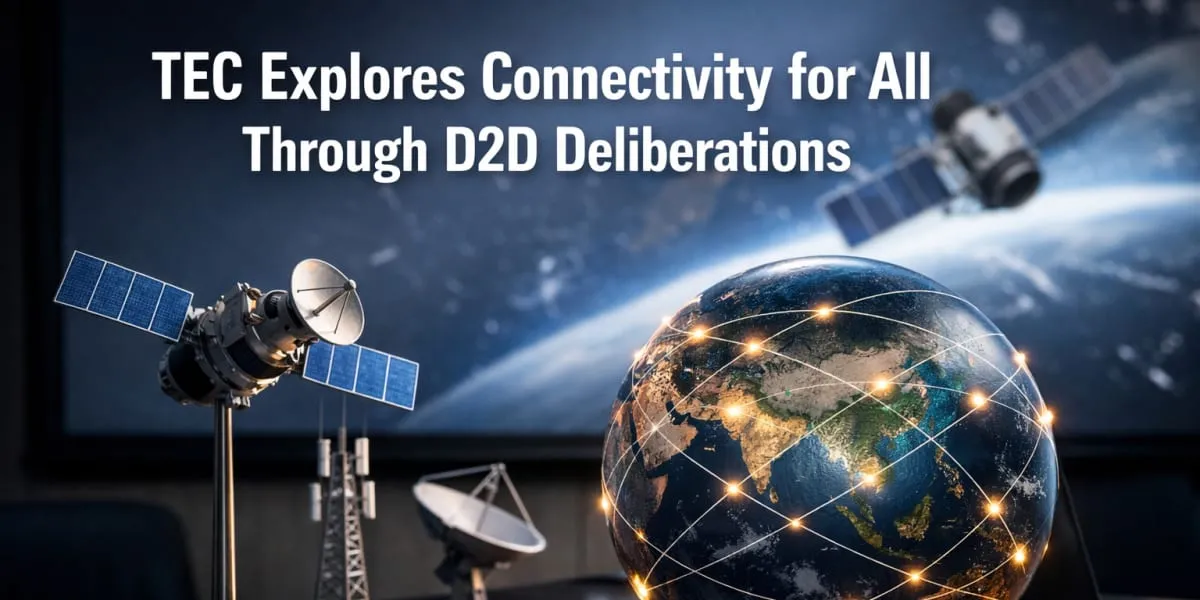
TEC Explores Connectivity for All Through D2D Deliberations
ECONOMY & POLICY

TEC Explores Connectivity for All Through D2D Deliberations

The Department of Telecommunications (DoT), through the Telecommunication Engineering Centre (TEC), organised a technical workshop in New Delhi to examine Direct-to-Device (D2D) satellite communication technologies and their global precedents and deployment models. The event brought together global experts, industry stakeholders and policymakers to deliberate technological advancements and regulatory considerations for the D2D and Non-Terrestrial Network (NTN) ecosystems. Participation included representatives of the Indian National Space Promotion and Authorisation Centre (IN-SPACe) and officers from the Wireless Planning and Coordination (WPC) Wing, TEC and DoT.

The workshop was inaugurated by Rudra Narayan Palai, Member (Technology) at the Department of Telecommunications, who underlined the role of next generation connectivity solutions in advancing the government vision of Connectivity for All and delivering seamless digital access to remote and underserved areas. Technical sessions featured presentations by industry participants including AST Space Mobile and Vodafone Idea Limited, who outlined recent developments in satellite to handset connectivity and evolving international regulatory approaches. Discussion addressed operational considerations for integrating D2D services with existing terrestrial infrastructure and potential deployment pathways in India.

Experts reviewed technological enablers and international precedents that inform spectrum, interoperability and handset certification requirements for D2D and NTN services, emphasising system resilience and scalability. Deliberations considered use cases such as extending coverage in geographically challenging regions and enhancing disaster preparedness through direct satellite links to standard mobile devices. Stakeholders assessed the regulatory and policy measures that would support responsible adoption while protecting consumer interests and maintaining network integrity.

The Department of Telecommunications reiterated its commitment to fostering innovation, enabling forward looking policy frameworks and strengthening collaboration with industry and regulators to advance cutting edge communication technologies. Officials signalled intent to continue consultations to refine technical standards and licensing approaches that balance rapid deployment with operational safeguards. The workshop was positioned as a step towards operationalising D2D technologies to complement terrestrial networks and accelerate progress towards universal digital coverage.

The Department of Telecommunications (DoT), through the Telecommunication Engineering Centre (TEC), organised a technical workshop in New Delhi to examine Direct-to-Device (D2D) satellite communication technologies and their global precedents and deployment models. The event brought together global experts, industry stakeholders and policymakers to deliberate technological advancements and regulatory considerations for the D2D and Non-Terrestrial Network (NTN) ecosystems. Participation included representatives of the Indian National Space Promotion and Authorisation Centre (IN-SPACe) and officers from the Wireless Planning and Coordination (WPC) Wing, TEC and DoT. The workshop was inaugurated by Rudra Narayan Palai, Member (Technology) at the Department of Telecommunications, who underlined the role of next generation connectivity solutions in advancing the government vision of Connectivity for All and delivering seamless digital access to remote and underserved areas. Technical sessions featured presentations by industry participants including AST Space Mobile and Vodafone Idea Limited, who outlined recent developments in satellite to handset connectivity and evolving international regulatory approaches. Discussion addressed operational considerations for integrating D2D services with existing terrestrial infrastructure and potential deployment pathways in India. Experts reviewed technological enablers and international precedents that inform spectrum, interoperability and handset certification requirements for D2D and NTN services, emphasising system resilience and scalability. Deliberations considered use cases such as extending coverage in geographically challenging regions and enhancing disaster preparedness through direct satellite links to standard mobile devices. Stakeholders assessed the regulatory and policy measures that would support responsible adoption while protecting consumer interests and maintaining network integrity. The Department of Telecommunications reiterated its commitment to fostering innovation, enabling forward looking policy frameworks and strengthening collaboration with industry and regulators to advance cutting edge communication technologies. Officials signalled intent to continue consultations to refine technical standards and licensing approaches that balance rapid deployment with operational safeguards. The workshop was positioned as a step towards operationalising D2D technologies to complement terrestrial networks and accelerate progress towards universal digital coverage.

Next Story
Infrastructure Urban

Mineral Auction Rules Amended To Speed Mine Operationalisation

The Ministry of Mines notified the Mineral (Auction) Second Amendment Rules, 2026 on 30 March 2026 to accelerate operationalisation of mines and improve ease of doing business in the mining sector. The amendment follows a prior change to the Mineral (Auction) Rules, 2015 effected on 17 October 2025 that introduced intermediary timelines between issuance of a letter of intent (LoI) and execution of the mining lease. The 2025 change provided that one per cent of performance security would be appropriated for each month of delay by the preferred bidder and introduced incentives for early operatio..

Next Story
Infrastructure Transport

Indian Railways Strengthens Telecom And AI Safety Systems

Indian Railways strengthened its telecom and digital infrastructure during 2025-26 with the aim of improving safety, operational efficiency and the passenger experience. The programme promoted modernisation through advanced technologies, robust communication systems and passenger-centric solutions. These measures were presented as part of a drive to build a digitally integrated rail ecosystem. A key development was the enhancement of the Internet Protocol Multi-Protocol Label Switching (IP MPLS) backbone, commissioned at 1,396 stations to meet bandwidth needs of mission-critical applications. ..

Next Story
Infrastructure Transport

NHAI Holds Workshop on Litigation Management and Coordination

The National Highways Authority of India (NHAI) organised a day-long workshop in New Delhi to strengthen capacity and interdepartmental synergy for faster execution of national highway projects. The event was held under Mission Karmayogi – Sadhana Saptah, an initiative of the Government of India to enhance governance through capacity building and improved processes. The workshop focused on structured and solution oriented deliberations to address implementation constraints. The session was chaired by the NHAI chairman Santosh Kumar Yadav and brought together senior officials from NHAI, the M..

Advertisement

Subscribe to Our Newsletter

Get daily newsletters around different themes from Construction world.

STAY CONNECTED

Advertisement

Advertisement

Advertisement