UNCCD Launches Business 4 Land Champions’ Council at Davos
ECONOMY & POLICY

UNCCD Launches Business 4 Land Champions’ Council at Davos

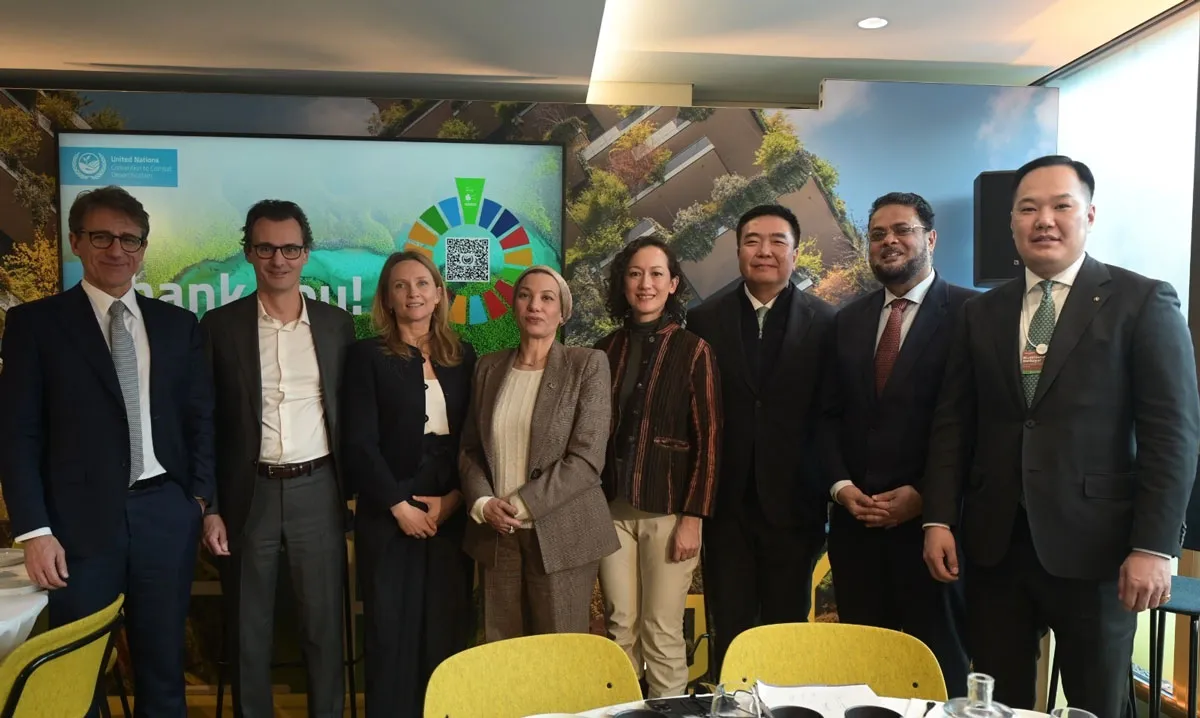
The United Nations Convention to Combat Desertification (United Nations Convention to Combat Desertification) Secretariat, together with the UNCCD COP16 Presidency led by the Kingdom of Saudi Arabia, has recently announced the official launch of the Business 4 Land (B4L) Champions’ Council at a high-level event held during the World Economic Forum Annual Meeting in Davos.
The B4L Champions’ Council brings together global chief executives and senior leaders from agriculture, consulting, environmental services, fashion, food, pulp and paper, renewable energy and technology sectors. The initiative aims to mobilise private sector leadership to restore 1.5 billion hectares of degraded land by 2030, aligning business strategies with global Sustainable Development Goals related to climate action, biodiversity protection and land degradation neutrality.
Addressing the gathering, Osama Ibrahim Faqeeha, Deputy Minister of Environment of Saudi Arabia and Adviser to the COP16 Presidency, underlined the economic and environmental urgency of land restoration. He noted that nearly half of global GDP depends on land-based systems such as agriculture, water, forests, cities and infrastructure, while nearly 100 million hectares of land are degraded annually under current practices. He emphasised that achieving land restoration at scale requires a fundamental shift in business models and investment priorities, driven by strong private sector participation.
The Council will support Business 4 Land actions aligned with the Riyadh Action Agenda, which was launched at COP16 in Riyadh in December 2024. At the summit, more than Rs 1 trillion equivalent was pledged globally for land restoration and drought resilience, with commitments from institutions including the Arab Coordination Group, the Islamic Development Bank, the OPEC Fund and the Government of Saudi Arabia. The B4L Champions’ Council is expected to build on this momentum through coordinated and measurable corporate action.
Yasmine Fouad, Executive Secretary of UNCCD, highlighted the economic rationale for land-positive investments, stating that every dollar invested in land restoration can generate up to 30 dollars in returns. She described B4L as the first formal private-sector platform under the UN environmental conventions, positioning land action as an integral component of corporate social responsibility rather than a voluntary add-on.
The Council’s priorities include mobilising private capital, scaling regenerative and land-positive business models, strengthening food security and drought resilience, enabling collaboration across global value chains, and supporting policy alignment through structured public-private dialogue. It will also contribute to implementing the Riyadh Global Drought Resilience Partnership, aimed at addressing escalating drought risks through coordinated international action.
During the Davos launch, founding corporate members stressed that land restoration is emerging as a strategic business imperative, linking environmental stewardship with long-term financial resilience and community well-being. The initiative marks a significant step in placing land restoration at the centre of global climate and development agendas, with the private sector positioned as a critical driver of impact.

The United Nations Convention to Combat Desertification (United Nations Convention to Combat Desertification) Secretariat, together with the UNCCD COP16 Presidency led by the Kingdom of Saudi Arabia, has recently announced the official launch of the Business 4 Land (B4L) Champions’ Council at a high-level event held during the World Economic Forum Annual Meeting in Davos.The B4L Champions’ Council brings together global chief executives and senior leaders from agriculture, consulting, environmental services, fashion, food, pulp and paper, renewable energy and technology sectors. The initiative aims to mobilise private sector leadership to restore 1.5 billion hectares of degraded land by 2030, aligning business strategies with global Sustainable Development Goals related to climate action, biodiversity protection and land degradation neutrality.Addressing the gathering, Osama Ibrahim Faqeeha, Deputy Minister of Environment of Saudi Arabia and Adviser to the COP16 Presidency, underlined the economic and environmental urgency of land restoration. He noted that nearly half of global GDP depends on land-based systems such as agriculture, water, forests, cities and infrastructure, while nearly 100 million hectares of land are degraded annually under current practices. He emphasised that achieving land restoration at scale requires a fundamental shift in business models and investment priorities, driven by strong private sector participation.The Council will support Business 4 Land actions aligned with the Riyadh Action Agenda, which was launched at COP16 in Riyadh in December 2024. At the summit, more than Rs 1 trillion equivalent was pledged globally for land restoration and drought resilience, with commitments from institutions including the Arab Coordination Group, the Islamic Development Bank, the OPEC Fund and the Government of Saudi Arabia. The B4L Champions’ Council is expected to build on this momentum through coordinated and measurable corporate action.Yasmine Fouad, Executive Secretary of UNCCD, highlighted the economic rationale for land-positive investments, stating that every dollar invested in land restoration can generate up to 30 dollars in returns. She described B4L as the first formal private-sector platform under the UN environmental conventions, positioning land action as an integral component of corporate social responsibility rather than a voluntary add-on.The Council’s priorities include mobilising private capital, scaling regenerative and land-positive business models, strengthening food security and drought resilience, enabling collaboration across global value chains, and supporting policy alignment through structured public-private dialogue. It will also contribute to implementing the Riyadh Global Drought Resilience Partnership, aimed at addressing escalating drought risks through coordinated international action.During the Davos launch, founding corporate members stressed that land restoration is emerging as a strategic business imperative, linking environmental stewardship with long-term financial resilience and community well-being. The initiative marks a significant step in placing land restoration at the centre of global climate and development agendas, with the private sector positioned as a critical driver of impact.

Next Story
Infrastructure Transport

Amrit Kaal or Asphault Illusion

Massive spending, inflated metrics, systemic delays and deep-rooted corruption now threaten the credibility of India’s highway expansion, observes  LT GEN RAJEEV CHAUDHRY (Retd), former DG Border Roads.India is spending more on national highways than ever before. With Rs 2.72 lakh crore earmarked for FY 2025–26 and ambitious targets under the Amrit Kaal vision, the narrative is one of speed, scale and transformation. Yet, beneath the headline numbers lies an uncomfortable reality: highways that crack under monsoons, projects that spiral into delays and arbitration, and a system where ..

Next Story
Infrastructure Transport

Executing 37,000 Crore Road Projects With Speed And Accountability

With Rs.37,000 crore worth of road projects under execution across Maharashtra, Maharashtra State Infrastructure Development Corporation (MSIDC) is driving one of the state’s largest infrastructure programmes. Dr Brijesh Dixit, Managing Director, discusses the institutional reforms, execution frameworks, financing strategies and technology adoption enabling timely, high-quality delivery, in conversation with PRATAP PADODE, Editor-in-Chief, CW.With over Rs.37,000 crore worth of road projects underway across districts – many under tight timelines – what institutional and executio..

Next Story
Infrastructure Urban

Technology-Focused Environmental Infrastructure For Sustainable Cities

The lack of scalable, scientific solutions capable of handling legacy waste and complex urban waste streams led to the establishment of Blue Planet Environmental Solutions. In conversation with CW, Prashant Singh, Co-Founder & CEO, shares the company’s journey from a startup to a city-scale environmental infrastructure player, detailing large municipal projects, decades-old legacy waste remediation, land recovery outcomes and its expanding circular economy footprint.How has the vision of Blue Planet Environmental Solutions evolved?Blue Planet was founded to address a fundamenta..

Advertisement

Subscribe to Our Newsletter

Get daily newsletters around different themes from Construction world.

STAY CONNECTED

Advertisement

Advertisement

Advertisement

Advertisement

Open In App