+
Union Minister and Chief Minister Lead JSJB Two Point Zero Review in Rajasthan
ECONOMY & POLICY

Union Minister and Chief Minister Lead JSJB Two Point Zero Review in Rajasthan

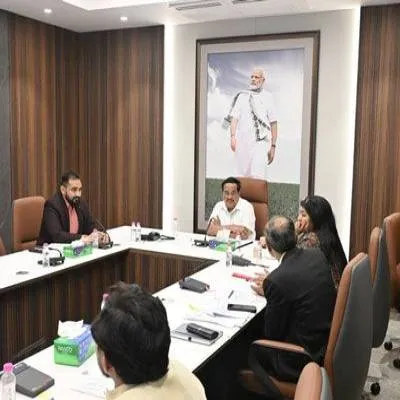
Union Minister of Jal Shakti C. R. Paatil and Chief Minister Bhajan Lal Sharma led a statewide review of Jal Sanchay Jan Bhagidari two point zero (JSJB two point zero) implementation in Rajasthan, convened by the National Water Mission, Department of Water Resources, River Development and Ganga Rejuvenation, Ministry of Jal Shakti in collaboration with the Government of Rajasthan. The meeting brought together District Collectors and Municipal Commissioners, along with the Chief Secretary and senior State and Central officers. The review aimed to assess readiness ahead of the monsoon and to share replicable approaches.

District Collectors from Bhilwara and Dungarpur presented district level progress and innovative water conservation initiatives under the programme. The Dungarpur presentation, representing a predominantly tribal district, illustrated how sustained community participation has driven river rejuvenation and local recharge efforts, yielding measurable ground level outcomes. Officers discussed monitoring mechanisms, community mobilisation strategies and the need to replicate successful interventions in similar agro climatic zones.

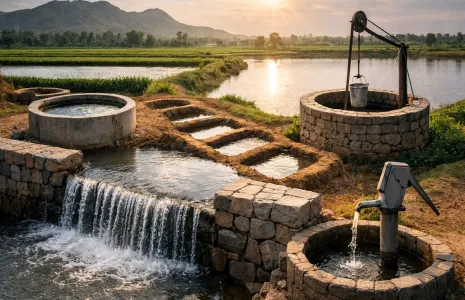
Rajasthan was recognised for securing the third position nationally under Jal Sanchay Jan Bhagidari one point zero (JSJB one point zero) and for leadership in large scale groundwater recharge and conservation. Officials highlighted the Alwar school model, where schools have helped create recharge structures and promote water literacy among students, and the revival and construction of traditional tankas in Barmer, which have strengthened decentralised storage and resilience in arid areas. These examples were cited as evidence that low cost, locally adapted interventions can deliver significant benefits.

The Chief Minister affirmed the State Government will intensify efforts under the programme and urged districts and urban local bodies to improve performance and contribute to national groundwater recharge goals. The Union Minister emphasised the urgency of creating adequate rainwater recharge capacity before the monsoon and noted that funds under MGNREGA have been earmarked for water conservation works, urging proactive utilisation and convergence with other schemes. Districts were asked to prioritise community participation and close monitoring to ensure effective implementation.

Union Minister of Jal Shakti C. R. Paatil and Chief Minister Bhajan Lal Sharma led a statewide review of Jal Sanchay Jan Bhagidari two point zero (JSJB two point zero) implementation in Rajasthan, convened by the National Water Mission, Department of Water Resources, River Development and Ganga Rejuvenation, Ministry of Jal Shakti in collaboration with the Government of Rajasthan. The meeting brought together District Collectors and Municipal Commissioners, along with the Chief Secretary and senior State and Central officers. The review aimed to assess readiness ahead of the monsoon and to share replicable approaches. District Collectors from Bhilwara and Dungarpur presented district level progress and innovative water conservation initiatives under the programme. The Dungarpur presentation, representing a predominantly tribal district, illustrated how sustained community participation has driven river rejuvenation and local recharge efforts, yielding measurable ground level outcomes. Officers discussed monitoring mechanisms, community mobilisation strategies and the need to replicate successful interventions in similar agro climatic zones. Rajasthan was recognised for securing the third position nationally under Jal Sanchay Jan Bhagidari one point zero (JSJB one point zero) and for leadership in large scale groundwater recharge and conservation. Officials highlighted the Alwar school model, where schools have helped create recharge structures and promote water literacy among students, and the revival and construction of traditional tankas in Barmer, which have strengthened decentralised storage and resilience in arid areas. These examples were cited as evidence that low cost, locally adapted interventions can deliver significant benefits. The Chief Minister affirmed the State Government will intensify efforts under the programme and urged districts and urban local bodies to improve performance and contribute to national groundwater recharge goals. The Union Minister emphasised the urgency of creating adequate rainwater recharge capacity before the monsoon and noted that funds under MGNREGA have been earmarked for water conservation works, urging proactive utilisation and convergence with other schemes. Districts were asked to prioritise community participation and close monitoring to ensure effective implementation.

Next Story
Infrastructure Urban

We’ve cut 50,000 tonnes of carbon emmissions since 2019

MatchLog is challenging a decades-old logistics norm and empty container miles by directly matching import flows with export demand. Indeed, the platform is unlocking measurable cost savings, cutting emissions and driving structural change in landside operations. Dhruv Taneja, Founder and Global CEO, outlines the quantified impact, adoption  journey and the evolving future of container reuse in an exclusive interview with Construction World. MatchLog has partnered with carriers such as Maersk, ONE and HMM in India. Could you share quantified outcomes from one specific corri..

Next Story
Infrastructure Transport

Airports: Capacity is Key

A lotus-inspired terminal design in Navi Mumbai International Airport. A terminal in a garden in Bengaluru’s Kempegowda International Airport. A peacock-inspired canopy in Chhatrapati Shivaji Maharaj International Airport. A nature-inspired terminal in Guwahati’s Lokpriya Gopinath Bordoloi International Airport.Truly, “India’s airports are no longer constrained by architectural ambition,” avers Ravikanth Mididhodi, Chief Technical Officer, J&F, a German-based engineering firm with over 25 years of global legacy in delivering advanced engineering and BIM services for air..

Next Story
Real Estate

In 2025, Amaravati attracted ₹ 28,075 crore in investments

In an exclusive interview with Construction World, Kanna Babu, IAS, Commissioner, Andhra Pradesh Capital Region Development Authority (APCRDA), reveals how Amaravati is entering a decisive new phase of capital city development. With 36 MoUs worth ₹ 45,589 crore, a ₹ 58,000 crore tender pipeline, and rising institutional investments, he explains the strategic execution, infrastructure rollout, and governance framework driving Amaravati’s emergence as a structured, investment-ready, and future-focused capital.APCRDA has recently secured major financial tie-ups, including loans from NA..

Advertisement

Subscribe to Our Newsletter

Get daily newsletters around different themes from Construction world.

STAY CONNECTED

Advertisement

Advertisement

Advertisement

Open In App