+
Vedanta Invests $2.5 Billion to Strengthen Metals Ecosystem
ECONOMY & POLICY

Vedanta Invests $2.5 Billion to Strengthen Metals Ecosystem

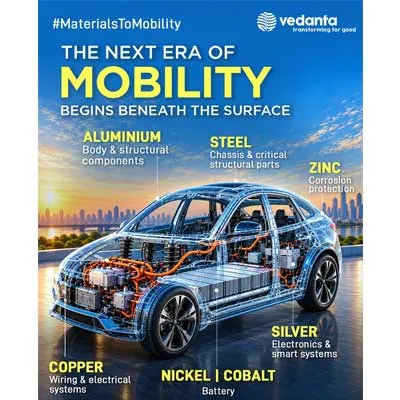
Vedanta Group has invested over Rs 210 billion ($2.5 billion) through FY26 in ongoing projects focused on metal production and capacity expansion across aluminium, zinc, value-added alloys, copper, steel, nickel and ferrochrome. The investments aim to strengthen India’s metals ecosystem and support the growing requirements of electric mobility and the automotive sector.

With India emerging as the world’s third-largest automobile market, demand for materials supporting electric vehicles (EVs), including battery systems, energy storage, electric motors, power electronics, charging infrastructure and lightweight vehicle components, is expected to rise significantly. The company highlighted that India’s requirement for critical minerals and rare earth elements could increase 4x to 10x by 2047, while the country currently imports a significant share of these resources.

Vedanta has expanded its focus on critical minerals by securing 10 critical mineral blocks across resources including copper, nickel-chromium-PGE, tungsten, graphite, vanadium, rare earth elements and potash. Exploration activities are underway across five blocks to strengthen domestic access to materials required for future mobility and advanced manufacturing applications.

The company’s aluminium business continues to support the EV value chain through lightweight and energy-efficient materials. In FY2025-26, Vedanta Aluminium Metal Limited produced a record 2.45 million tonnes of aluminium, with its portfolio including primary foundry alloys, rolled products, billets and slabs for automotive applications. The company has also introduced low-carbon aluminium offerings, Restora and Restora Ultra, to help customers reduce material-related carbon emissions.

Investments at Vedanta Aluminium’s facilities in Chhattisgarh and Odisha are expanding aluminium smelting and value-added capacities for automotive, electrical and advanced applications. The company has also introduced products such as Copper-Doped Alloy and Vedanta Foundry Alloy (VFA) for high-performance applications.

Nickel production remains a key focus area as the metal plays an important role in EV battery manufacturing. Vedanta, as India’s sole primary nickel producer, aims to strengthen domestic availability of this critical battery material.

Through its subsidiary Hindustan Zinc Limited, Vedanta is also supporting electrification requirements with zinc and silver production. Hindustan Zinc produced 851,000 tonnes of refined zinc and 627 tonnes of saleable silver in FY2025-26, while its portfolio includes automotive zinc alloys and low-carbon zinc offering EcoZen.

Copper is another important component of vehicle electrification, with EVs requiring 3–4 times more copper compared to conventional vehicles. Vedanta recorded its highest-ever cathode production of 170,000 tonnes in FY2025-26, supporting applications across motors, cables, conductors and electrical systems.

Commenting on the developments, Arun Misra, CEO, Vedanta Group, said that securing reliable access to metals and critical minerals will be essential for India’s long-term mobility ambitions. He added that Vedanta is expanding capabilities across key metals and critical minerals to support future vehicle, battery and charging infrastructure value chains.

The company is also advancing next-generation battery technologies through partnerships with IIT Madras and JNCASR, focusing on sustainable zinc-based battery solutions for India’s evolving electric mobility and energy storage ecosystem.

Vedanta Group has invested over Rs 210 billion ($2.5 billion) through FY26 in ongoing projects focused on metal production and capacity expansion across aluminium, zinc, value-added alloys, copper, steel, nickel and ferrochrome. The investments aim to strengthen India’s metals ecosystem and support the growing requirements of electric mobility and the automotive sector.With India emerging as the world’s third-largest automobile market, demand for materials supporting electric vehicles (EVs), including battery systems, energy storage, electric motors, power electronics, charging infrastructure and lightweight vehicle components, is expected to rise significantly. The company highlighted that India’s requirement for critical minerals and rare earth elements could increase 4x to 10x by 2047, while the country currently imports a significant share of these resources.Vedanta has expanded its focus on critical minerals by securing 10 critical mineral blocks across resources including copper, nickel-chromium-PGE, tungsten, graphite, vanadium, rare earth elements and potash. Exploration activities are underway across five blocks to strengthen domestic access to materials required for future mobility and advanced manufacturing applications.The company’s aluminium business continues to support the EV value chain through lightweight and energy-efficient materials. In FY2025-26, Vedanta Aluminium Metal Limited produced a record 2.45 million tonnes of aluminium, with its portfolio including primary foundry alloys, rolled products, billets and slabs for automotive applications. The company has also introduced low-carbon aluminium offerings, Restora and Restora Ultra, to help customers reduce material-related carbon emissions.Investments at Vedanta Aluminium’s facilities in Chhattisgarh and Odisha are expanding aluminium smelting and value-added capacities for automotive, electrical and advanced applications. The company has also introduced products such as Copper-Doped Alloy and Vedanta Foundry Alloy (VFA) for high-performance applications.Nickel production remains a key focus area as the metal plays an important role in EV battery manufacturing. Vedanta, as India’s sole primary nickel producer, aims to strengthen domestic availability of this critical battery material.Through its subsidiary Hindustan Zinc Limited, Vedanta is also supporting electrification requirements with zinc and silver production. Hindustan Zinc produced 851,000 tonnes of refined zinc and 627 tonnes of saleable silver in FY2025-26, while its portfolio includes automotive zinc alloys and low-carbon zinc offering EcoZen.Copper is another important component of vehicle electrification, with EVs requiring 3–4 times more copper compared to conventional vehicles. Vedanta recorded its highest-ever cathode production of 170,000 tonnes in FY2025-26, supporting applications across motors, cables, conductors and electrical systems.Commenting on the developments, Arun Misra, CEO, Vedanta Group, said that securing reliable access to metals and critical minerals will be essential for India’s long-term mobility ambitions. He added that Vedanta is expanding capabilities across key metals and critical minerals to support future vehicle, battery and charging infrastructure value chains.The company is also advancing next-generation battery technologies through partnerships with IIT Madras and JNCASR, focusing on sustainable zinc-based battery solutions for India’s evolving electric mobility and energy storage ecosystem.

Related Stories

Gold Stories

Next Story
Infrastructure Energy

Alternative Fuels Overtake Petrol As August Retail Peaks

The Indian automobile industry recorded its best-ever August retail as alternative fuels such as compressed natural gas, hybrid and electric vehicles combined overtook petrol in the passenger vehicle segment for the first time. The shift coincided with oil price rises linked to the war in the Middle East and a cooled public response to higher ethanol content in petrol. Dealers attributed stronger demand to lower running costs and concerns over the E20 petrol transition. Data released by the Federation of Automobile Dealers Associations (FADA) showed total vehicle retail registrations in August..

Next Story
Infrastructure Urban

Singapore Minister Defends SIA Investment In Air India

Singapore government defended Singapore Airlines' investment in Air India after two weeks of public scrutiny over a funding request, saying the flag carrier must expand overseas and that outcomes are for the company and its shareholders to judge. The remarks in parliament followed reports that Air India had sought about US$1.5 billion (US$1.5 bn) of fresh equity from owners Tata Sons and Singapore Airlines. The issue drew attention because Singapore Airlines is majority-owned by Temasek and raised questions about Temasek's role. Officials framed the matter as a commercial decision rather than ..

Next Story
Infrastructure Transport

IndiGo To Begin Guwahati Bangkok Flights

IndiGo will launch non-stop flights between Guwahati and Bangkok from 27 October 2026, marking the carrier's first international operations from the city. A special inaugural service will operate on 27 October, with regular twice a week flights scheduled from 31 October on Wednesdays and Saturdays, subject to regulatory approvals. The new link will provide direct connectivity between Northeast India and Thailand and expand the airline's India–Thailand network. The inaugural Bangkok to Guwahati sector, flight 6E1086, is scheduled to depart Bangkok at 8:50 am and arrive in Guwahati at 10:25 am..

Advertisement

Subscribe to Our Newsletter

Get daily newsletters around different themes from Construction world.

STAY CONNECTED

Advertisement

SPECIAL OFFER
QR Code