


EICI, FIEO Discuss Customs Reforms and Trade Growth
Company News

EICI, FIEO Discuss Customs Reforms and Trade Growth

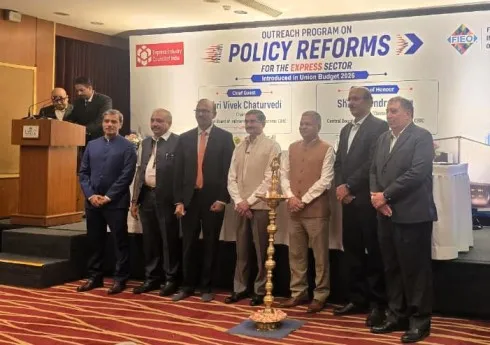
The Express Industry Council of India (EICI), in collaboration with the Federation of Indian Export Organisations (FIEO), convened an industry outreach programme in New Delhi to discuss the implementation of customs reforms announced in Union Budget 2026 and their implications for India's cross-border trade ecosystem.

The event brought together senior officials from the Central Board of Indirect Taxes and Customs (CBIC), Directorate General of Foreign Trade (DGFT), Department for Promotion of Industry and Internal Trade (DPIIT), policymakers and industry stakeholders to evaluate the early impact of the reforms and identify priorities for the next phase of trade facilitation.

Discussions focused on customs modernisation, digital integration, cross-border e-commerce and export competitiveness, particularly for micro, small and medium enterprises (MSMEs). Participants noted that while recent reforms have strengthened the foundation for simplified cross-border trade, future efforts should prioritise technology-enabled customs processes, risk-based inspections, paperless documentation and greater coordination among regulatory agencies.

"The express sector has become a cornerstone of India's trade competitiveness, enabling MSMEs, artisans and e-commerce businesses to seamlessly access global markets," said Vivek Chaturvedi, Chairman, CBIC. He added that measures introduced under the Union Budget 2026-27, including the removal of export value caps, streamlined return mechanisms and enhanced digital processes, are aimed at making cross-border trade faster and more efficient.

Yogendra Garg, Member (Customs), CBIC, highlighted the growing importance of the express courier ecosystem in supporting India's trade ambitions and emphasised the need for a trust-based, technology-driven customs framework.

R S Subramanian, Vice Chairman, EICI, said the reforms and continued collaboration between industry and regulators present an opportunity to create a fully digital and compliance-driven trade ecosystem that reduces transaction costs and improves ease of doing business.

Industry representatives also called for enhanced automation, unified digital platforms, intelligent risk management systems and continued institutional dialogue to further strengthen trade facilitation. The programme concluded with a reaffirmation of the shared commitment between customs authorities and industry stakeholders to support export-led growth, innovation and India's vision of becoming a leading global trading hub.

"Join industry leaders at RAHSTA Expo, India's premier platform for roads, highways and traffic infrastructure. Register now to explore innovations, network with experts and shape the future of mobility."

The Express Industry Council of India (EICI), in collaboration with the Federation of Indian Export Organisations (FIEO), convened an industry outreach programme in New Delhi to discuss the implementation of customs reforms announced in Union Budget 2026 and their implications for India's cross-border trade ecosystem.The event brought together senior officials from the Central Board of Indirect Taxes and Customs (CBIC), Directorate General of Foreign Trade (DGFT), Department for Promotion of Industry and Internal Trade (DPIIT), policymakers and industry stakeholders to evaluate the early impact of the reforms and identify priorities for the next phase of trade facilitation.Discussions focused on customs modernisation, digital integration, cross-border e-commerce and export competitiveness, particularly for micro, small and medium enterprises (MSMEs). Participants noted that while recent reforms have strengthened the foundation for simplified cross-border trade, future efforts should prioritise technology-enabled customs processes, risk-based inspections, paperless documentation and greater coordination among regulatory agencies.The express sector has become a cornerstone of India's trade competitiveness, enabling MSMEs, artisans and e-commerce businesses to seamlessly access global markets, said Vivek Chaturvedi, Chairman, CBIC. He added that measures introduced under the Union Budget 2026-27, including the removal of export value caps, streamlined return mechanisms and enhanced digital processes, are aimed at making cross-border trade faster and more efficient.Yogendra Garg, Member (Customs), CBIC, highlighted the growing importance of the express courier ecosystem in supporting India's trade ambitions and emphasised the need for a trust-based, technology-driven customs framework.R S Subramanian, Vice Chairman, EICI, said the reforms and continued collaboration between industry and regulators present an opportunity to create a fully digital and compliance-driven trade ecosystem that reduces transaction costs and improves ease of doing business.Industry representatives also called for enhanced automation, unified digital platforms, intelligent risk management systems and continued institutional dialogue to further strengthen trade facilitation. The programme concluded with a reaffirmation of the shared commitment between customs authorities and industry stakeholders to support export-led growth, innovation and India's vision of becoming a leading global trading hub.

Next Story
Infrastructure Transport

Uttar Pradesh unveils infrastructure-led growth roadmap at RAHSTA

Mumbai, 9 July 2026: Uttar Pradesh’s ambitious infrastructure-led growth strategy took centre stage on Day 2 of the 16th RAHSTA Expo, where senior government officials outlined how expressways, industrial corridors and technology-driven governance are transforming the state into one of India's most attractive investment destinations.Delivering the keynote address, Srihari Pratap Shahi, IAS, Additional Chief Executive Officer, Uttar Pradesh Expressways Industrial Development Authority (UPEIDA), highlighted the state's long-term vision of integrating world-class expressways with industrial dev..

Next Story
Real Estate

NCW closes PRIME Offices Fund at Rs 40 billion

Nuvama and Cushman & Wakefield Management (NCW) has announced the final close of its flagship PRIME Offices Fund at approximately Rs 40 billion, exceeding its original target of Rs 30 billion following strong investor demand.The fund was launched to provide Indian investors with access to institutional-grade commercial office assets across key office markets in the country. According to NCW, the increase in the fund size was supported by strong investor participation and the availability of investment opportunities in India's office sector.The fund has already committed around 45 per cent ..

Next Story
Real Estate

Mayfair Housing adopts Autodesk Forma for digital project planning

Mayfair Housing has entered into a three-year strategic partnership with Autodesk to deploy Autodesk Forma, an AI-enabled cloud platform, as part of its digital transformation programme aimed at improving project planning and execution across its development and redevelopment portfolio.The platform will be integrated into the company's Building Information Modelling (BIM) workflow to support architects, planners and project teams during the early stages of design and development. Autodesk Forma combines real-world data, environmental simulations and collaborative workflows to facilitate data-d..

Advertisement

Subscribe to Our Newsletter

Get daily newsletters around different themes from Construction world.

STAY CONNECTED

Advertisement

Advertisement

Advertisement