+
SECI Tender Shows Solar Storage Can Mimic Coal
POWER & RENEWABLE ENERGY

SECI Tender Shows Solar Storage Can Mimic Coal

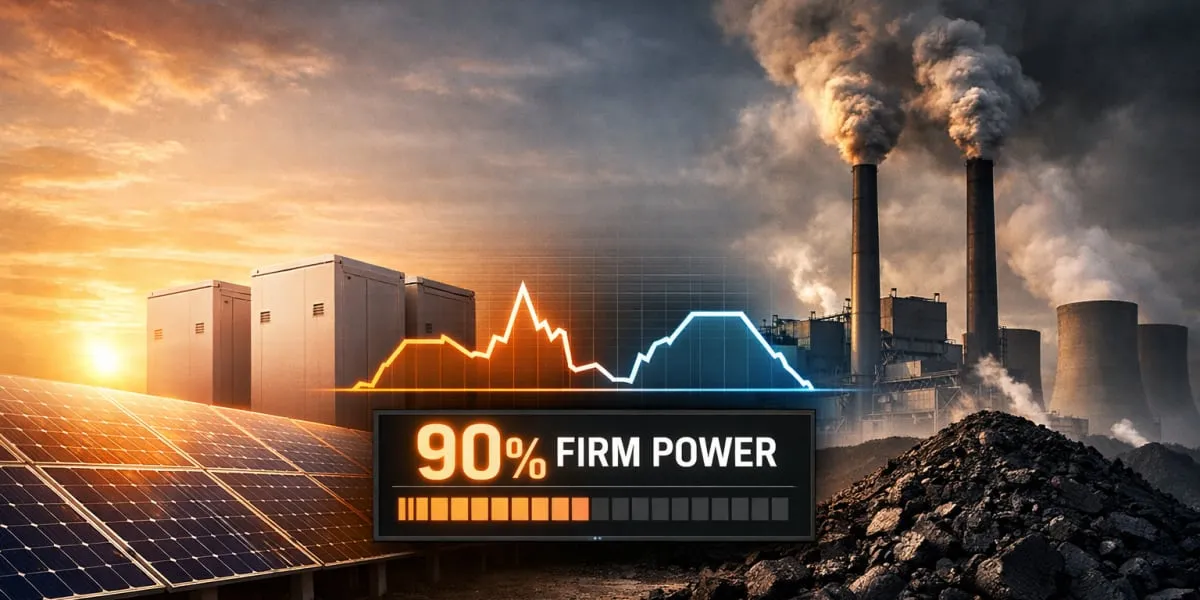
SECI's FDRE-RTC-V tender for 1,000 MW seeks firm power at 90 per cent of capacity during six evening-to-morning peak hours and discovered a tariff of Rs5.25 per kWh. Delivery will be assessed in 15-minute blocks and the study said shortfalls will attract a penalty equivalent to 1.5 times the applicable tariff. The profile restricts midday deliveries to reflect solar abundance.

The analysis compared the tariff with coal power purchase agreements signed in 2025 that started at Rs5.38-Rs6.30 per kWh, with a midpoint of Rs5.84 per kWh. Applying CERC fuel escalation of 2.61 per cent annually lifts the midpoint towards Rs6.4 per kWh by 2036 and to about Rs7.4 per kWh by 2050. Adjusting Rs5.25 for four per cent inflation over 25 years yields Rs3.79 in today’s rupees.

Using Rs95 to the dollar, Rs5.25 per kWh equates to about 55 dollars per megawatt-hour (MWh). With an assumed three per cent annual rupee depreciation the dollar price could fall to about 41 dollars per MWh by 2036 and to around 27 dollars per MWh by the contract end.

The study said the tender seeks to align supply with India’s net load and to mimic the shape that coal plants provide. Net load approaches a 211 gigawatt (GW) peak at six PM and falls to about 69 per cent of that level at midday. Batteries, rather than panels, determine design because the profile requires 11 gigawatt-hour (GWh) across 14 non-solar hours and about 12 GWh of usable storage after losses.

IECC modelling indicated that a configuration of three gigawatt alternating current (GW-AC) of solar and 12 GWh of battery per one GW of firm capacity can meet the profile at about Rs5.15 per kWh, below the discovered Rs5.25, with penalties around 0.5 per cent of revenue. The tender could enable open access procurement of firm clean power for energy intensive industries.

SECI's FDRE-RTC-V tender for 1,000 MW seeks firm power at 90 per cent of capacity during six evening-to-morning peak hours and discovered a tariff of Rs5.25 per kWh. Delivery will be assessed in 15-minute blocks and the study said shortfalls will attract a penalty equivalent to 1.5 times the applicable tariff. The profile restricts midday deliveries to reflect solar abundance. The analysis compared the tariff with coal power purchase agreements signed in 2025 that started at Rs5.38-Rs6.30 per kWh, with a midpoint of Rs5.84 per kWh. Applying CERC fuel escalation of 2.61 per cent annually lifts the midpoint towards Rs6.4 per kWh by 2036 and to about Rs7.4 per kWh by 2050. Adjusting Rs5.25 for four per cent inflation over 25 years yields Rs3.79 in today’s rupees. Using Rs95 to the dollar, Rs5.25 per kWh equates to about 55 dollars per megawatt-hour (MWh). With an assumed three per cent annual rupee depreciation the dollar price could fall to about 41 dollars per MWh by 2036 and to around 27 dollars per MWh by the contract end. The study said the tender seeks to align supply with India’s net load and to mimic the shape that coal plants provide. Net load approaches a 211 gigawatt (GW) peak at six PM and falls to about 69 per cent of that level at midday. Batteries, rather than panels, determine design because the profile requires 11 gigawatt-hour (GWh) across 14 non-solar hours and about 12 GWh of usable storage after losses. IECC modelling indicated that a configuration of three gigawatt alternating current (GW-AC) of solar and 12 GWh of battery per one GW of firm capacity can meet the profile at about Rs5.15 per kWh, below the discovered Rs5.25, with penalties around 0.5 per cent of revenue. The tender could enable open access procurement of firm clean power for energy intensive industries.

Related Stories

Gold Stories

Next Story
Infrastructure Transport

MMRDA Targets Completion of Projects by December 2028

The Mumbai Metropolitan Region Development Authority (MMRDA) is targeting the completion of all its ongoing infrastructure projects by December 2028, a year ahead of its December 2029 deadline, Metropolitan Commissioner Dr Sanjay Mukherjee has said.Speaking at the sixth edition of the Real Estate & Infrastructure Investors' Summit (REIIS) 2026 in Mumbai, Mukherjee said the authority was developing an integrated network of roads, tunnels, sea links and Metro corridors under its broader vision of “Mumbai in 59 Minutes”.The objective is to improve east-west and north-south connectivity an..

Next Story
Building Material

High-Performance Façades Gain Ground in Indian Buildings

High-performance façades are gaining greater importance in Indian architecture as developers and architects increasingly focus on energy efficiency, thermal comfort and building performance, according to Shankar Fenestrations & Glasses.The company said modern façade systems are increasingly being considered as part of a building's overall performance strategy rather than being used primarily as aesthetic elements.High-performance glass, curtain wall systems and structural glazing can contribute to thermal regulation, solar control, daylight management and indoor comfort. Their growing ad..

Next Story
Technology

SPML Infra's 104.4 kWh BESS Battery Pack Clears Global Tests

SPML Infra has announced that its proprietary 104.4 kWh Battery Energy Storage System (BESS) battery pack has completed key international safety, performance and transportation testing and certification requirements, marking a step towards its commercial deployment.Developed under the company's own intellectual property, the battery pack has completed requirements under UL9540A, IEC 62619, IEC 63056, IEC 60730, IEC 61000-6-2, IEC 61000-6-4 and UN38.3 standards.The testing covers areas including thermal runaway safety, battery performance, system functional safety, electromagnetic compatibility..

Advertisement

Subscribe to Our Newsletter

Get daily newsletters around different themes from Construction world.

STAY CONNECTED

Advertisement

SPECIAL OFFER
QR Code