ICSI Advocates Principle-Based Stewardship to Tackle Climate Change
Company News

ICSI Advocates Principle-Based Stewardship to Tackle Climate Change

With COP30 concluding in Brazil, the Institute of Company Secretaries of India (ICSI) has pressed the need for a principle-based corporate response to climate change and highlighted the strategic importance of embedding Environmental, Social and Governance (ESG) principles into business frameworks for long-term competitiveness.
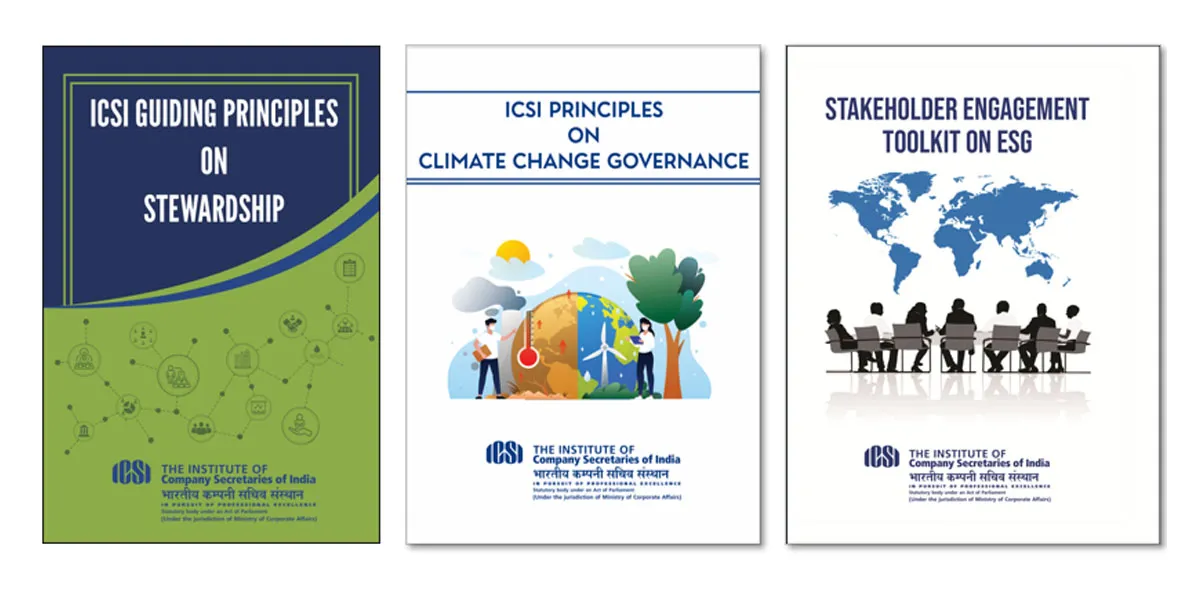
As a statutory body advancing corporate governance best practices, ICSI has positioned stewardship as responsible management of assets and relationships for sustained value creation, introducing the ICSI Guiding Principles on Stewardship (IGPS). The International Financial Services Centres Authority (IFSCA) has recognised the IGPS for adoption by Fund Management Entities and Institutional Investors in IFSCs, safeguarding the interests of clients, beneficiaries and society.
Emphasising stewardship beyond compliance, the IGPS aims to harness the role of Institutional Investors and Fund Managers in encouraging companies to shift from short-term gains to long-term outcomes by insisting on robust ESG frameworks that prioritise sustainable growth.
To support practical adoption, ICSI has launched a Stakeholder Engagement Toolkit on ESG to supplement the IGPS and assist Company Secretaries and Boards in formulating comprehensive ESG policies. The Institute has also introduced the ICSI Principles on Climate Change Governance (IPCG), providing guidance on climate-related disclosures, metrics and target-setting to monitor sustainability performance.
Highlighting the Institute’s proactive role, CS Dhananjay Shukla, President, the ICSI, said, “Integrating climate consideration into business frameworks require a cohesive methodology of well-crafted principles, detailed guidance on climate and sustainability matters and equipped professionals who can coherently translate it into reality. As a leading force in promoting best practices, the ICSI is offering it all, through its various initiatives.”
CS Asish Mohan, Secretary, the ICSI, added, “In a world where climate change is requiring corporations and nations, investors and investees, to act strategically, the Institute of Company Secretaries of India aims to utilise the significant pedestals occupied by these investors and stewards and promote principles-based governance to support sustainable development.”

With COP30 concluding in Brazil, the Institute of Company Secretaries of India (ICSI) has pressed the need for a principle-based corporate response to climate change and highlighted the strategic importance of embedding Environmental, Social and Governance (ESG) principles into business frameworks for long-term competitiveness.As a statutory body advancing corporate governance best practices, ICSI has positioned stewardship as responsible management of assets and relationships for sustained value creation, introducing the ICSI Guiding Principles on Stewardship (IGPS). The International Financial Services Centres Authority (IFSCA) has recognised the IGPS for adoption by Fund Management Entities and Institutional Investors in IFSCs, safeguarding the interests of clients, beneficiaries and society.Emphasising stewardship beyond compliance, the IGPS aims to harness the role of Institutional Investors and Fund Managers in encouraging companies to shift from short-term gains to long-term outcomes by insisting on robust ESG frameworks that prioritise sustainable growth.To support practical adoption, ICSI has launched a Stakeholder Engagement Toolkit on ESG to supplement the IGPS and assist Company Secretaries and Boards in formulating comprehensive ESG policies. The Institute has also introduced the ICSI Principles on Climate Change Governance (IPCG), providing guidance on climate-related disclosures, metrics and target-setting to monitor sustainability performance.Highlighting the Institute’s proactive role, CS Dhananjay Shukla, President, the ICSI, said, “Integrating climate consideration into business frameworks require a cohesive methodology of well-crafted principles, detailed guidance on climate and sustainability matters and equipped professionals who can coherently translate it into reality. As a leading force in promoting best practices, the ICSI is offering it all, through its various initiatives.”CS Asish Mohan, Secretary, the ICSI, added, “In a world where climate change is requiring corporations and nations, investors and investees, to act strategically, the Institute of Company Secretaries of India aims to utilise the significant pedestals occupied by these investors and stewards and promote principles-based governance to support sustainable development.”

Next Story
Real Estate

Smartworks Signs ~1.68 Lakh Sq Ft Flex Lease with IT Major in Kolkata

Smartworks Coworking Spaces, India’s largest managed office platform by total area under management, has leased approximately 1.68 lakh sq ft in Kolkata to a leading global information technology, consulting and business process services company. The office space is spread across Smartworks’ Victoria Park and Mediasiti campuses in Salt Lake City, Sector V, marking the largest flex-office deal signed in the region. JLL India served as the advisory partner for the transaction.“Enterprise adoption of managed campuses has entered a decisive phase. Large organisations are scaling faster and l..

Next Story
Infrastructure Energy

Samko, SRAM & MRAM Team Up for Smart-city Venture with Gigafactories

Samko Renewable Energy, a subsidiary of Samko Holdings UK, and SRAM & MRAM Projects of the SRAM & MRAM Group have formed a joint venture, Samko SRAM & MRAM BESS, to spearhead the Nikola Tesla Smart City Project. The initiative aims to develop integrated manufacturing townships that will feature Gigafactories, commercial towers, retail complexes, leisure zones, and resort-style infrastructure. The first cluster is planned for Tamil Nadu, with a parallel rollout in the United Kingdom.Positioned as a multi-billion-dollar global programme, the project envisions Gigafactory-scale develo..

Next Story
Infrastructure Transport

NFR Deploys Underwater Robots to Inspect 34 Bridges

The Northeast Frontier Railway (NFR) has carried out extensive inspections of major railway bridges using underwater robotic vehicles, including the iconic Saraighat Bridge over the Brahmaputra in Guwahati. The initiative uses advanced Remotely Operated Robotic Vehicle (RORV) technology to assess submerged structures that require year-round monitoring.The Saraighat Bridge — India’s first rail-cum-road bridge linking Pandu and Amingaon — underwent a comprehensive evaluation using a combination of RORV surveys, LiDAR, thermal imaging, Ground Penetrating Radar (GPR) and Ultrasonic Pulse Vel..

Advertisement

Subscribe to Our Newsletter

Get daily newsletters around different themes from Construction world.

STAY CONNECTED

Advertisement

Advertisement

Advertisement

Advertisement

Get CW App