+
AAI Submits Hydrology Report to WRD for Chennai Airport Corridor
AVIATION & AIRPORTS

AAI Submits Hydrology Report to WRD for Chennai Airport Corridor

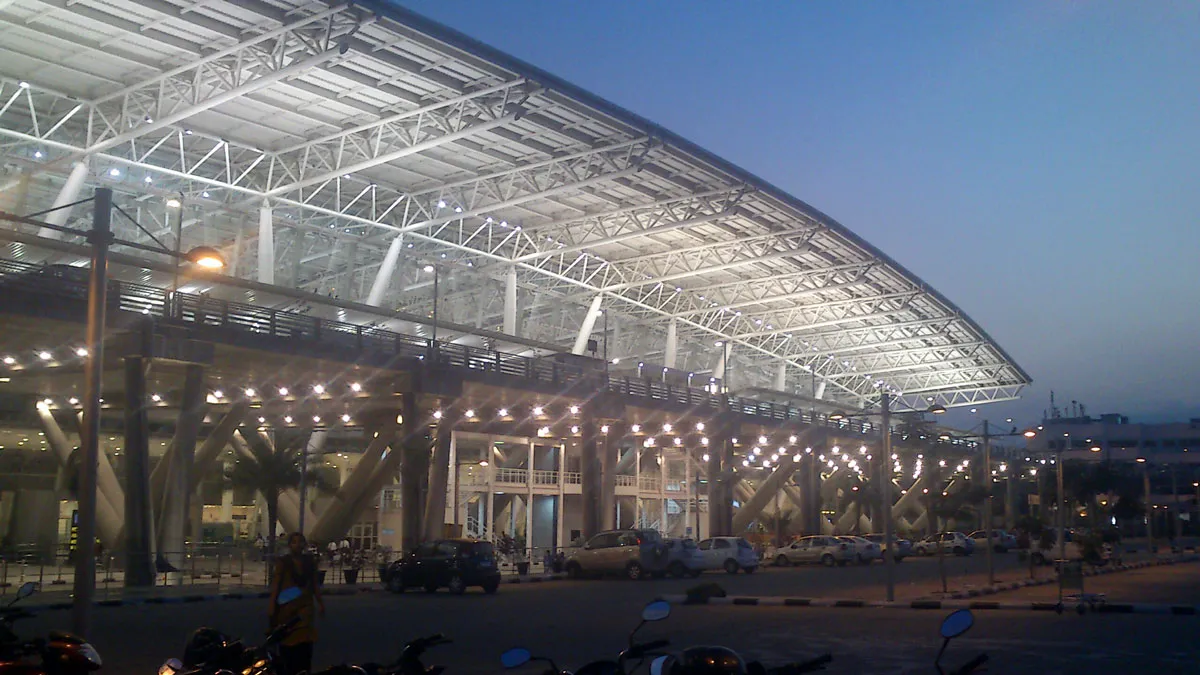
In a move to accelerate the implementation of an elevated corridor and the long-pending satellite terminal at Chennai Airport, the Airports Authority of India (AAI) has submitted a detailed study report to the Water Resources Department (WRD) of the Tamil Nadu government.

The satellite terminal, first proposed nearly eight years ago, is aimed at easing congestion by handling additional aircraft and passenger traffic while optimally utilising remote bays at the airport. Although the project remained stalled for several years, it gained renewed momentum in 2024 after AAI revived the proposal.

According to officials, the Tamil Nadu government had earlier informed AAI that additional land could not be provided to establish surface connectivity to the proposed terminal. In response, AAI submitted a revised proposal early last year, suggesting the construction of an elevated corridor from National Highway 32 to provide direct access to the satellite terminal without acquiring extra land.

As per the new plan, the four-lane elevated corridor would originate near Madha Arts and Science College at Thandalam, cross the Adyar River, and terminate at the satellite terminal entry point within the airport premises. Since the alignment involves placing pillars within the river, the State government sought a detailed assessment of its potential impact on water flow.

An AAI official said the WRD had asked for a hydrological impact study to examine whether the proposed pillars could obstruct the Adyar river’s flow during different conditions, including dry periods, monsoon rains and floods. “We requested the Centre for Water Resources, Anna University, to carry out the study. The report has now been submitted to the WRD,” the official said.

AAI officials said approvals are also required from the Central Pollution Control Board before work can proceed. Once the necessary clearances are obtained, AAI will allocate funds for the construction of the satellite terminal and the elevated corridor.

“The satellite terminal could function either as a full-fledged passenger terminal or as a dedicated cargo terminal. With the proposed Parandur airport likely to take another four to five years, this facility will provide significant relief to the city’s growing aviation demand,” an official added.

News source: The Hindu

In a move to accelerate the implementation of an elevated corridor and the long-pending satellite terminal at Chennai Airport, the Airports Authority of India (AAI) has submitted a detailed study report to the Water Resources Department (WRD) of the Tamil Nadu government.The satellite terminal, first proposed nearly eight years ago, is aimed at easing congestion by handling additional aircraft and passenger traffic while optimally utilising remote bays at the airport. Although the project remained stalled for several years, it gained renewed momentum in 2024 after AAI revived the proposal.According to officials, the Tamil Nadu government had earlier informed AAI that additional land could not be provided to establish surface connectivity to the proposed terminal. In response, AAI submitted a revised proposal early last year, suggesting the construction of an elevated corridor from National Highway 32 to provide direct access to the satellite terminal without acquiring extra land.As per the new plan, the four-lane elevated corridor would originate near Madha Arts and Science College at Thandalam, cross the Adyar River, and terminate at the satellite terminal entry point within the airport premises. Since the alignment involves placing pillars within the river, the State government sought a detailed assessment of its potential impact on water flow.An AAI official said the WRD had asked for a hydrological impact study to examine whether the proposed pillars could obstruct the Adyar river’s flow during different conditions, including dry periods, monsoon rains and floods. “We requested the Centre for Water Resources, Anna University, to carry out the study. The report has now been submitted to the WRD,” the official said.AAI officials said approvals are also required from the Central Pollution Control Board before work can proceed. Once the necessary clearances are obtained, AAI will allocate funds for the construction of the satellite terminal and the elevated corridor.“The satellite terminal could function either as a full-fledged passenger terminal or as a dedicated cargo terminal. With the proposed Parandur airport likely to take another four to five years, this facility will provide significant relief to the city’s growing aviation demand,” an official added.News source: The Hindu

Next Story
Building Material

NITI Aayog Unveils Cement Decarbonisation Roadmap

NITI Aayog has released a sector-specific decarbonisation roadmap for cement as part of three green transition reports covering cement, aluminium and MSMEs. The report projects cement production rising to around 2,100 million tonnes by 2070 from 391 million tonnes in 2023, while targeting a reduction in carbon intensity to 0.09–0.13 tCO₂e per tonne. It recommends clinker substitution, refuse-derived fuels, CCUS adoption and carbon trading mechanisms to enable deep decarbonisation. ..

Next Story
Technology

Genesys Launches Advanced GeoRadar System

Genesys International Corporation has launched an advanced Ground Penetrating Radar (GPR) solution from IDS GeoRadar for underground utility mapping in India. The system uses patented Equalised Scrambling Technology (EST) and Wide/Multi-Array Antenna Technology to deliver high-resolution three-dimensional imaging of subsurface infrastructure. The technology enables the detection and mapping of buried assets such as water pipelines, sewer networks, telecom cables and power lines. By providing detailed subsurface insights, the system aims to help urban authorities and infrastructure developers ..

Next Story
Infrastructure Urban

Hindustan Zinc Partners Virginia Tech to Boost Silver Recovery

Hindustan Zinc Limited recently signed a Memorandum of Understanding (MoU) with Virginia Tech to advance research aimed at improving silver recovery across its lead–zinc (Pb–Zn) concentrators. The collaboration will focus on refining flotation techniques and optimising reagent usage to improve concentrate quality and operational efficiency at processing plants.Virginia Tech, based in Blacksburg, Virginia, is globally recognised for its expertise in mining engineering, mineral processing and applied metallurgical research. Through this partnership, Hindustan Zinc will leverage global resear..

Advertisement

Subscribe to Our Newsletter

Get daily newsletters around different themes from Construction world.

STAY CONNECTED

Advertisement

Advertisement

Advertisement

Open In App