Nanded Helicopter Plant to Receive Rs 42.5 Billion Investment
AVIATION & AIRPORTS

Nanded Helicopter Plant to Receive Rs 42.5 Billion Investment

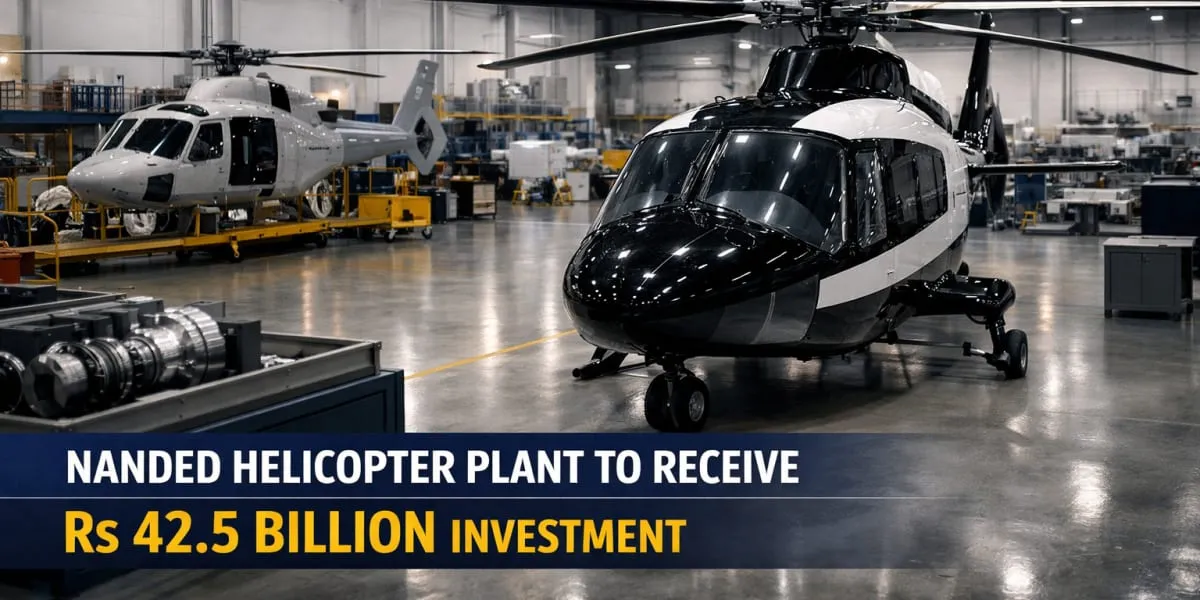
A new investment of Rs 42.5 billion (Rs 42.5 bn) has been announced for a helicopter manufacturing plant in Nanded. The funding is slated to support construction, tooling and initial production phases at the site. The announcement described the project as a major step for domestic rotorcraft capability. The backers indicated that the facility will aim to meet both civil and defence requirements.

The project is expected to strengthen the regional manufacturing base and to deepen local supply chains for aerospace components. Local firms and ancillary suppliers may gain new contracts as the plant progresses towards operational readiness. Industry analysts noted that such investments typically accelerate supplier development and quality control in adjacent sectors. Training and workforce development were identified as priorities to support specialised assembly and maintenance activities.

Details on the project timeline and financing structure remain subject to regulatory clearances and final approvals. The developers plan phased implementation to manage technical integration and capacity ramp up over time. Collaboration with state authorities and industry partners is likely to be necessary to align infrastructure and logistical requirements. Procurement strategies may favour domestic content where feasible.

Regional economic benefits are anticipated through increased industrial activity and services demand during construction and operation. The investment could attract further capital into the aerospace and engineering supply chain in the broader region. Observers said that successful execution would enhance the country's ability to support rotorcraft needs locally and reduce dependence on imports. Close monitoring of project milestones will be essential to assess the realisation of promised benefits.

Stakeholders emphasised the need for transparent reporting on milestones, budget allocation and environmental management. Independent audits and community engagement are likely to shape public confidence as the project advances. Continued dialogue between developers, suppliers and local authorities will be important to unlock long term benefits.

A new investment of Rs 42.5 billion (Rs 42.5 bn) has been announced for a helicopter manufacturing plant in Nanded. The funding is slated to support construction, tooling and initial production phases at the site. The announcement described the project as a major step for domestic rotorcraft capability. The backers indicated that the facility will aim to meet both civil and defence requirements. The project is expected to strengthen the regional manufacturing base and to deepen local supply chains for aerospace components. Local firms and ancillary suppliers may gain new contracts as the plant progresses towards operational readiness. Industry analysts noted that such investments typically accelerate supplier development and quality control in adjacent sectors. Training and workforce development were identified as priorities to support specialised assembly and maintenance activities. Details on the project timeline and financing structure remain subject to regulatory clearances and final approvals. The developers plan phased implementation to manage technical integration and capacity ramp up over time. Collaboration with state authorities and industry partners is likely to be necessary to align infrastructure and logistical requirements. Procurement strategies may favour domestic content where feasible. Regional economic benefits are anticipated through increased industrial activity and services demand during construction and operation. The investment could attract further capital into the aerospace and engineering supply chain in the broader region. Observers said that successful execution would enhance the country's ability to support rotorcraft needs locally and reduce dependence on imports. Close monitoring of project milestones will be essential to assess the realisation of promised benefits. Stakeholders emphasised the need for transparent reporting on milestones, budget allocation and environmental management. Independent audits and community engagement are likely to shape public confidence as the project advances. Continued dialogue between developers, suppliers and local authorities will be important to unlock long term benefits.

Next Story
Infrastructure Urban

MIDC and Ramky Unit Sign Concession for Life Sciences Park

Maharashtra Industrial Development Corporation has signed a concession agreement with Maha Integrated Life Sciences City Limited (MILeS City), a wholly owned subsidiary of Ramky Infrastructure Limited (RIL), to develop a high-tech pharmaceutical park at Dighi Port Industrial Area in Raigad. The project will follow a public-private partnership under a DBFOT model and has an estimated cost of Rs 30 billion (Rs 30 bn). The concession will run for 95 years, including a five-year construction phase, with MILeS City responsible for development and management. The development will occupy approximatel..

Next Story
Real Estate

BuzzWorks Leases Hyderabad Office to MyComplianceOffice

Brigade Group’s managed workspace provider BuzzWorks has leased 550 seats at Mindspace Business Park in Hyderabad to Dublin based MyComplianceOffice, in what is the company’s largest office in India. With this signing, BuzzWorks' total leased office space in Hyderabad stands at zero point one one million (mn) square feet. The new premises will house core functions including product engineering, product management, customer success and global operations. Artificial intelligence enabled compliance technology initiatives will also be part of the local delivery model. BuzzWorks will provide wo..

Next Story
Infrastructure Transport

Jindal Stainless Flags Operational Strain From Middle East Crisis

Jindal Stainless warned that the Middle East war crisis has affected its operations because of dependence on industrial gases such as propane and LPG and on natural gas. The scrap-based production route used by the stainless steel maker does not generate blast furnace or coke oven gases internally, unlike the conventional steel industry. Several plant processes have been adversely impacted and production is being run at rationalised capacity. Disruptions in global shipping routes have resulted in vessel diversions, longer transit times and cargo delays, adding pressure to supply chains and to ..

Advertisement

Subscribe to Our Newsletter

Get daily newsletters around different themes from Construction world.

STAY CONNECTED

Advertisement

Advertisement

Advertisement