

+
Assam Plans Four-Lane Digaru-Narengi Road
ROADS & HIGHWAYS

Assam Plans Four-Lane Digaru-Narengi Road

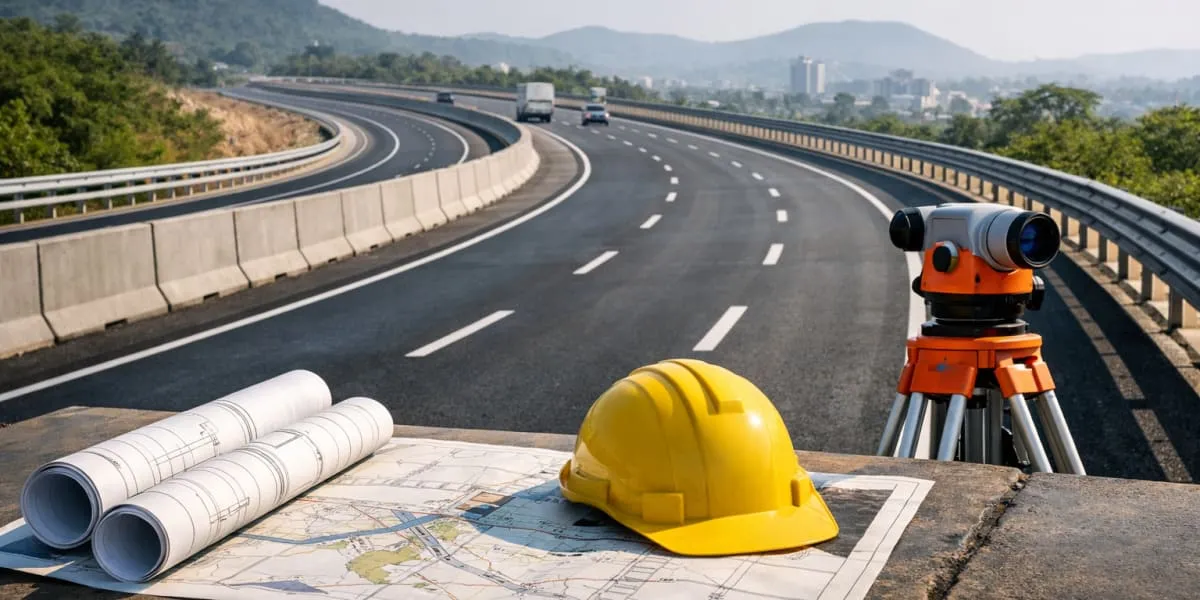
Assam government has announced plans to build a four-lane Digaru-Narengi road intended to relieve pressure on the Jorabat Corridor. The road is envisaged as an alternative arterial link for commuter and freight movements around greater Guwahati. State authorities describe the move as part of a broader strategy to improve regional connectivity and reduce congestion on existing routes. Planning authorities have signalled that corridor studies and route alignment assessments will form the initial phase.

The project is presented to redistribute traffic flow and to provide relief during peak hours by offering a parallel corridor. Urban planning documents indicate potential improvements in travel reliability and reductions in vehicle operating costs for road users. The scheme is positioned to support balanced urban growth and to ease pressure on inner city road networks that currently experience heavy mixed traffic. Local administration will coordinate with transport agencies on traffic management integration.

Environmental and social considerations will be integral to project development, with assessments of ecological sensitivity and community impact forming part of the work. Authorities will carry out environmental impact appraisals and stakeholder consultations to inform design decisions and mitigation measures. Alignment choices will aim to minimise displacement and to preserve critical habitats where present, while engineering solutions will seek to balance safety, durability and maintenance needs. Financial modelling and land acquisition strategies will be addressed during detailed planning.

Next steps will include preparation of a detailed project report and technical studies to finalise alignment, design standards and cost estimates. Funding discussions will involve state agencies and potential partnership models without prejudice to eventual funding sources. Timelines will be established following statutory clearances and approvals, and implementation will be phased to limit disruption to existing traffic. The government has indicated that the proposal intends to strengthen regional connectivity and to support economic resilience.

Assam government has announced plans to build a four-lane Digaru-Narengi road intended to relieve pressure on the Jorabat Corridor. The road is envisaged as an alternative arterial link for commuter and freight movements around greater Guwahati. State authorities describe the move as part of a broader strategy to improve regional connectivity and reduce congestion on existing routes. Planning authorities have signalled that corridor studies and route alignment assessments will form the initial phase. The project is presented to redistribute traffic flow and to provide relief during peak hours by offering a parallel corridor. Urban planning documents indicate potential improvements in travel reliability and reductions in vehicle operating costs for road users. The scheme is positioned to support balanced urban growth and to ease pressure on inner city road networks that currently experience heavy mixed traffic. Local administration will coordinate with transport agencies on traffic management integration. Environmental and social considerations will be integral to project development, with assessments of ecological sensitivity and community impact forming part of the work. Authorities will carry out environmental impact appraisals and stakeholder consultations to inform design decisions and mitigation measures. Alignment choices will aim to minimise displacement and to preserve critical habitats where present, while engineering solutions will seek to balance safety, durability and maintenance needs. Financial modelling and land acquisition strategies will be addressed during detailed planning. Next steps will include preparation of a detailed project report and technical studies to finalise alignment, design standards and cost estimates. Funding discussions will involve state agencies and potential partnership models without prejudice to eventual funding sources. Timelines will be established following statutory clearances and approvals, and implementation will be phased to limit disruption to existing traffic. The government has indicated that the proposal intends to strengthen regional connectivity and to support economic resilience.

Related Stories

Gold Stories

Next Story
Infrastructure Urban

KONE Opens India's First Digital Experience Centre in Pune

KONE, a global elevator and escalator manufacturer, has inaugurated its first Digital Experience Centre (DEC) in India, located in Pune. The facility aims to showcase how artificial intelligence (AI), connectivity and data-driven technologies can enhance customer experiences and improve building operations.The centre was inaugurated by Jussi Herlin, Executive Vice Chair, KONE Corporation; Philippe Delorme, President and CEO, KONE; and Nandan Nilekani, Co-founder and Chairman of the Board, Infosys.Designed as an interactive customer environment, the facility demonstrates digital solutions cover..

Next Story
Infrastructure Urban

CII GreenCo Launches Circularity Guidelines for Indian Industry

The Confederation of Indian Industry (CII) GreenCo Council has launched the CII GreenCo Circularity Guidelines – Pilot Version at the 17th CII GreenCo Waste & Resource Management Summit 2026 in Chennai. The initiative aims to strengthen resource efficiency, waste reduction and circular economy practices across Indian manufacturing and process industries.The guidelines introduce a structured framework with circularity indices covering raw materials, consumables, packaging and other resource inputs. These indicators will help industries assess existing practices, identify opportunities to ..

Next Story
Infrastructure Energy

Global Electronics Association Launches IPC-1783-CO2E Standard

The Global Electronics Association has introduced IPC-1783-CO2E, a new international standard aimed at improving consistency, transparency and comparability in product carbon footprint reporting across the electronics manufacturing industry.The standard, titled International Standard for Data Collection and Reporting of CO2 Equivalent (CO2e) Emissions for the Electronics Manufacturing Supply Chain, provides industry-specific guidance for collecting, estimating and reporting carbon emissions data.With increasing regulatory requirements and customer expectations, electronics manufacturers face c..

Advertisement

Subscribe to Our Newsletter

Get daily newsletters around different themes from Construction world.

STAY CONNECTED

Advertisement

SPECIAL OFFER
QR Code