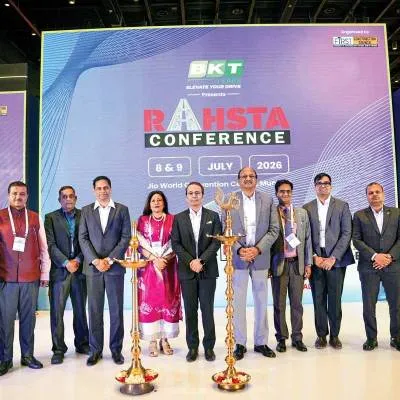
For an industry often described as capital-intensive, India’s roads and highways sector faces an interesting paradox: Capital is available, but not every form of capital is willing to take every kind of risk.The discussion on Financing Roads & Highways in a Capital-Constrained Era, moderated by Suneet K Maheshwari, Managing Partner, Udvik Infra, and Independent Board Director, brought together Pratik Panwala, Vice President, Investments, NIIFL; Vishal Gupta, Senior Vice President - PA&SF, SBI Capital Markets; Sandeep Upadhyay, Managing Director - Infrastructure Advisory, Centrum Capital; and Vishal Biraia, Portfolio Manager, Bandhan Infra Fund, to examine how the financing landscape is evolving.The broad consensus was clear: The challenge is no longer simply raising money. It is about matching the right pool of capital with the right stage of project risk.The price of credibilityFrom a lender's perspective, the quality and track record of the developer remain central to financing decisions. Gupta pointed out that a developer's demonstrated ability to deliver projects on time and within cost can translate into more favourable financing terms.This becomes particularly relevant during the construction phase, when execution risk remains high. Once a project becomes operational, the risk profile changes substantially and financing can be repriced. The panel noted that refinancing after project completion can result in lower borrowing costs, while a change in ownership can sometimes improve financing terms even further. The implication is significant: Financing is not determined by the asset alone. The sponsor behind it, its execution history and its ability to manage risk can materially influence the cost of capital. Capital follows riskFor Panwala of NIIFL, the issue is not a lack of equity capital. Institutional investors, pension funds, family offices and other pools of capital are increasingly active in the sector. The challenge is determining which investor is willing to participate at which stage of the asset lifecycle.Operational assets with established cash flows are easier to place. The more difficult task is attracting capital towards construction risk, last-mile funding and projects with evolving risk profiles. According to Panwala, improvements in the PPP framework and a more balanced allocation of risk are gradually increasing institutional appetite for such opportunities. That distinction could define the next phase of highway financing. Rather than expecting banks, developers, private equity and institutional investors to approach every project in the same way, the sector may increasingly require a layered capital structure aligned with the project's evolving risk.The InvIT effectPerhaps the most important structural change in recent years has been the emergence of infrastructure investment trusts, or InvITs, as an asset-recycling mechanism.Biraia highlighted the transformation in the market over the past decade. For developers, the ability to construct an asset, operationalise it, transfer it to an InvIT and redeploy the released equity into new projects has fundamentally changed the infrastructure financing cycle.This is particularly important in a sector where working capital requirements have historically been significant. Asset recycling can help developers unlock capital tied up in operational projects and return to the market for new opportunities. Upadhyay also pointed to the rapid growth of the InvIT ecosystem, particularly in roads. However, he noted that domestic participation remains relatively limited compared with foreign institutional investors, even as the product offers investors an opportunity to access long-term infrastructure cash flows. The traffic questionIf construction risk can be managed and operational assets recycled, traffic risk remains one of the more difficult variables to price, particularly for greenfield and toll-based projects.FASTag has significantly improved the availability and transparency of traffic data for operational roads. Yet historical data alone cannot address the risk posed by alternate routes, new road networks or changes in the wider transportation ecosystem.The panel argued that traditional traffic modelling may also need to account more seriously for competing modes of transport, including rail and waterways. A road's future traffic cannot be assessed in isolation when freight and passenger movement are increasingly influenced by a wider multimodal network. For greenfield projects, the challenge is even greater. Incorrect traffic projections at the beginning of operations can quickly undermine project economics. The panel discussed the potential for combining brownfield and greenfield assets in a portfolio, allowing existing traffic and cash-flow visibility to offset some of the uncertainty associated with entirely new alignments. Beyond financial engineeringThe discussion ultimately moved beyond the availability of debt and equity. Better corporate governance, project quality and lifecycle costing were identified as equally important to attracting long-term capital.Biraia argued that stronger governance could deliver tangible benefits, including a lower cost of borrowing and equity. Upadhyay emphasised that investors looking at assets over a long horizon would increasingly focus on quality and lifecycle performance rather than simply the initial capital expenditure. The panel also identified the need for more rigorous and independent technical due diligence, deeper bond-market participation and more efficient mechanisms for developers to exit assets.The next phase of road development, therefore, may depend less on discovering new sources of capital and more on creating structures that allow each investor to take risks it understands and can price.As Maheshwari noted during the discussion, the significance of roads extends beyond the infrastructure asset itself. Roads shape economic activity and open up development across their hinterland. The task for the financing ecosystem is to ensure that capital can move with similar efficiency – from construction to operations, and from mature assets to the next generation of projects.The road to the next highway cycle is, therefore, not primarily a search for capital. It is a search for the right balance between capital, risk and confidence.