Bengaluru Plans 10 Flyovers To Ease Traffic Congestion
ROADS & HIGHWAYS

Bengaluru Plans 10 Flyovers To Ease Traffic Congestion

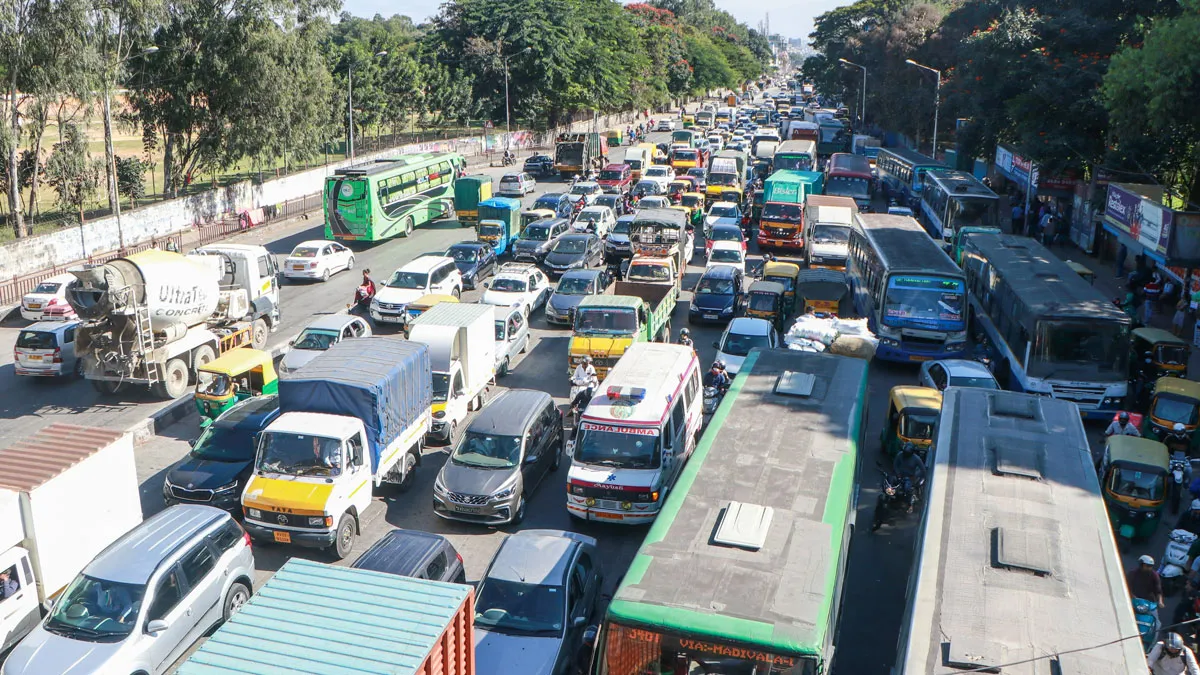
Bengaluru Smart Infrastructure Ltd (B-SMILE), a government-run agency, has begun forming internal teams to execute 10 flyover projects aimed at easing traffic congestion across the city, even as mobility experts continue to question their effectiveness.

In a series of office orders, Bengaluru Smart Infrastructure Ltd has assigned individual engineers to oversee each of the proposed projects. The engineers have been directed to study existing road conditions and suggest modifications to the detailed project reports.

The flyovers have been categorised into three groups based on length: up to 5 km, between 5 km and 10 km, and over 10 km. Projects exceeding 10 km are expected to be implemented under a public-private partnership model, with the government providing viability gap funding of up to 40 per cent of the total project cost.

Engineers have been asked to submit their assessments and recommendations by January 28. They have also been instructed to inform the respective city corporations about the activities proposed along the identified stretches to ensure coordination during execution.

The flyovers are planned along several major corridors, including Sirsi Circle–Nayandahalli, Yeshwanthpur–Halasuru, Anay Anand Bhavan on Kanakapura Road, Minerva Circle–Hudson Circle, Marenahalli Main Road, MEI Junction, Pipeline Road, Dodballapur Road and Old Madras Road, among others.

The projects form part of the city’s broader efforts to improve mobility and reduce congestion on key arterial routes, though their long-term impact on traffic flow remains under debate.

Bengaluru Smart Infrastructure Ltd (B-SMILE), a government-run agency, has begun forming internal teams to execute 10 flyover projects aimed at easing traffic congestion across the city, even as mobility experts continue to question their effectiveness. In a series of office orders, Bengaluru Smart Infrastructure Ltd has assigned individual engineers to oversee each of the proposed projects. The engineers have been directed to study existing road conditions and suggest modifications to the detailed project reports. The flyovers have been categorised into three groups based on length: up to 5 km, between 5 km and 10 km, and over 10 km. Projects exceeding 10 km are expected to be implemented under a public-private partnership model, with the government providing viability gap funding of up to 40 per cent of the total project cost. Engineers have been asked to submit their assessments and recommendations by January 28. They have also been instructed to inform the respective city corporations about the activities proposed along the identified stretches to ensure coordination during execution. The flyovers are planned along several major corridors, including Sirsi Circle–Nayandahalli, Yeshwanthpur–Halasuru, Anay Anand Bhavan on Kanakapura Road, Minerva Circle–Hudson Circle, Marenahalli Main Road, MEI Junction, Pipeline Road, Dodballapur Road and Old Madras Road, among others. The projects form part of the city’s broader efforts to improve mobility and reduce congestion on key arterial routes, though their long-term impact on traffic flow remains under debate.

Next Story
Infrastructure Urban

Implementation Status of Jal Jeevan Mission

Since August 2019 the Government has implemented Jal Jeevan Mission to provide assured potable water through household tap connections in rural India. At the start of the mission only 32.3 million (mn) rural households, representing 16.7 per cent, were reported to have tap water connections. States and union territories have reported that 125.8 mn additional rural households have since been provided with tap connections. As a result, of about 193.6 mn rural households roughly 158.2 mn, or 81.71 per cent, are reported to have tap water supply at home.\n\nThe State, district and village level st..

Next Story
Infrastructure Urban

Jal Jeevan Mission Reaches Eighty One Per Cent Rural Coverage

The Government reported substantial progress under the Jal Jeevan Mission, launched in August 2019 to provide tap water to every rural household. At launch only 32.3 million (mn) rural households had tap connections and states and Union territories reported provision of 125.8 mn additional households by March 2026. Consequently, out of about 193.6 mn rural households around 158.2 mn, or 81.71 per cent, are reported to have tap water at home. The Finance Minister announced extension of the mission until 2028 in the 2025-26 budget speech. The Swachh Bharat Mission Grameen, launched in October 20..

Next Story
Infrastructure Urban

Empowering Local Governance for Sustainable Rural Water Supply

The Ministry of Jal Shakti has aligned the Jal Jeevan Mission (JJM) with the 73rd Amendment to strengthen village level planning and community ownership of water supply. Gram Panchayats, village water and sanitation committees and Pani Samitis are to plan, implement, manage and maintain piped water systems, with gram sabha processes formalising handover and oversight. Implementation support agencies including non government organisations, community based organisations and self help groups have been empanelled to train local committees and promote women participation. Under JJM, the department ..

Advertisement

Subscribe to Our Newsletter

Get daily newsletters around different themes from Construction world.

STAY CONNECTED

Advertisement

Advertisement

Advertisement