
Bihar Set for First Six-Lane NH, New Expressways
ROADS & HIGHWAYS

Bihar Set for First Six-Lane NH, New Expressways

Bihar is set for a significant overhaul of its road infrastructure, with the state poised to get its first six-lane national highway along with multiple expressway and access-controlled highway projects over the next two years.

The flagship Varanasi–Aurangabad six-lane highway, now in its final phase, is expected to be completed by 2026. Once operational, the corridor will provide faster and smoother connectivity between Bihar and Delhi via Uttar Pradesh. Another six-lane stretch, the Aurangabad–Chorda road, is also nearing completion and is expected to strengthen road links with Jharkhand and West Bengal.

Bihar’s first access-controlled highway, being developed on the Amas–Darbhanga route, is scheduled for completion in 2026. Meanwhile, work on the Chakia–Bairgania and Parsarma–Saharsa–Mahishi two-lane roads is progressing steadily and is expected to be completed later this year.

An official from the state’s road construction department said improved urban and regional connectivity is also on track. Work on the Sonepur–Bakarpur–Manikpur section under the Patna–Bettiah corridor is set to be completed, easing travel from Patna AIIMS via the J P Ganga Path to Sonepur and Bakarpur.

Several other road projects are nearing completion, including Kachchi Dargah–Bidupur, Bakhtiyarpur–Tajpur, the Gaya–Biharsharif four-lane, Baisi–Bahadurganj–Dighalbank, Bettiah–Narkatiaganj and Katihar–Balrampur stretches.

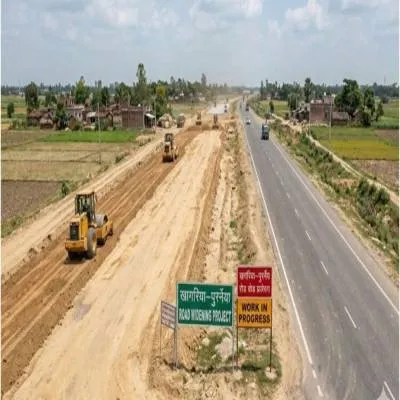
The Centre has already granted expressway status to the Patna–Purnia corridor, clearing the way for the construction of Bihar’s first expressway once financial approval is secured. Preparatory work is also under way for expressways and access-controlled highways on routes such as Gorakhpur–Siliguri, Raxaul–Haldia, Buxar–Bhagalpur and Patna–Ara–Sasaram.

Looking ahead to 2026, the state plans to launch additional highway projects, including the Varanasi–Kolkata route, the Bhagalpur–Hansdiha four-lane, and the Patna–Aurangabad road with bypasses at Arwal and Daudnagar. With institutional funding support, projects such as marine drives in Bhagalpur and Munger, new bridges, road overbridges and widening of key corridors are also in the pipeline.

Bihar is set for a significant overhaul of its road infrastructure, with the state poised to get its first six-lane national highway along with multiple expressway and access-controlled highway projects over the next two years. The flagship Varanasi–Aurangabad six-lane highway, now in its final phase, is expected to be completed by 2026. Once operational, the corridor will provide faster and smoother connectivity between Bihar and Delhi via Uttar Pradesh. Another six-lane stretch, the Aurangabad–Chorda road, is also nearing completion and is expected to strengthen road links with Jharkhand and West Bengal. Bihar’s first access-controlled highway, being developed on the Amas–Darbhanga route, is scheduled for completion in 2026. Meanwhile, work on the Chakia–Bairgania and Parsarma–Saharsa–Mahishi two-lane roads is progressing steadily and is expected to be completed later this year. An official from the state’s road construction department said improved urban and regional connectivity is also on track. Work on the Sonepur–Bakarpur–Manikpur section under the Patna–Bettiah corridor is set to be completed, easing travel from Patna AIIMS via the J P Ganga Path to Sonepur and Bakarpur. Several other road projects are nearing completion, including Kachchi Dargah–Bidupur, Bakhtiyarpur–Tajpur, the Gaya–Biharsharif four-lane, Baisi–Bahadurganj–Dighalbank, Bettiah–Narkatiaganj and Katihar–Balrampur stretches. The Centre has already granted expressway status to the Patna–Purnia corridor, clearing the way for the construction of Bihar’s first expressway once financial approval is secured. Preparatory work is also under way for expressways and access-controlled highways on routes such as Gorakhpur–Siliguri, Raxaul–Haldia, Buxar–Bhagalpur and Patna–Ara–Sasaram. Looking ahead to 2026, the state plans to launch additional highway projects, including the Varanasi–Kolkata route, the Bhagalpur–Hansdiha four-lane, and the Patna–Aurangabad road with bypasses at Arwal and Daudnagar. With institutional funding support, projects such as marine drives in Bhagalpur and Munger, new bridges, road overbridges and widening of key corridors are also in the pipeline.

Related Stories

Gold Stories
Next Story
Infrastructure Urban

KONE Opens India's First Digital Experience Centre in Pune

KONE, a global elevator and escalator manufacturer, has inaugurated its first Digital Experience Centre (DEC) in India, located in Pune. The facility aims to showcase how artificial intelligence (AI), connectivity and data-driven technologies can enhance customer experiences and improve building operations.The centre was inaugurated by Jussi Herlin, Executive Vice Chair, KONE Corporation; Philippe Delorme, President and CEO, KONE; and Nandan Nilekani, Co-founder and Chairman of the Board, Infosys.Designed as an interactive customer environment, the facility demonstrates digital solutions cover..

Next Story
Infrastructure Urban

CII GreenCo Launches Circularity Guidelines for Indian Industry

The Confederation of Indian Industry (CII) GreenCo Council has launched the CII GreenCo Circularity Guidelines – Pilot Version at the 17th CII GreenCo Waste & Resource Management Summit 2026 in Chennai. The initiative aims to strengthen resource efficiency, waste reduction and circular economy practices across Indian manufacturing and process industries.The guidelines introduce a structured framework with circularity indices covering raw materials, consumables, packaging and other resource inputs. These indicators will help industries assess existing practices, identify opportunities to ..

Next Story
Infrastructure Energy

Global Electronics Association Launches IPC-1783-CO2E Standard

The Global Electronics Association has introduced IPC-1783-CO2E, a new international standard aimed at improving consistency, transparency and comparability in product carbon footprint reporting across the electronics manufacturing industry.The standard, titled International Standard for Data Collection and Reporting of CO2 Equivalent (CO2e) Emissions for the Electronics Manufacturing Supply Chain, provides industry-specific guidance for collecting, estimating and reporting carbon emissions data.With increasing regulatory requirements and customer expectations, electronics manufacturers face c..

Advertisement

Subscribe to Our Newsletter

Get daily newsletters around different themes from Construction world.

STAY CONNECTED

Advertisement

SPECIAL OFFER
QR Code