+
CAQM Issues Norms for Mechanised Road Sweeping in NCR
ROADS & HIGHWAYS

CAQM Issues Norms for Mechanised Road Sweeping in NCR

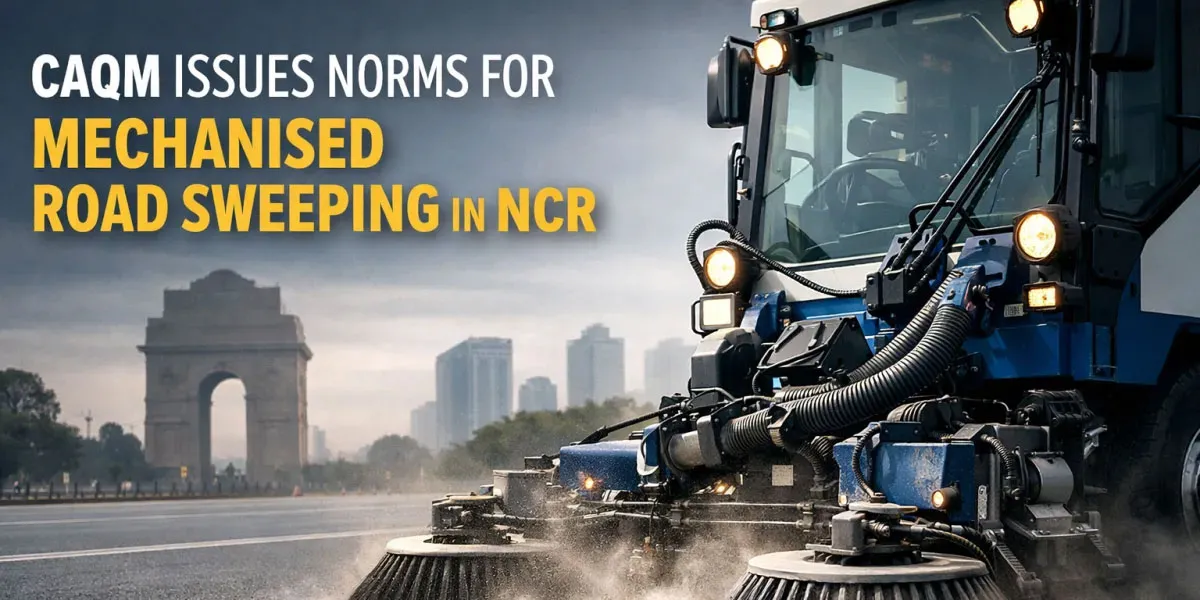
The Commission for Air Quality Management in the National Capital Region and Adjoining Areas (CAQM) has issued a detailed circular prescribing technical and operational norms for deployment and utilisation of Mechanised Road Sweeping Machines (MRSMs) by all road owning and road maintenance agencies across the National Capital Region (NCR). The circular notes that road dust remains a dominant contributor to PM10 and a significant contributor to PM two point five levels, particularly during drier months, and that non-uniform or inadequate sweeping practices adversely affect ambient air quality.

The norms establish a Right of Way (RoW) based deployment framework and seek uniform standards for MRSM induction, capacity, coverage and performance across NCR states. Technical specifications differentiate large size, medium size and small size machines, with hopper capacities of greater than four cubic metres for large machines, between one and four cubic metres for medium machines and less than one cubic metre for small machines, and corresponding operating widths and RoW thresholds to ensure effective mechanised sweeping.

Operational requirements specify that each MRSM should be capable of at least an eight hour operational shift and that large and medium machines should be able to cover approximately 40 running km while small machines should cover 20 running km during an eight hour shift. Fleet planning, procurement and operations are to align with these norms, including preference for CNG-fuelled or electric variants, integrated water spraying and particulate filtration systems, and the option to operate newly inducted machines under an OPEX mode.

The circular also provides for handheld vacuum-cleaning machines and litter pickers for roadside and footpath cleaning and mandates scientific disposal of collected road dust to prevent re-entry of particles into ambient air. The Commission has stated that targeted mechanised sweeping is critical for abatement of road dust and for reduction of PM10 and PM two point five levels across NCR and will continue to monitor compliance and implementation of the norms.

The Commission for Air Quality Management in the National Capital Region and Adjoining Areas (CAQM) has issued a detailed circular prescribing technical and operational norms for deployment and utilisation of Mechanised Road Sweeping Machines (MRSMs) by all road owning and road maintenance agencies across the National Capital Region (NCR). The circular notes that road dust remains a dominant contributor to PM10 and a significant contributor to PM two point five levels, particularly during drier months, and that non-uniform or inadequate sweeping practices adversely affect ambient air quality. The norms establish a Right of Way (RoW) based deployment framework and seek uniform standards for MRSM induction, capacity, coverage and performance across NCR states. Technical specifications differentiate large size, medium size and small size machines, with hopper capacities of greater than four cubic metres for large machines, between one and four cubic metres for medium machines and less than one cubic metre for small machines, and corresponding operating widths and RoW thresholds to ensure effective mechanised sweeping. Operational requirements specify that each MRSM should be capable of at least an eight hour operational shift and that large and medium machines should be able to cover approximately 40 running km while small machines should cover 20 running km during an eight hour shift. Fleet planning, procurement and operations are to align with these norms, including preference for CNG-fuelled or electric variants, integrated water spraying and particulate filtration systems, and the option to operate newly inducted machines under an OPEX mode. The circular also provides for handheld vacuum-cleaning machines and litter pickers for roadside and footpath cleaning and mandates scientific disposal of collected road dust to prevent re-entry of particles into ambient air. The Commission has stated that targeted mechanised sweeping is critical for abatement of road dust and for reduction of PM10 and PM two point five levels across NCR and will continue to monitor compliance and implementation of the norms.

Next Story
Real Estate

Casagrand Launches Keystone In Tiruppur

Casagrand has launched Casagrand Keystone, a gated residential development at Rakkiyapalayam, off Avinashi Road, in Tiruppur. Spread across 2.2 acres, the B+G+5 structure comprises 142 units of 2 and 3 BHK homes, supported by 48 indoor and outdoor amenities. The project is introduced at a starting price of Rs 5,199 per sq. ft. The development allocates 1.3 acres to open space, including a central park of about 24,500 sq. ft. A 6,800 sq. ft. clubhouse includes a multipurpose hall, mini theatre and indoor recreation facilities. Other amenities include a 5,100 sq. ft. swimming pool, poolside par..

Next Story
Real Estate

Premium homes account for half of India’s housing sales in 2025

Knight Frank India, in its latest report on India’s office and residential property market, has highlighted a significant shift in housing demand, with homes priced above Rs 10 million accounting for 50 per cent of total residential sales across the top eight cities in 2025. The findings underscore the growing dominance of premium housing in the country’s real estate landscape.Out of 348,247 residential units sold during the year, approximately 175,091 units were in the Rs 10 million-plus category, marking a 14 per cent year-on-year increase. The data reflects changing buyer preferences, w..

Next Story
Infrastructure Energy

Xbattery launches XB-5K energy storage system for homes, offices

Xbattery, a Hyderabad-based deep-tech company specialising in next-generation energy storage and battery management technologies, has introduced its flagship XB-5K, a scalable 5kWh energy storage system designed for homes and offices in India.The XB-5K is built on the company’s indigenously developed BharatBMS platform, described as India’s first universal high-voltage battery management system architecture aimed at reducing import dependence and improving after-sales service capabilities. The launch comes as India seeks to strengthen domestic manufacturing and address reliance on imported..

Advertisement

Subscribe to Our Newsletter

Get daily newsletters around different themes from Construction world.

STAY CONNECTED

Advertisement

Advertisement

Advertisement

Open In App