Centre Approves Upgrade Of 100-km NH-16 To Access-Controlled Corridor
ROADS & HIGHWAYS

Centre Approves Upgrade Of 100-km NH-16 To Access-Controlled Corridor

The central government has approved the conversion of a 100-km stretch of NH-16 into a fully access-controlled corridor, improving connectivity between Vijayawada and Bengaluru. The section runs from Muppavaram near Addanki in Prakasam district to Kaja near the Vijayawada bypass in Guntur district and will integrate with the under-construction Bengaluru-Amaravati greenfield expressway. The upgrade aims to provide faster and safer access to the Amaravati capital region and support regional logistics.

A Bhopal-based contractor, LN Malviya, has been appointed to prepare the detailed project report within a year, covering land acquisition, engineering design, environmental impact assessment and project cost estimates. The existing carriageway is a six-lane highway but lacks adequate service roads, causing frequent interruptions as local traffic merges onto main lanes. The DPR will assess measures to resolve these issues before tenders are floated.

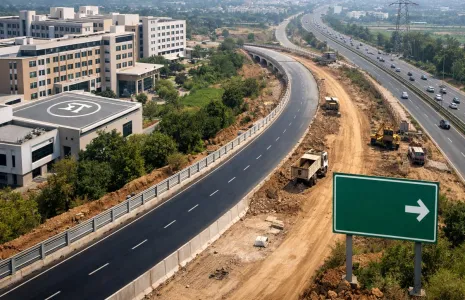
The proposed design will include two-lane service roads on both sides to allow local vehicles to travel parallel to the main highway without entering high-speed lanes, and will eliminate direct access from villages and minor roads. Entry and exit points will be placed at Muppavaram, where the corridor links with the Amaravati Outer Ring Road, near Kaja at the Vijayawada bypass, and potentially at Chilakaluripet if required. Toll collection will be distance-based and applied only at designated points to ensure uninterrupted traffic flow.

The project will connect with the 343-km Bengaluru-Vijayawada economic corridor, a six-lane greenfield access-controlled highway under construction from Kodur to Muppavaram, potentially reducing travel time from Bengaluru to the Amaravati region to seven to eight hours. Access-controlled design will remove at-grade intersections and unregulated entries, improving safety and reducing congestion while rerouting local traffic to service roads. Officials expect the corridor to enhance trade and regional economic growth by creating more efficient transport infrastructure.

The central government has approved the conversion of a 100-km stretch of NH-16 into a fully access-controlled corridor, improving connectivity between Vijayawada and Bengaluru. The section runs from Muppavaram near Addanki in Prakasam district to Kaja near the Vijayawada bypass in Guntur district and will integrate with the under-construction Bengaluru-Amaravati greenfield expressway. The upgrade aims to provide faster and safer access to the Amaravati capital region and support regional logistics. A Bhopal-based contractor, LN Malviya, has been appointed to prepare the detailed project report within a year, covering land acquisition, engineering design, environmental impact assessment and project cost estimates. The existing carriageway is a six-lane highway but lacks adequate service roads, causing frequent interruptions as local traffic merges onto main lanes. The DPR will assess measures to resolve these issues before tenders are floated. The proposed design will include two-lane service roads on both sides to allow local vehicles to travel parallel to the main highway without entering high-speed lanes, and will eliminate direct access from villages and minor roads. Entry and exit points will be placed at Muppavaram, where the corridor links with the Amaravati Outer Ring Road, near Kaja at the Vijayawada bypass, and potentially at Chilakaluripet if required. Toll collection will be distance-based and applied only at designated points to ensure uninterrupted traffic flow. The project will connect with the 343-km Bengaluru-Vijayawada economic corridor, a six-lane greenfield access-controlled highway under construction from Kodur to Muppavaram, potentially reducing travel time from Bengaluru to the Amaravati region to seven to eight hours. Access-controlled design will remove at-grade intersections and unregulated entries, improving safety and reducing congestion while rerouting local traffic to service roads. Officials expect the corridor to enhance trade and regional economic growth by creating more efficient transport infrastructure.

Related Stories

Gold Stories

Next Story
Infrastructure Urban

KONE Opens India's First Digital Experience Centre in Pune

KONE, a global elevator and escalator manufacturer, has inaugurated its first Digital Experience Centre (DEC) in India, located in Pune. The facility aims to showcase how artificial intelligence (AI), connectivity and data-driven technologies can enhance customer experiences and improve building operations.The centre was inaugurated by Jussi Herlin, Executive Vice Chair, KONE Corporation; Philippe Delorme, President and CEO, KONE; and Nandan Nilekani, Co-founder and Chairman of the Board, Infosys.Designed as an interactive customer environment, the facility demonstrates digital solutions cover..

Next Story
Infrastructure Urban

CII GreenCo Launches Circularity Guidelines for Indian Industry

The Confederation of Indian Industry (CII) GreenCo Council has launched the CII GreenCo Circularity Guidelines – Pilot Version at the 17th CII GreenCo Waste & Resource Management Summit 2026 in Chennai. The initiative aims to strengthen resource efficiency, waste reduction and circular economy practices across Indian manufacturing and process industries.The guidelines introduce a structured framework with circularity indices covering raw materials, consumables, packaging and other resource inputs. These indicators will help industries assess existing practices, identify opportunities to ..

Next Story
Infrastructure Energy

Global Electronics Association Launches IPC-1783-CO2E Standard

The Global Electronics Association has introduced IPC-1783-CO2E, a new international standard aimed at improving consistency, transparency and comparability in product carbon footprint reporting across the electronics manufacturing industry.The standard, titled International Standard for Data Collection and Reporting of CO2 Equivalent (CO2e) Emissions for the Electronics Manufacturing Supply Chain, provides industry-specific guidance for collecting, estimating and reporting carbon emissions data.With increasing regulatory requirements and customer expectations, electronics manufacturers face c..

Advertisement

Subscribe to Our Newsletter

Get daily newsletters around different themes from Construction world.

STAY CONNECTED

Advertisement

SPECIAL OFFER
QR Code