+
India Aims To Halve Road Deaths By 2030 With AI And Safer Highways
ROADS & HIGHWAYS

India Aims To Halve Road Deaths By 2030 With AI And Safer Highways

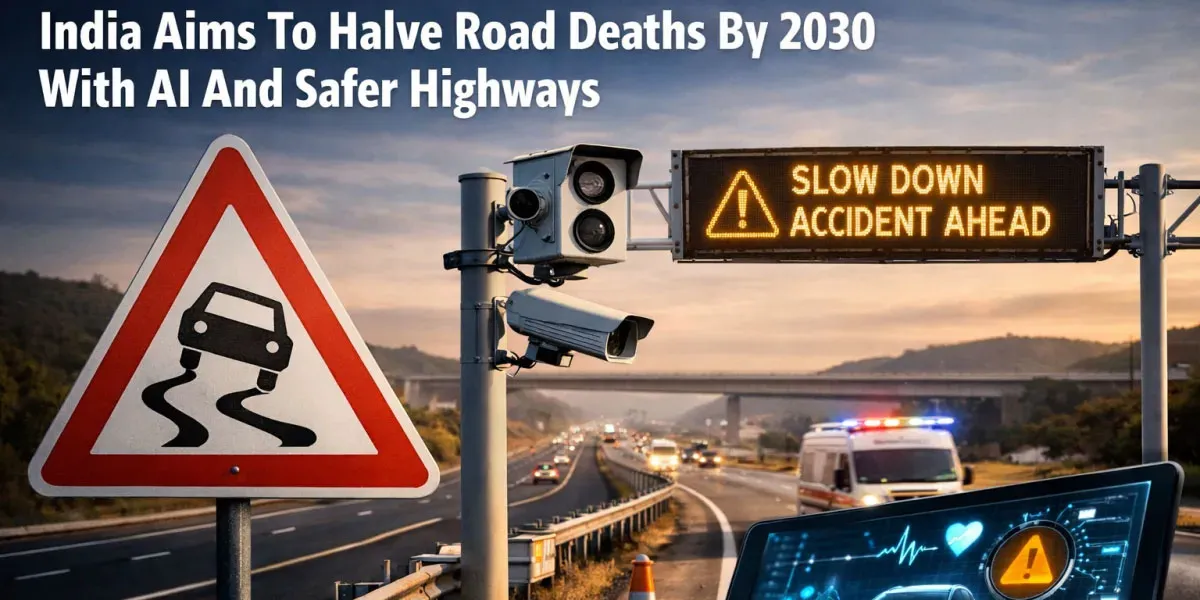
Union Road Transport and Highways Minister Nitin Gadkari told the Rajya Sabha that the government has set a target to reduce road accidents by 50 per cent by 2030. The roadmap combines technology-driven enforcement, safer highway engineering and stricter vehicle safety standards to tackle a major public safety challenge. The initiative includes institutional and systems measures aimed at improving detection of incidents and speeding up emergency response along key corridors.

A Centre of Excellence for Road Safety will be set up at the Indian Institute of Technology Madras (IIT Madras) to promote best practices and strengthen collaboration between academic institutions, industry and policymakers. The centre will focus on research, training and the dissemination of standards that support safer design and operations. Its long-term vision includes halving fatalities by 2030 and working towards zero deaths by 2040 as part of a phased approach.

Advanced Traffic Management Systems (ATMS) are being expanded across national highways to include AI-based video incident detection, automatic number plate recognition cameras and wider surveillance networks. ATMS installations are already operational on several high-traffic corridors and the plan is to extend coverage to all four-lane national highways. These systems are expected to improve enforcement against violators, enable faster real-time response and provide data for targeted engineering improvements.

Vehicle safety requirements will be tightened with active safety features made mandatory in medium and heavy duty categories including M2, M3, N1, N2, N3 and quadricycles. The upgrades include anti-lock braking systems, endurance braking, vehicle stability functions, lane departure warnings, driver drowsiness alerts, blind spot information and moving-off information systems, with phased compliance effective from January one, 2027 for new models and from October one, 2027 through January 2028 for existing models. Site specific highway fixes such as black spot remediation, traffic calming and improved signage will complement technology and vehicle measures.

Union Road Transport and Highways Minister Nitin Gadkari told the Rajya Sabha that the government has set a target to reduce road accidents by 50 per cent by 2030. The roadmap combines technology-driven enforcement, safer highway engineering and stricter vehicle safety standards to tackle a major public safety challenge. The initiative includes institutional and systems measures aimed at improving detection of incidents and speeding up emergency response along key corridors. A Centre of Excellence for Road Safety will be set up at the Indian Institute of Technology Madras (IIT Madras) to promote best practices and strengthen collaboration between academic institutions, industry and policymakers. The centre will focus on research, training and the dissemination of standards that support safer design and operations. Its long-term vision includes halving fatalities by 2030 and working towards zero deaths by 2040 as part of a phased approach. Advanced Traffic Management Systems (ATMS) are being expanded across national highways to include AI-based video incident detection, automatic number plate recognition cameras and wider surveillance networks. ATMS installations are already operational on several high-traffic corridors and the plan is to extend coverage to all four-lane national highways. These systems are expected to improve enforcement against violators, enable faster real-time response and provide data for targeted engineering improvements. Vehicle safety requirements will be tightened with active safety features made mandatory in medium and heavy duty categories including M2, M3, N1, N2, N3 and quadricycles. The upgrades include anti-lock braking systems, endurance braking, vehicle stability functions, lane departure warnings, driver drowsiness alerts, blind spot information and moving-off information systems, with phased compliance effective from January one, 2027 for new models and from October one, 2027 through January 2028 for existing models. Site specific highway fixes such as black spot remediation, traffic calming and improved signage will complement technology and vehicle measures.

Next Story
Infrastructure Urban

ABB to Invest Rs 6.25 Billion to Expand India Manufacturing

ABB recently announced plans to invest approximately Rs 6.25 billion ($75 million) in India during 2026 to expand its manufacturing footprint and research and development capabilities. The investment follows more than $35 million spent in 2025 and reflects the company’s continued focus on strengthening its ‘local-for-local’ strategy in the country.The investment will support ABB’s Electrification, Motion and Automation businesses and expand manufacturing capacity for infrastructure sectors such as renewable energy, metro rail, data centres and industrial applications. Approximately 300..

Next Story
Equipment

Six WOLFF Cranes Handle 60,000 m³ Concrete for German Hospital

Six WOLFF tower cranes are playing a key role in constructing a new hospital complex in Memmingen, Germany, supporting large-scale material handling for the project. The facility is being built on a 7.7-hectare site and will feature six floors, around 480 beds and a gross floor area exceeding 75,000 sq m.Building shell works began recently in February 2025. One WOLFF 6531.12 Cross crane supported early site preparation before being dismantled in autumn 2025, while five remaining cranes continue operations. Over an average deployment period of 16 months, the cranes are expected to move approxim..

Next Story
Equipment

REC Funds Rs 115.6 Million CSR Support for Bihar Eye Hospital

REC recently committed Rs 115.6 million under its Corporate Social Responsibility (CSR) programme for the procurement of clinical and non-clinical equipment at Sankara Eye Hospital in Saharsa, Bihar. The initiative aims to strengthen healthcare infrastructure and improve access to specialised eye care services in the region.A Memorandum of Agreement (MoA) was recently signed between Pradeep Fellows, Executive Director (CSR), REC Limited, and Wg Cdr V. Shankar (Retd), Trustee and Executive Director of Sankara Eye Hospital, at the REC office in the SCOPE Complex, New Delhi.The support is expecte..

Advertisement

Subscribe to Our Newsletter

Get daily newsletters around different themes from Construction world.

STAY CONNECTED

Advertisement

Advertisement

Advertisement