Mumbai Trans Harbour Link : First OSD span launched in Package-I
ROADS & HIGHWAYS

Mumbai Trans Harbour Link : First OSD span launched in Package-I

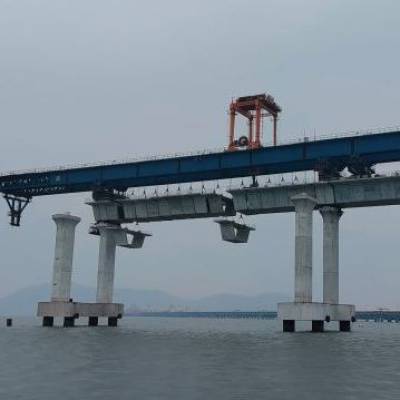
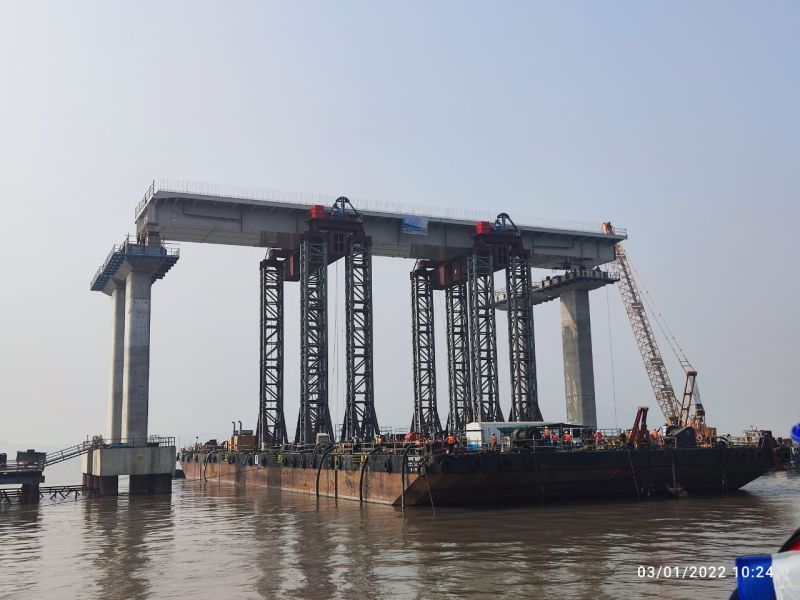
The Package-I of Mumbai Trans Harbour Link's (MTHL) first Orthotropic Steel Deck (OSD) span of length 119 m and weight 1,331 metric tonnes (mt) was launched on 14 January.

The Mumbai Metropolitan Region Development Authority (MMRDA), the nodal agency of the bridge construction project, has shared the details of the developments in the project work.

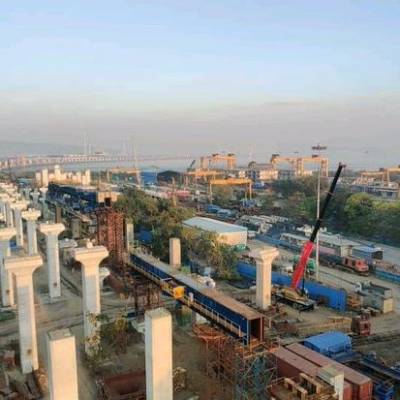
The Package-I of the bridge construction project was awarded to Larsen and Toubro (L&T) and IHI Infrastructure Systems (L&T-IHI) consortium. The bridge construction project involves the construction of the 10.38 km long bridge across the Mumbai Bay and Sewri Interchange at Mumbai Side.

According to the sources, the OSD is a Steel Deck Superstructure, which helps carry vehicular load efficiently among three planes. It enhances the load-carrying capacity of the bridge, compared to Concrete Superstructure. The OSD's are less in self-weight compared to concrete or composite girders and have a longer span of 180 m.

It might be an ideal solution, considering the conditions of the MTHL and longer Pier-Pier distances. It is more cost-effective as compared to Cable Stay or Suspension Bridges. For transporting heavy OSD sections, a barge was specially designed.

Earlier, the Package-2 of the first OSD was launched, paving the way for 31 OSD spans to be built under the project.

The MTHL bridge of 22 km long, and the six-lane bridge was about 16.5 km long over the sea, about 5.5 km viaduct on either side of the land has interchanges at Sewri in Central Mumbai, Shivaji Nagar at Mumbai Bay and National Highway 4B at Chirle in Navi Mumbai.

The bridge will be well-equipped with an Intelligent Transport System (ITS) and other amenities. The travel time from South Mumbai to Navi Mumbai will reduce to 25 minutes from the current travel time of 120 minutes. The expected cost of the project is Rs 17,843 crore. About 80% of piers and 65% of the total project are completed. The infrastructure project is expected to finish by 2023.

Image Source

Also read: Mumbai Trans-Harbor Link: First Orthotropic Steel Deck launched

Also read: Sewri-Nhava Sheva trans-harbour enters complex construction phase

"Join industry leaders at RAHSTA Expo, India's premier platform for roads, highways and traffic infrastructure. Register now to explore innovations, network with experts and shape the future of mobility."

The Package-I of Mumbai Trans Harbour Link's (MTHL) first Orthotropic Steel Deck (OSD) span of length 119 m and weight 1,331 metric tonnes (mt) was launched on 14 January. The Mumbai Metropolitan Region Development Authority (MMRDA), the nodal agency of the bridge construction project, has shared the details of the developments in the project work. The Package-I of the bridge construction project was awarded to Larsen and Toubro (L&T) and IHI Infrastructure Systems (L&T-IHI) consortium. The bridge construction project involves the construction of the 10.38 km long bridge across the Mumbai Bay and Sewri Interchange at Mumbai Side. According to the sources, the OSD is a Steel Deck Superstructure, which helps carry vehicular load efficiently among three planes. It enhances the load-carrying capacity of the bridge, compared to Concrete Superstructure. The OSD's are less in self-weight compared to concrete or composite girders and have a longer span of 180 m. It might be an ideal solution, considering the conditions of the MTHL and longer Pier-Pier distances. It is more cost-effective as compared to Cable Stay or Suspension Bridges. For transporting heavy OSD sections, a barge was specially designed. Earlier, the Package-2 of the first OSD was launched, paving the way for 31 OSD spans to be built under the project. The MTHL bridge of 22 km long, and the six-lane bridge was about 16.5 km long over the sea, about 5.5 km viaduct on either side of the land has interchanges at Sewri in Central Mumbai, Shivaji Nagar at Mumbai Bay and National Highway 4B at Chirle in Navi Mumbai. The bridge will be well-equipped with an Intelligent Transport System (ITS) and other amenities. The travel time from South Mumbai to Navi Mumbai will reduce to 25 minutes from the current travel time of 120 minutes. The expected cost of the project is Rs 17,843 crore. About 80% of piers and 65% of the total project are completed. The infrastructure project is expected to finish by 2023. Image Source Also read: Mumbai Trans-Harbor Link: First Orthotropic Steel Deck launched Also read: Sewri-Nhava Sheva trans-harbour enters complex construction phase

Next Story
Real Estate

Pecan Realty Completes Rs 1.5 Billion Transactions

Pecan Realty has recently completed four institutional transactions worth over Rs 1.5 billion over the past two years, strengthening its position as an execution-led real estate platform. The deals include resolution-led acquisitions, structured finance transactions and capital partnerships across its development portfolio.The transactions covered acquisitions through the National Company Law Tribunal process and helped provide repayment or exits to both private and public sector lenders. The company said the deals demonstrate its ability to resolve complex project situations, work with instit..

Next Story
Real Estate

SNN Estates Expands North Bengaluru Housing Project

SNN Estates has announced an expansion of its SNN Estates Felicity residential project in North Bengaluru following strong buyer demand, with 75 per cent of the first-phase inventory sold within three days of launch.The developer will add 76 apartments in the new phase, taking the project's estimated revenue potential to around Rs 1,000 crore upon completion of Phase 2.Spread across 6.5 acres in Rachenahalli, near Manyata Tech Park, the project comprises 604 apartments in 1.5, 2, 2.5, 3 and 4 BHK configurations. The development includes a 50,000-sq-ft clubhouse with amenities such as sports co..

Next Story
Infrastructure Urban

SCG Drives ASEAN Industrial Transformation Strategy

SCG is strengthening its focus on ASEAN as a key growth region by advancing industrial transformation, enhancing competitiveness and building resilient regional value chains. Thammasak Sethaudom, President and Chief Executive Officer, SCG, highlighted the need for industries to continuously develop capabilities, strengthen resilience and deepen regional cooperation to achieve sustainable long-term growth.SCG views ASEAN as an important growth engine alongside China, supported by favourable demographics, trade connectivity and investment flows. With ASEAN’s GDP projected to grow by around 4.7..

Advertisement

Subscribe to Our Newsletter

Get daily newsletters around different themes from Construction world.

STAY CONNECTED

Advertisement

Advertisement

Advertisement