Recycling plastic wastes by mixing them with bitumen can help build stronger, better quality roads at a cheaper cost.
Can you imagine roads without potholes this monsoon? Indeed, India’s pothole menace has been a never-ending one, with the country reporting an increasing number of deaths yearafteryear. Speaking of hazards, another is the modern-day problem of disposing plastic. Here’s a solution to tackle both these perils together: building plastic roads. Such roads not only prevent potholes but are eco-friendly and cheaper to build and maintain.
The roadmap
This technology was first used by Tyagraja College of Engineering in 2002 with a pilot inside the college campus. The technology is patented by TCE, Madurai, under the guidance of Dr R Vasudevan. Tata Steel’s Jamshedpur Utilities and Services Company (JUSCO) then got in touch with Prof Vasudevan in 2009, understood the process, reengineered it and implemented it, as per its own conditions and machineries. “We were the first to do it in eastern India, with a vision to replicate it further in other cities,” says Gaurav Anand, Chief Manager, Business Excellence, JUSCO.
Several cities then visited JUSCO to see the successful implementation of this technology. Civic officials from Ranchi, Chas, Giridih and Jamtara visited Jamshedpur in 2017 to learn this technology and replicate it in their respective towns. “We shared all the knowhow, along with the challenges and issues,” says Anand.Over 7.5 km of roads have reportedly been made with plastic at these four places. JUSCO had already proved this technology by being a pioneer of building such roads in Jamshedpur in 2011-12. “We were able to facilitate the construction of plastic roads not only in India but overseas as well,” avers Anand. “While in India, Ranchi, Bokaro, Dhanbad and districts of Chhattisgarh deployed this technology with our help, countries like South Africa, Kenya, Nigeria and Cyprusalso learnt from us and replicated it.”
How is it done?
JUSCO collects waste plastics from the source, segregates the waste, shreds it into 2-4mm size, and mixes the shredded plastic to make a coating over the aggregates used for road construction, thus providing the road tremendous strength at no extra cost. Plastic gets coated over stone, the hot plastic-coated stone is mixed with bitumen (tar) and the mix is used for road laying.
The aggregate mix, used for flexible road construction, is first coated with molten plastics waste and this plastic-coated aggregate is used as raw material. (The plastics used include disposed carrybags, films, cups, etc, with a maximum thickness of 60 micron.) To the hot plastic-coated aggregate (165oC), bitumen (160oC) is added, mixed and used for road construction.The bitumen is not blended with plastic waste. (Read more in ‘The Process’.)
A study of the properties of the plasticwaste-coated aggregatebitumen mixshows:
Even after 96 hours, there is no stripping of the bitumen layer, showing resistance towards stripping and pothole formation.
The Marshall Stability Value increases depending upon the percentage of plastics used for coating from 1,265 kg to approximately 2,500 kg, thus increasing the strength of the road. Field trials are still on.
Extraction of bitumen from the above mix is slow compared to a non-plasticbitumen mix, showing the increased strength of binding of bitumen.
Plastic-coated aggregate has a low percentage of voids and, hence, less oxidation of bitumen and less ravelling and rutting.
Plastic-coated aggregatebitumen mix has low moisture absorption and, hence, no stripping or pothole formation.
The percentage of bitumen needed to form an effective mix can be reduced from 5 per cent to 4.5 per cent. Thus a saving of bitumen, of not less than 10 per cent, is also possible.
When plastic-coated aggregate is soaked in water for 72 hours, there is no stripping. The aggregate gains non-wetting property with respect to water.
Plastic-coated aggregate mixes well with hot bitumen and the blend can be used for road construction. Coated plastic waste helps increase both blending property and binding property.
Roads can be constructed with plastic wastes (8 per cent) in conjunction with bitumen (92 per cent). Test samples of plastic-bitumen roads show reduced penetration and ductility; a higher softening point; less rutting and cold cracking and 260 per cent improved resistance to water-soaking, hence, ideal for subgrade; 100 per cent improvement in the fatigue life of roads; and greatly reduced road cracking.
The advantages
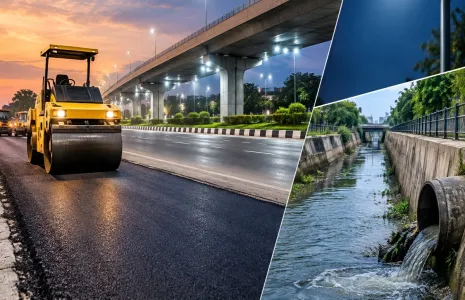
There is hardly any difference in constructing roads with this technology compared to conventional road construction methods. The mixing of shredded plastics is the onlyadditional process. Yet, recycling plastic wastes by mixing them with bitumen can help build stronger, better quality roads at a cheaper cost.
“The technology is about utilising the lowest-end plastic waste, which hardly has any recycling value and would have otherwise polluted water bodies, choked the nallahs and killed animals if consumed by them,” highlights Anand.“The biggest advantage of plastic roads can be seen during the monsoon, when there is water-logging on the road and still no potholes are formed.” He elaborates that the main reason is that the aggregates used in this construction are pre-laminated or coated with plastics, which stops rainwater from percolate through, hence contributing to longevity. Besides, it ensures better quality, water-resistant, maintenance-friendly roads, among other benefits. In fact, its longevity is twice that of bitumen-only roads. Further, it is maintenancefree for the first five years.
Other qualities of plastic-tar roads include:
- Strength of the road increases by 100 per cent (increasedMarshall Stability Value)
- Better resistance towards rainwater and water stagnation
- No stripping and no potholes
- Increased binding and better bonding of the mix
- Increased load-withstanding property(withstanding increased load transport)
- Consumption of bitumen decreases by not less than 10 per cent
- Reduction in pores in aggregate and, hence, less rutting and ravelling
- Better soundness
- Maintenance cost of the road is almost nil
- Road life is doubled
- No leaching of plastics
- No effect of radiation like UV.
Environmental benefits include:
The waste plastic is used only for the lamination of stone aggregate. There is no evolution of any gas during the process. There is no air or land pollution.
There is no evolution of CO2 (only melting of plastics).
If 1 km of single-lane plastic tar road is laid, 1 tonne of plastic is used; this helps avoid the evolution of 3 tonne of CO2, which may otherwise result owing to the burning of plastics.
Investment, cost and returns
There is no additional investment using this technology. In fact, there is a reduction in the cost and saving of bitumen. When comparing a road constructed with this technology, the cost is about Rs 50,000 less than a conventional road, considering the construction of a road surface area of 4,000 sq m, highlights Anand. Where 1 tonne of bitumen costs Rs 50,000, the same volume of waste plastic would cost Rs 10,000. About 10 per cent of bitumen can be substituted by plastic. When calculated, using plastic wastes would save about 1 tonne of bitumen or Rs 40,000 net for 1 km of a 4-m-wide road. Further, there is no maintenance expenditure for five years. (See ‘Cheap and Good’.)
The returns include a clean environment, free from plastic waste; better roadswithout any deformation from rain or traffic load; saving natural resources; and using plastic waste effectively in an eco-friendly manner.
Time to act
As this activity requires a positive cross-functional relationship between the PWD and municipal bodies, it requires clear-cut responsibilities of activities to be undertaken by both departments. “Collection of plastic is not a challenge; the major issue is to get the plastics shredded to 2-4 mm size,” Anand points out. Once the shredded plastics are available, mixing can be easily done at the hot-mix plant.
Indeed, it’s time for India to use its plastic to make (not litter) roads!
SERAPHINA D’SOUZA
The process
Mixing by mini hot-mix plant:
Step 1: Plastic waste made out of PE, PP and PS is cut into a size between 2.36 mm and 4.75 mm using a shredding machine.
Step 2:The bitumen is to be heated to a maximum of 1700C for good binding and to prevent weak bonding. (Monitoring the temperature is important.)
Step 3: At the mixing chamber, the shredded plastic waste is to be added to the hot aggregate. It gets coated uniformly over the aggregate within 30 seconds, giving an oily look.Thus, plastic-coated aggregate is obtained.
Step 4: Hot bitumen is then added over the plastic-coated aggregate and the resulting mix is used for road construction. The road-laying temperature is between 1100C and 1200C. The roller used is 8-tonne capacity.
INFOGRAPHIC
The way it’s done