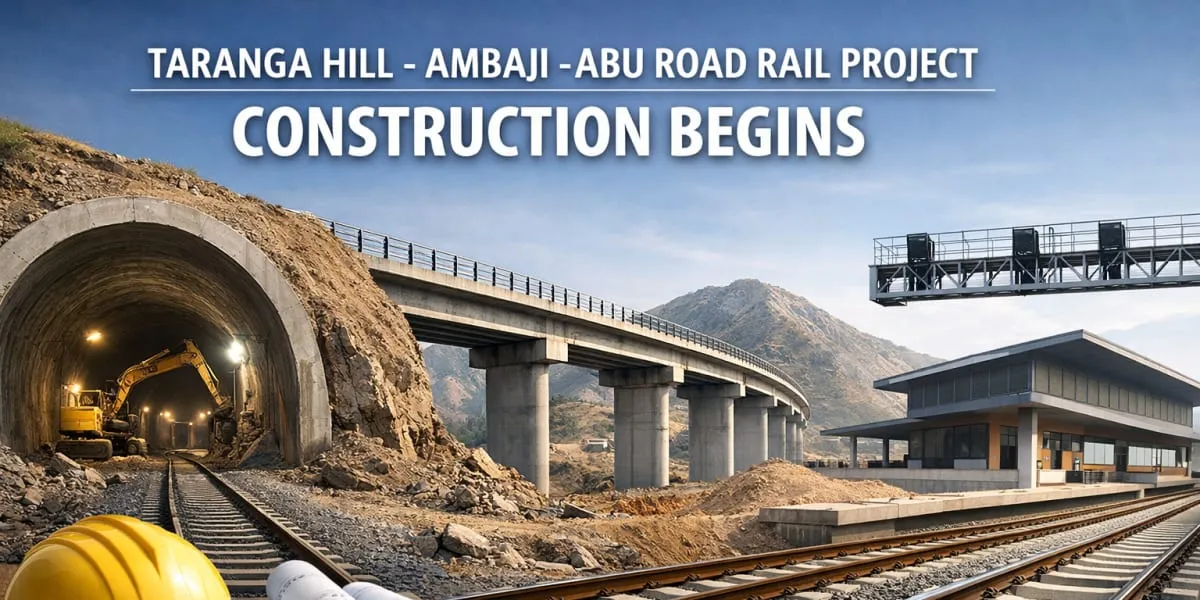
Taranga Hill Ambaji Abu Road Rail Project Construction Begins
ROADS & HIGHWAYS

Taranga Hill Ambaji Abu Road Rail Project Construction Begins

Construction work on the Abu Road–Taranga Hill–Ambaji new railway line project is progressing rapidly, with earthwork, tunnel excavation, station buildings and road under bridges under way at multiple locations. The 116.65 km railway line, estimated at about Rs 30.5 billion (Rs 30.5 bn), includes 13 tunnels with a total length of about 13 km, of which four major tunnels are targeted for completion by March 2027. A new platform is being constructed at Abu Road and the station building at Taranga Hill has commenced.

North Western Railway officials said land acquisition is complete and that work on earthwork, station buildings, road under bridges and tunnels is progressing steadily. The longest tunnel will be near the Shaktipeeth Ambaji station and will be about 2,300 metres, and tunnelling is using the New Austrian Tunnelling Method as on the Udhampur–Katra project. The route will include the tallest bridge near Surpagla village with a height of around 80 metres.

The line will pass through Sirohi district in Rajasthan and Mehsana, Sabarkantha and Banaskantha districts in Gujarat and will include 15 stations, among which Ambaji will have the largest station with a multi-storey passenger rest house to serve devotees visiting the Shaktipeeth temple. A base camp and temporary laboratory have been set up in the Maliyavas area of Siyava for testing and construction purposes and track laying is under way in villages in the Abu Road block. Officials indicated that four major tunnels are a priority for completion by March 2027 to maintain the project schedule.

The Prime Minister’s Office is monitoring progress through regular drone photography and videography and the visuals are being reviewed to ensure adherence to timelines. The project team is working to complete the alignment within the stipulated timeframe and to integrate the new stations with existing rail infrastructure to improve connectivity to major religious destinations. Taranga Hill, known for its twelfth-century Jain temple and Jogidani cave, and Ambaji will be linked to the rail network, improving access for pilgrims and visitors.

Construction work on the Abu Road–Taranga Hill–Ambaji new railway line project is progressing rapidly, with earthwork, tunnel excavation, station buildings and road under bridges under way at multiple locations. The 116.65 km railway line, estimated at about Rs 30.5 billion (Rs 30.5 bn), includes 13 tunnels with a total length of about 13 km, of which four major tunnels are targeted for completion by March 2027. A new platform is being constructed at Abu Road and the station building at Taranga Hill has commenced. North Western Railway officials said land acquisition is complete and that work on earthwork, station buildings, road under bridges and tunnels is progressing steadily. The longest tunnel will be near the Shaktipeeth Ambaji station and will be about 2,300 metres, and tunnelling is using the New Austrian Tunnelling Method as on the Udhampur–Katra project. The route will include the tallest bridge near Surpagla village with a height of around 80 metres. The line will pass through Sirohi district in Rajasthan and Mehsana, Sabarkantha and Banaskantha districts in Gujarat and will include 15 stations, among which Ambaji will have the largest station with a multi-storey passenger rest house to serve devotees visiting the Shaktipeeth temple. A base camp and temporary laboratory have been set up in the Maliyavas area of Siyava for testing and construction purposes and track laying is under way in villages in the Abu Road block. Officials indicated that four major tunnels are a priority for completion by March 2027 to maintain the project schedule. The Prime Minister’s Office is monitoring progress through regular drone photography and videography and the visuals are being reviewed to ensure adherence to timelines. The project team is working to complete the alignment within the stipulated timeframe and to integrate the new stations with existing rail infrastructure to improve connectivity to major religious destinations. Taranga Hill, known for its twelfth-century Jain temple and Jogidani cave, and Ambaji will be linked to the rail network, improving access for pilgrims and visitors.

Next Story
Resources

Anant Raj Appoints Anish Sarin as Director

Anant Raj has appointed Anish Sarin as Director on its Board, marking a key step in the company’s leadership transition and long-term growth strategy. The announcement was made during the company’s Q4 and FY26 results declaration, reflecting the induction of next-generation leadership as the company expands across real estate, cloud infrastructure and data centre businesses. Anish Sarin, grandson of veteran industrialist Ashok Sarin, represents the emerging leadership at Anant Raj. Educated at Regent’s University London, he brings a global business outlook along with a strong focus on t..

Next Story
Technology

Vedanta eyes AI-led value growth

Vedanta Group expects to unlock USD 300–400 million in additional value over the next three years through large-scale deployment of AI-led industrial technologies across its businesses. The group said its V-Spark DeepTech Ventures platform has already delivered nearly four times return on investment since inception.Vedanta is scaling AI, predictive analytics, Industrial Internet of Things, digital twins, machine learning, automation and connected manufacturing technologies across its metals, mining, energy and industrial operations. These deployments are aimed at improving productivity, lowe..

Next Story
Infrastructure Urban

Hindustan Zinc inks pact with Group Nirmal

Hindustan Zinc has signed an MoU with Group Nirmal to set up a zinc wire manufacturing facility at its Zinc Industrial Park in Khankhala, Bhilwara district, Rajasthan. The partnership will expand downstream manufacturing activity and support value-added zinc applications in India.Under the agreement, Group Nirmal will manufacture zinc wire products using Hindustan Zinc’s Special High Grade zinc. The products will cater to infrastructure, renewable energy, automotive and industrial engineering sectors.Zinc wire is used in thermal spray coating and metallising processes to protect steel struct..

Advertisement

Subscribe to Our Newsletter

Get daily newsletters around different themes from Construction world.

STAY CONNECTED

Advertisement

Advertisement

Advertisement