Uppilipalayam Flyover Widening Yet To Begin, Commuters Strain
ROADS & HIGHWAYS

Uppilipalayam Flyover Widening Yet To Begin, Commuters Strain

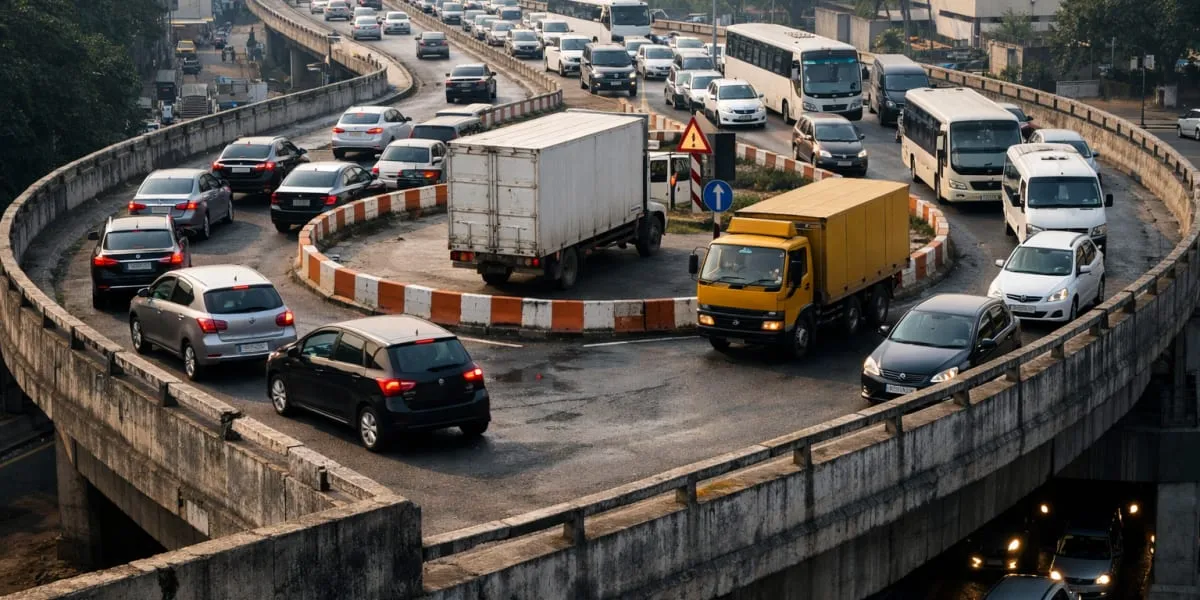
Two years after authorities first announced plans to strengthen and widen the old Uppilipalayam flyover in Coimbatore, work has not begun and daily commuters face worsening congestion. The 50-year-old structure on Old Avinashi Road links Avinashi Road, Goods Shed Road, Mill Road and Dr Krishnaswamy Road and is among the city's busiest junctions. The roundabout atop the flyover has become a major bottleneck during peak hours and lengthens journey times.

During the monsoon the subway beneath becomes waterlogged and traffic routinely spills onto the flyover, producing gridlocks that extend to Chinthamani on Dr Krishnaswamy Road, to Uppilipalayam Junction on Avinashi Road and to the railway station signal on Goods Shed Road. The disruption has added to commuter delays and affected freight movement across the corridor.

The need for an upgrade rose after a gas tanker overturned at the curve in January 2025 and emergency teams contained the incident. In 2024 the District Road Safety Committee and the State Highways Department proposed widening the 10.5-metre roundabout, with officials estimating the narrower scheme could cost less than Rs 10 million (Rs 10 mn) if pillars were added on vacant land. That local proposal stalled when the National Highways Authority of India (NHAI) declined a no-objection certificate.

The NHAI later announced a larger plan to expand the roundabout to 14 metres at an estimated cost of Rs 300 mn and prepared a detailed project report for central approval. In December 2025 the Ministry of Road Transport and Highways transferred the Sathyamangalam Road corridor, including the Uppilipalayam roundabout, to the NHAI and the stretch was handed over on July one 2026, though commuters report little visible progress since.

The Coimbatore City Municipal Corporation (CCMC) is conducting pipeline works adjacent to the strained roundabout, raising concern about the structure's condition. A senior State Highways Department official told The New Indian Express that control of the old flyover transferred to the NHAI from July one and that steps to acquire land and secure funds have been initiated, with work possible once approvals are received.

Two years after authorities first announced plans to strengthen and widen the old Uppilipalayam flyover in Coimbatore, work has not begun and daily commuters face worsening congestion. The 50-year-old structure on Old Avinashi Road links Avinashi Road, Goods Shed Road, Mill Road and Dr Krishnaswamy Road and is among the city's busiest junctions. The roundabout atop the flyover has become a major bottleneck during peak hours and lengthens journey times. During the monsoon the subway beneath becomes waterlogged and traffic routinely spills onto the flyover, producing gridlocks that extend to Chinthamani on Dr Krishnaswamy Road, to Uppilipalayam Junction on Avinashi Road and to the railway station signal on Goods Shed Road. The disruption has added to commuter delays and affected freight movement across the corridor. The need for an upgrade rose after a gas tanker overturned at the curve in January 2025 and emergency teams contained the incident. In 2024 the District Road Safety Committee and the State Highways Department proposed widening the 10.5-metre roundabout, with officials estimating the narrower scheme could cost less than Rs 10 million (Rs 10 mn) if pillars were added on vacant land. That local proposal stalled when the National Highways Authority of India (NHAI) declined a no-objection certificate. The NHAI later announced a larger plan to expand the roundabout to 14 metres at an estimated cost of Rs 300 mn and prepared a detailed project report for central approval. In December 2025 the Ministry of Road Transport and Highways transferred the Sathyamangalam Road corridor, including the Uppilipalayam roundabout, to the NHAI and the stretch was handed over on July one 2026, though commuters report little visible progress since. The Coimbatore City Municipal Corporation (CCMC) is conducting pipeline works adjacent to the strained roundabout, raising concern about the structure's condition. A senior State Highways Department official told The New Indian Express that control of the old flyover transferred to the NHAI from July one and that steps to acquire land and secure funds have been initiated, with work possible once approvals are received.

Next Story
Infrastructure Urban

Centre Clears Power Distribution Upgrade for Uttar Pradesh

The Central Government has approved power distribution projects worth Rs 407.39 billion for Uttar Pradesh under the Revamped Distribution Sector Scheme (RDSS). The investment will be used to modernise the state's electricity distribution infrastructure and strengthen network capacity across urban and rural areas. The package targets one of the country's largest distribution networks as the state experiences rapid urbanisation and rising electricity consumption. Planned interventions include the strengthening of distribution lines, modernisation of substations, replacement of ageing electrical ..

Next Story
Infrastructure Energy

India Data Centres To Consume 191 TWh By 2040 Driving Renewables

A Wood Mackenzie report says India's operational data centre capacity is projected to increase more than fivefold to 12 gigawatt (GW) by 2030 from 2.2 GW in 2025 as artificial intelligence (AI) and cloud computing drive demand. It projects electricity consumption to rise from 10 terawatt-hour (TWh) in 2025 to 191 TWh by 2040. The study forecasts a compound annual growth rate of around 40 per cent and notes AI-dedicated capacity will surge nearly 24-fold from 275 megawatt (MW) in 2025 to 6,546 MW by 2030. The report places India's digital economy at Rs 32 trillion (tn) in 2025 and says it contr..

Next Story
Infrastructure Transport

Hydrogen Train Completes 1,200 Kilometres Of Trials

India's first hydrogen train was flagged off between Jind and Sonipat on July 17 and has travelled over 1,200 kilometres in trials, saving diesel consumption of more than 3,200 litres, a Railway Ministry press release said. The deployment marks the introduction of a zero-emission fuel cell train into route testing and represents a milestone in domestic rail innovation. The train generates electricity onboard through a chemical reaction between hydrogen and oxygen, producing electricity to propel the vehicle while emitting only water vapour as a by-product. There is no smoke and no tailpipe car..

Advertisement

Subscribe to Our Newsletter

Get daily newsletters around different themes from Construction world.

STAY CONNECTED

Advertisement

Advertisement

Advertisement