Cyberabad to Study Last-Mile Gaps on Metro Corridor
RAILWAYS & METRO RAIL

Cyberabad to Study Last-Mile Gaps on Metro Corridor

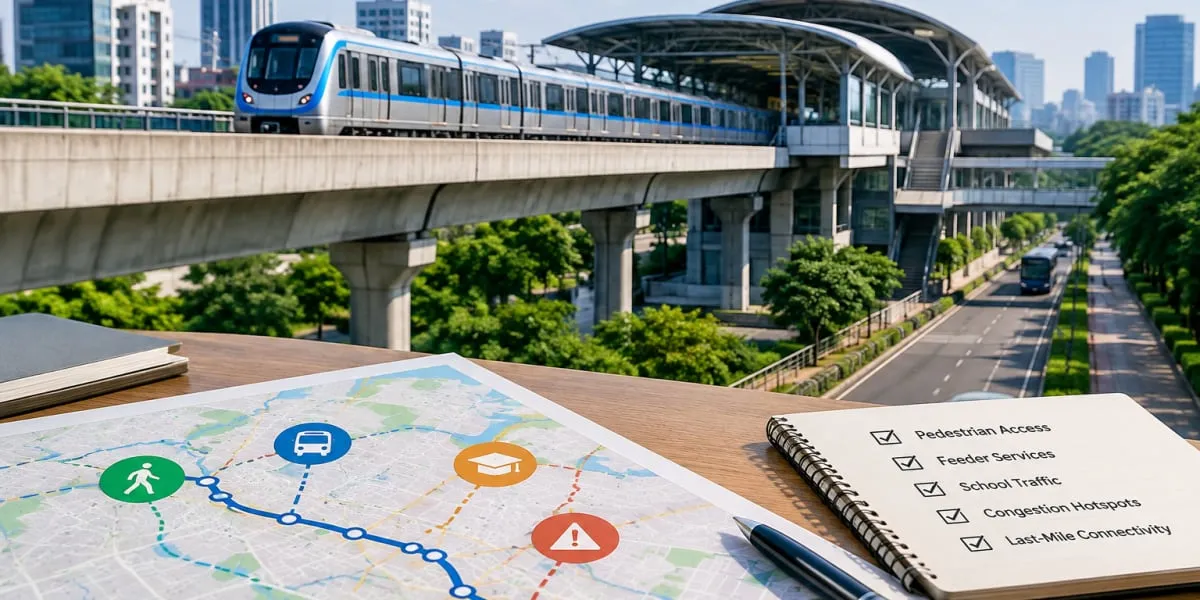
The Cyberabad Municipal Corporation will conduct a mobility study along the 8.5-km JNTU–Miyapur–Raidurg Metro corridor to identify gaps in last-mile connectivity. The exercise will focus on pedestrian access, feeder services, school traffic and congestion hotspots that encourage commuters to use private vehicles.

The assessment will examine links between Metro stations and nearby residential, commercial and institutional areas. It will map missing footpaths, unsafe stretches, crossings, encroachments and walking routes used to reach stations. The study will also consider access arrangements around major junctions and locations where pedestrian movement is difficult.

Municipal data show that Hyderabad added about 6,400,000 daily person trips between 2011 and 2024, taking the total to 11,040,000 trips a day. Nearly 6,200,000 of the additional trips shifted to private two-wheelers, cars, auto-rickshaws and taxis. Two- and four-wheelers account for 67 per cent of motorised trips, while 63 per cent of GPS-recorded trips are within 5 km, highlighting the need for better walking and public transport links.

A traffic police survey around Cyber Towers during morning peak hours on April 2 recorded 10,138 single riders and 3,584 double riders in an hour. The findings indicate a high proportion of solo travel and will be used to assess alternatives for the first and last legs of journeys. Auto-rickshaw and feeder services will be mapped, along with designated pick-up and drop-off points and feeder auto stands at Metro stations and major junctions.

Traffic officials will review congestion points, accident-prone locations, signage, barricading and pedestrian crossings along the corridor. School traffic will receive particular attention, including congestion caused by buses, vans and parents’ vehicles during peak periods. The proposal includes school pick-up and drop-off areas away from the main carriageway, car-pooling options and better integration of walking, cycling, feeder autos and e-autos with Metro stations, schools, offices, residential colonies and commercial establishments.

The Cyberabad Municipal Corporation will conduct a mobility study along the 8.5-km JNTU–Miyapur–Raidurg Metro corridor to identify gaps in last-mile connectivity. The exercise will focus on pedestrian access, feeder services, school traffic and congestion hotspots that encourage commuters to use private vehicles. The assessment will examine links between Metro stations and nearby residential, commercial and institutional areas. It will map missing footpaths, unsafe stretches, crossings, encroachments and walking routes used to reach stations. The study will also consider access arrangements around major junctions and locations where pedestrian movement is difficult. Municipal data show that Hyderabad added about 6,400,000 daily person trips between 2011 and 2024, taking the total to 11,040,000 trips a day. Nearly 6,200,000 of the additional trips shifted to private two-wheelers, cars, auto-rickshaws and taxis. Two- and four-wheelers account for 67 per cent of motorised trips, while 63 per cent of GPS-recorded trips are within 5 km, highlighting the need for better walking and public transport links. A traffic police survey around Cyber Towers during morning peak hours on April 2 recorded 10,138 single riders and 3,584 double riders in an hour. The findings indicate a high proportion of solo travel and will be used to assess alternatives for the first and last legs of journeys. Auto-rickshaw and feeder services will be mapped, along with designated pick-up and drop-off points and feeder auto stands at Metro stations and major junctions. Traffic officials will review congestion points, accident-prone locations, signage, barricading and pedestrian crossings along the corridor. School traffic will receive particular attention, including congestion caused by buses, vans and parents’ vehicles during peak periods. The proposal includes school pick-up and drop-off areas away from the main carriageway, car-pooling options and better integration of walking, cycling, feeder autos and e-autos with Metro stations, schools, offices, residential colonies and commercial establishments.

Related Stories

Gold Stories

Next Story
Building Material

From Rough to Refined: How Modern Plastering Is Changing Wall Finishes

When Rohan first walked into his newly constructed home, he imagined what it would become—a warm living room, a bright bedroom, and walls smooth enough to complement his carefully chosen interiors.But there was one problem.The walls didn't look anything like the finished home he had imagined.They were uneven in places, rough to the touch, and covered with visible patches and minor surface imperfections. Rohan initially thought paint would fix everything.His contractor had a different answer.“Before the paint, we need to get the plastering right.”That conversation made Rohan realise somet..

Next Story
Infrastructure Urban

Embraer to Acquire 51 Per Cent Stake in Mahindra Aerospace Arm

Brazilian aerospace major Embraer will acquire a 51 per cent equity stake in Novavayu Aerospace, a step-down subsidiary of Mahindra and Mahindra, under an Investment Agreement notified by the automobile company in an exchange filing. The transaction will give Embraer control of the aerospace business. Following completion of the acquisition, Novavayu Aerospace will cease to be a wholly owned subsidiary and become an associate of Mahindra Defence Systems, which is a step-down wholly owned subsidiary of Mahindra and Mahindra. The agreement is expected to be completed on or before December 1. Mah..

Next Story
Infrastructure Urban

RBI Opens Special Dollar Window for Three State-Run OMCs

The Reserve Bank of India (RBI) has opened a special facility to meet the entire daily US dollar requirements of three public sector oil marketing companies (OMCs), in a move aimed at easing pressure on the Indian rupee. The facility will take effect on October 12, 2026, and remain available until further notice. Indian Oil Corporation, Hindustan Petroleum Corporation and Bharat Petroleum Corporation are eligible to use the arrangement. Under the facility, the RBI will sell US dollars to the three companies through designated banks, allowing them to meet their oil-import payments without sourc..

Advertisement

Subscribe to Our Newsletter

Get daily newsletters around different themes from Construction world.

STAY CONNECTED

Advertisement

SPECIAL OFFER
QR Code